
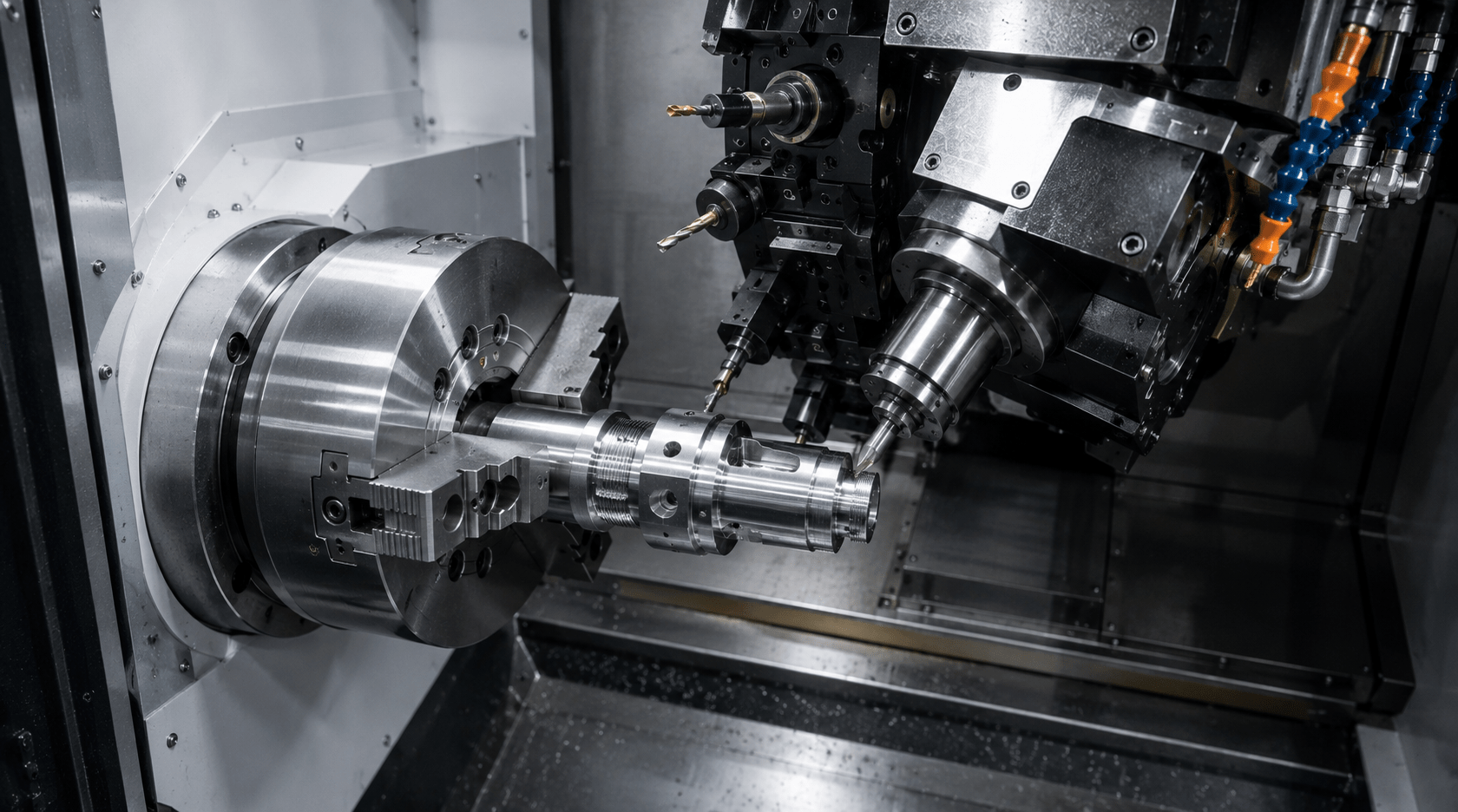
The shaft came back from the first shop looking wrong. Dimensionally it was fine – the diameters hit, the threads were good. But the cross-holes were off. Not by a lot. Just enough. They had turned it on a lathe, moved it to a mill for the cross-drilling, and somewhere in that transfer the position drifted.
The second time around it went on a mill-turn. Same part, same drawing. Diameters, threads, and cross-holes all cut in one setup. When the part came off, the cross-hole position sat exactly where it needed to be relative to the turned features, because both were cut by the same machine from the same datum at the same time.
That is the actual argument for mill-turn machining. Not a marketing claim about combined capabilities. Just what happens when you remove the handoff between processes.
簡単な答え: ミル・ターン加工 combines CNC turning and milling in one machine. A rotating workpiece gets turned, drilled, milled, and tapped without changing setups. The result is better accuracy between features, fewer handling steps, and shorter lead time on parts that would otherwise need two machines.
How Mill-Turn Machining Actually Works
A conventional lathe spins the workpiece against a fixed tool to make round features. A conventional mill holds the workpiece still and spins the tool to make flats and pockets. These are fundamentally different setups, which is why the same part has traditionally needed two machines.
Mill-turn solves this by adding two things to a turning machine: live tooling and C-axis control.
Live tooling means the turret carries powered, rotating tools – end mills, drills, taps – alongside the static turning tools. C-axis control means the spindle can be indexed to an exact rotational position and held there while the live tools work.
So the sequence looks like this: the spindle turns a diameter, slows and stops at a programmed angle, holds while a live drill puts a cross-hole through the part at that exact position, rotates to another angle for a flat milled on the face, then spins back up for the next turning pass. One setup. One datum. One clamping. If you want the underlying process detail, our CNC turning guide explains how the lathe side works, and our comparison of CNC milling vs. turning covers how the two processes differ fundamentally.
More capable mill-turns add a Y-axis for off-center milling and a second spindle so the part can be transferred and finished from the other end automatically. A genuinely complex component can come off the machine fully done, nothing left for a second operation.
Where the Cost Savings Actually Come From
Mill-turn machines cost more per hour than a plain lathe. The savings have to come from somewhere else, and on the right parts they do, by a significant margin.
- Fewer setups. Turning and milling happen in one clamping. You pay setup cost once instead of twice and skip the labor of moving and re-fixturing. That saved setup is pure cost reduction.
- Better accuracy between features. When a cross-hole and a turned shoulder are cut in the same setup, the machine holds their relationship. When they are cut on two separate machines with a re-fixturing between them, the relationship depends on how accurately the part was re-located. Mill-turn eliminates that variable entirely.
- Less handling. Moving a part between machines is time, labor, and risk. A nearly-finished part can get dinged, misoriented, or sit in a queue for two days. Removing that step removes all of those costs.
- Shorter lead time. No queue between lathe and mill. The part finishes on one machine and goes to inspection or shipping. On time-sensitive jobs that can matter as much as unit cost.
There is also a quieter benefit: re-fixturing is where nearly-finished expensive parts get damaged. Remove the re-fixturing step and you remove that risk.
Mill-Turn vs Separate Turning and Milling
The trade-off is straightforward when you lay it out:
| ファクター | ミルターン | Separate lathe + mill |
| Number of setups | One | Two or more |
| Accuracy between features | Set by the machine | Depends on re-fixturing accuracy |
| Machine hourly rate | より高い | Lower per machine |
| Part handling | 最小限 | Move and re-clamp between machines |
| リードタイム | 短縮版 | Longer (two queues) |
| Scrap risk | より低い | Higher at re-fixturing stage |
| こんな方に最適 | Complex turned + milled parts | Simple parts of one type |
The break-even point is part complexity. A plain turned bushing gains nothing from a mill-turn machine. A shaft with cross-holes at three different angles, a hex feature on one end, and several milled flats – that part is built for mill-turn, and the saved setups will more than offset the higher hourly rate.
Which Parts Belong on Mill-Turn
The test is simple: is the part fundamentally round, and does it also carry milled features that need to relate precisely to the turned geometry? If both are true, mill-turn is worth considering seriously.
- Shafts with flats, keyways, or cross-holes. The classic application. The body turns, the milled features position precisely relative to the turning. Mill-turn holds that relationship without question.
- Fittings and hydraulic manifolds. Turned bodies with ports drilled and tapped at precise angles. Threading, drilling, and turning all happen together in one setup.
- Medical components. Bone screws with turned threads and milled drive features, for example. Concentricity and position tolerances are tight enough that re-fixturing introduces unacceptable variability.
- Complex connectors and housings. Round bodies with slots, flats, and cross-holes that must relate to each other precisely.
Parts that do not benefit: a simple turned pin, a basic milled bracket, anything that needs only one process. Running those on a mill-turn just pays the higher hourly rate for capability that never gets used.
Swiss-Type Mill-Turn for Small, Slender Parts
When parts are small and slender, there is a specialized variant worth knowing about: the Swiss-type lathe.
On a Swiss machine, the bar stock is supported close to the cutting zone by a guide bushing. The tool cuts right next to that support, so even a very long, thin workpiece cannot deflect under cutting forces. Add live tooling and you have a machine that makes tiny, precise, complex turned-and-milled parts at production speeds.
Watch components, surgical screws, connector pins, and micro-fittings are all natural Swiss-turn candidates. The parts are too small and slender for a conventional lathe to hold tolerance on, but a Swiss machine handles them without difficulty.
If your parts are under about 25-30mm in diameter and have meaningful length to them, mention it when asking for a quote. It often changes the recommended machine and the achievable tolerances significantly.
Where Mill-Turn Does Not Help
Mill-turn is a specialist tool. It earns its place on complex parts and overpays on simple ones.
The machines are expensive and the programming is involved. Coordinating turning, C-axis positioning, and live tooling in one coherent program takes real setup time. For a genuinely complex part, that time is justified by what it saves across the run. For a simple part, you are paying programming time for capability you never use.
Very large parts often make more sense on dedicated machines sized for the work. And some parts genuinely only need one process – trying to mill-turn something that only needs turning is just adding cost with no corresponding benefit.
The question to ask is straightforward: does this part need both turning and milled features, and do those features need to relate to each other precisely? If yes to both, mill-turn earns its place. If not, a dedicated lathe or mill is the more economical route.
よくある質問
What is mill-turn machining?
A mill-turn machine combines CNC turning and milling in one. The workpiece rotates on a spindle as on a lathe, but the machine also carries live (powered) rotating tools and C-axis control, letting it mill, drill, and tap at precise angles without moving the part to a separate machine.
How does mill-turn save money?
Mainly through fewer setups and better accuracy. Turning and milling happen in one clamping, so setup cost is paid once and re-fixturing labor is eliminated. Features cut in the same setup are more accurately positioned relative to each other, reducing scrap and rework. Lead time is also shorter because there is no queue between two machines.
What is live tooling on a lathe?
Live tooling refers to powered, rotating cutting tools mounted in a turning machine’s turret. Unlike static turning tools, live tools can mill, drill, and tap while the part is held in the lathe spindle. Combined with C-axis control that positions the spindle at an exact angle, live tooling turns a lathe into a mill-turn machine.
Is mill-turn better than separate turning and milling?
For parts that need both and where the features must relate precisely to each other, yes. For simple parts that need only one process, no. A plain turned or milled part gains nothing from a mill-turn machine except a higher hourly rate.
What is a Swiss-type lathe?
A Swiss-type lathe supports bar stock with a guide bushing close to the cutting zone, preventing deflection even in long, thin workpieces. Combined with live tooling, it produces small, precise, complex turned-and-milled parts. Common applications include surgical screws, connector pins, watch components, and micro-fittings.
________________________________________
About the author
Lewei精密エンジニアリングチーム is a manufacturing writer and CNC process specialist with hands-on experience across turning, milling, and multi-axis machining. He writes practical, engineer-first guides that help buyers and designers match complex parts to the right process and understand when advanced options like mill-turn pay off and when they do not.

 English
  简体中文
简体中文  Español
  Deutsch (Sie)
  日本語
日本語  Português