
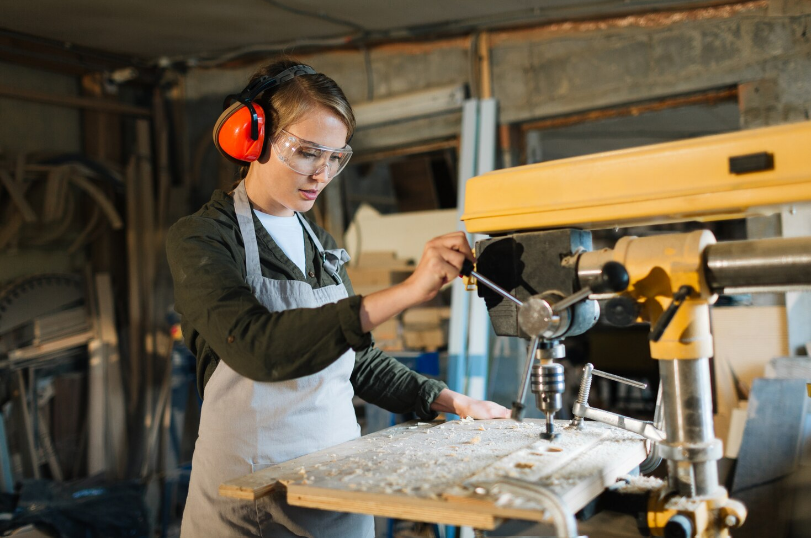
In 2026, more U.S. manufacturers are evaluating reshoring CNC machining because the real cost of a precision part extends beyond the number printed on a purchase order. Freight, tariffs, inventory, long lead times, engineering changes, quality problems, production interruptions, working capital and supply-chain risk can materially change the economics.
For years, sourcing CNC-machined parts overseas was often treated as the obvious way to reduce manufacturing costs. A lower quoted unit price could make a distant supplier look significantly more attractive than a machine shop closer to the final assembly plant.
For precision parts, CNC machining sits at an important point in this trend. It is automated, flexible and capable of producing high-value components without the labor content associated with many manual manufacturing processes.
Why CNC Machining Is a Strong Candidate for Reshoring
CNC machining differs from labor-intensive manufacturing because much of the value is created by capital equipment, programming, tooling, process engineering and automation.
Once a machining center is running a stable program, labor may represent a smaller percentage of total manufacturing cost than it would in a highly manual assembly operation.
That matters because higher U.S. labor rates become less decisive when production is increasingly automated.
Deloitte’s manufacturing analysis similarly identifies higher-value, complex products with strict quality requirements and capital-intensive production processes as stronger candidates for economically viable U.S. reshoring.
Precision machining fits many of those characteristics.
Typical reshoring candidates can include aerospace components, semiconductor equipment parts, robotics hardware, medical-device components, automation equipment, defense-related parts, energy systems and other components where accuracy, availability or engineering responsiveness matters more than finding the lowest nominal labor cost.
The Reshoring Decision Has Shifted From Unit Price to Total Cost
A $35 offshore component is not necessarily cheaper than a $45 domestic component.
The buyer must first determine what it actually costs to place that part into production.
Consider two hypothetical CNC suppliers:
| コスト係数 | Offshore Supplier | Domestic Supplier |
| Quoted piece price | より低い | より高い |
| International freight | より高い | より低い |
| Import exposure | Possible | より低い |
| Transit inventory | より高い | より低い |
| Response to engineering change | Slower | より速く |
| Emergency replenishment | 難しい | より簡単に |
| Supplier visits | More difficult | より簡単に |
| Inventory requirement | Usually higher | Potentially lower |
This does not mean the domestic quote will always win.
It means purchase price and total cost of ownership are different numbers.
The Reshoring Initiative’s 2026 survey found that use of total-cost-of-ownership analysis among surveyed OEMs increased from 30% in 2025 to 40% in 2026.
For CNC components, a realistic sourcing calculation should account for machining, finishing, quality control, freight, duties where applicable, inventory, rejected parts, engineering support and the financial impact of long replenishment cycles.
Shorter Lead Times Can Change the Economics of Precision Parts
Lead time is one of the strongest arguments for domestic CNC machining.
A part manufactured near its U.S. customer avoids long international transportation routes and much of the uncertainty associated with ocean freight, port movement and customs processing.
That can create benefits beyond simply receiving a shipment sooner.
Shorter replenishment cycles may allow manufacturers to hold less safety stock.
They can also react faster when:
- Demand unexpectedly changes
- A drawing is revised
- A component fails testing
- Production volume increases
- An assembly line needs replacement parts
For a custom component that changes frequently, the ability to modify a machining program and obtain another production batch quickly can be more valuable than a small unit-price advantage.
Reshoring Brings Manufacturing Closer to Engineering
Precision parts rarely exist independently from the engineers designing the complete product.
A difficult component may require discussion around datum structures, GD&T, tool access, thin walls, deep pockets, surface finish, heat treatment or realistic tolerance capability.
Distance can make those conversations slower.
When a CNC supplier is close to the customer’s engineering organization, teams can potentially resolve manufacturing questions faster and inspect early parts more directly.
This becomes especially useful during new product introduction.
Imagine that a machined housing reaches prototype testing and engineers discover that two mounting holes need to move 0.75 mm.
The CAD change itself may take minutes.
The real question is how quickly the manufacturing and logistics system can respond.
When development speed influences time to market, supplier proximity has economic value.
Quality Risk Looks Different When Parts Travel Thousands of Miles
Offshore manufacturing does not inherently mean poor quality. Excellent CNC machining suppliers operate throughout the world.
The risk comes from distance combined with long replenishment cycles.
If an incoming shipment contains a critical dimensional problem, the buyer may already have another large quantity:
- In transit
- At a port
- In the supplier’s finished-goods inventory
- Entering another production batch
That can turn one process problem into a larger supply disruption.
Domestic sourcing shortens the feedback loop.
When a problem is detected, manufacturers may be able to contain production, investigate the process and replace affected parts more quickly.
For precision components, buyers should therefore compare more than a supplier’s advertised tolerance.
They should evaluate the complete quality system: inspection planning, measurement equipment, material control, process capability, traceability, nonconformance management and responsiveness when something goes wrong.
Tariffs Have Made Sourcing Economics More Dynamic
Trade policy is another reason manufacturers continue to review the location of their supply chains.
Tariffs can increase the landed cost of imported components and make previously attractive offshore pricing less competitive. At the same time, tariffs on raw materials or intermediate inputs can also raise costs for manufacturers operating inside the United States.
That means the effect is not always straightforward.
Companies should avoid building a reshoring business case around one temporary tariff assumption.
A stronger decision compares several scenarios and asks whether domestic production still makes sense if trade conditions change.
This is particularly important for long-term CNC programs where fixtures, inspection plans and supplier qualification may require significant upfront investment.
Automation Helps U.S. CNC Shops Compete
Reshoring precision parts does not necessarily mean recreating the factories of several decades ago.
Modern CNC manufacturing increasingly depends on automation.
Examples include pallet systems, automatic bar feeders, robotic loading, in-process probing, tool-life monitoring and unattended machining.
A highly automated machining process can reduce the amount of direct labor required per component while increasing machine utilization.
This is especially important for U.S. manufacturers because skilled labor remains one of the largest reshoring constraints.
The 2026 Reshoring Initiative survey found that 66% of respondents described hiring technical workers, including machinists and other technicians as very difficult or at crisis levels.
Automation does not eliminate the need for skilled people.
Instead, it changes where their skills create value. Manufacturers still need machinists, programmers, manufacturing engineers, quality technicians, maintenance specialists and people capable of developing stable production processes.
Which CNC Parts Are Best Suited to Reshoring?
Not every component should receive the same sourcing strategy.
The strongest reshoring candidates are often parts where supply-chain responsiveness or manufacturing complexity represents a significant portion of total value.
For example, a complex 5-axis aerospace bracket made in modest quantities may be a stronger reshoring candidate than a simple high-volume commodity spacer.
A useful decision framework looks like this:
| Part Characteristic | Reshoring Potential |
| High-value precision component | 高い |
| Frequent engineering revisions | 高い |
| Low-to-medium production quantities | Often high |
| Critical production-line spare | 高い |
| Complex quality requirements | 高い |
| Heavy part with expensive freight | Potentially high |
| Highly automated manufacturing process | Potentially high |
| Simple commodity part at very high volume | Case dependent |
| Stable part with large offshore cost advantage | より低い |
| Component requiring specialized overseas supply chain | より低い |
The point is to reshore selectively rather than apply the same policy to an entire bill of materials.
CNC Milling and Turning Support Different Reshoring Opportunities
A reshoring program should also match each component with the correct machining process.
CNC milling is commonly used for housings, brackets, manifolds, plates, fixtures, structural components and parts containing pockets or multi-sided geometry.
More complicated parts may justify 4-axis or 5-axis machining if reducing setups improves efficiency or feature relationships.
CNC turning is better suited to rotational parts such as shafts, pins, bushings, sleeves, fittings and adapters.
Advanced turning centers with live tooling can also produce cross-holes, flats and milled features without transferring the component to a separate machine.
For companies reviewing their complete precision-parts supply chain, the manufacturing process should be evaluated part by part rather than simply requesting a generic CNC quote.
Reshoring Can Reduce Inventory Without Eliminating Supply Risk
Long supply chains often encourage companies to carry more inventory.
If replenishment takes many weeks, buyers naturally need larger buffers to protect production.
Domestic sourcing can make smaller and more frequent deliveries practical.
That can reduce capital tied up in:
- Finished parts
- Safety stock
- Goods in transit
- Obsolete revisions
However, relying on one domestic supplier creates its own form of concentration risk.
A machine failure, workforce problem, material shortage or natural disaster can still interrupt production.
This is why reshoring and supply-chain resilience are related but not identical.
A resilient strategy may involve two qualified U.S. suppliers or a domestic primary source backed by a qualified international second source.
Why Hybrid Sourcing Still Matters
Bringing selected production back to the United States does not require abandoning international manufacturing.
In many cases, the strongest supply chain is hybrid.
Domestic CNC manufacturing may be used for urgent parts, engineering-intensive components, regulated programs or items where short replenishment cycles create measurable value.
International suppliers may continue to support cost-sensitive production, overflow capacity, prototypes, non-restricted components or second-source requirements.
This approach gives procurement teams another lever when capacity or economic conditions change.
It also avoids treating sourcing as a binary choice between “everything domestic” and “everything offshore.”
Where LEWEI Precision Fits in a Reshoring Strategy
LEWEI’s CNC加工サービス support metal and engineering-plastic components from prototypes through production. Its published capabilities include CNC milling, turning, routing, drilling, EDM and precision grinding, with 3-axis, 4-axis and 5-axis machining available for different part geometries.
For American manufacturers adopting a hybrid sourcing strategy, LEWEI can function as an international CNC manufacturing option for components that do not require U.S.-based production or as an additional source when companies want to diversify capacity.
The service page also lists more than 700 CNC machines across its manufacturing capabilities and supports materials including aluminum, steel, stainless steel, copper, brass, titanium and engineering plastics.
For U.S. buyers, the decision should therefore be made at part level.
If a program requires domestic production, a qualified American CNC supplier is the appropriate path. If global sourcing is allowed, LEWEI can be compared on manufacturing capability, quality requirements, lead time, landed cost and supply-chain strategy.
How to Decide Whether a CNC Part Should Be Reshored
A useful reshoring review starts with the existing bill of materials rather than a corporate slogan.
For each machined component, calculate the current total landed cost and identify where supply-chain risk is actually created.
Then examine whether domestic production could improve:
Lead time, inventory, engineering response, quality containment, freight cost or production continuity.
Finally, obtain realistic quotes using the same CAD files, drawings, material specifications, finishing requirements and inspection scope.
Comparing unequal quotes creates a misleading business case.
A domestic supplier quoting full CMM reporting and certified material should not be compared directly with an offshore quote that excludes those requirements.
What Manufacturers Should Include in a CNC Reshoring RFQ
The transition is easier when the engineering package is complete.
A reshoring RFQ should normally include the 3D CAD model, controlled 2D drawing, exact material grade, production quantity, expected annual demand, critical tolerances, GD&T, surface finish and inspection requirements.
If existing production is being transferred, provide relevant process knowledge without forcing the new supplier to duplicate an inefficient old process.
The objective should be to reproduce the functional part, not necessarily every historical manufacturing decision.
A capable new supplier may identify a better fixture, reduce setups, move the job to a multi-axis machine or recommend different stock dimensions that improve domestic economics.
Reshoring CNC Machining Is Ultimately a Part-by-Part Decision
The reshoring conversation in 2026 is less about reversing globalization completely and more about deciding where precision manufacturing creates the most value.
CNC machining is well positioned for that analysis because advanced machine tools, automation and digital manufacturing can reduce the importance of direct labor while increasing the value of engineering skill, process control and responsiveness.
For some components, moving production back to the United States can shorten lead times, reduce inventory and give engineering teams greater control.
For others, international sourcing will remain economically and operationally sensible.
The strongest manufacturers will not choose between domestic and global production based on ideology or unit price alone. They will evaluate total cost, risk, capacity, quality and responsiveness for every important part.
For U.S. companies maintaining a global or dual-source manufacturing strategy, LEWEI Precision’s custom CNC machining services can support precision metal and plastic parts from prototype through production alongside a broader sourcing plan.
よくある質問
What does reshoring mean in manufacturing?
Reshoring means moving manufacturing or sourcing that was previously performed overseas back to the United States. It can involve bringing work into an OEM’s own facility or transferring production to a domestic contract manufacturer.
Why are U.S. companies reshoring CNC machining?
Major reasons include shorter supply chains, faster engineering response, reduced logistics exposure, quality control, tariff considerations, lower inventory requirements and increased interest in supply-chain resilience. The business case varies by component.
Is domestic CNC machining always cheaper than overseas machining?
No. Domestic quoted prices can still be higher for many components. The relevant comparison is total cost of ownership, including freight, tariffs where applicable, inventory, quality risk, lead time and disruption exposure.
What CNC parts are easiest to reshore?
Higher-value precision parts, frequently revised components, low-to-medium-volume parts and components requiring advanced automated machining are often stronger candidates than simple labor-intensive commodity products.
Can reshoring reduce lead times?
Often, yes. Moving production closer to a U.S. assembly facility can reduce international transportation and customs time, making replenishment and engineering changes faster. Actual lead time still depends on supplier capacity and material availability.
Does reshoring mean companies should stop using international CNC suppliers?
No. Many manufacturers can benefit from a diversified sourcing strategy. Domestic and international suppliers can serve different parts, quantities or risk requirements within the same supply chain.
著者について
著者について
Lewei精密エンジニアリングチーム — Manufacturing engineers at Lewei Precision. The Lewei Precision engineering team has spent more than 21 years machining and molding parts for aerospace, medical, automotive, and semiconductor customers across 120-plus countries. Our factory runs 3-axis through 5-axis CNC machining, turning, injection molding, and sheet metal fabrication under ISO 9001:2015, ISO 13485, ISO 14001, and IATF 16949 quality systems. The guidance here reflects what we see on real production floors and in customer DFM reviews every week, not textbook theory. Have a part in front of you? Send us the CAD file and we will tell you exactly how we would make it.

 English
  简体中文
简体中文  Español
  Deutsch (Sie)
  日本語
日本語  Português