
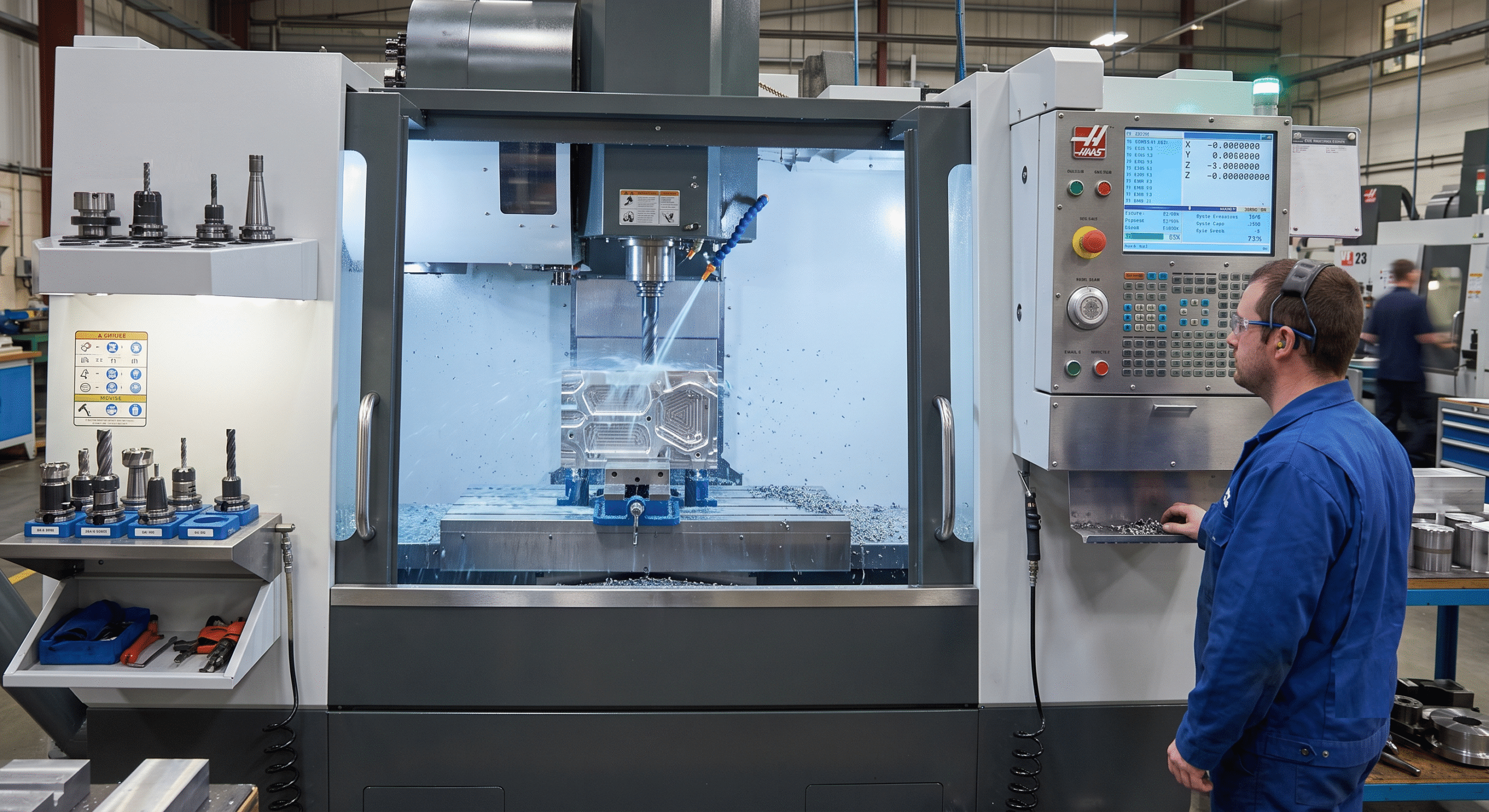
Ask three shops to quote the same part and you can get three very different numbers. To a buyer, that feels random. It is not. CNC machining cost follows a clear logic once you know what the machine, the material, and the operator are really spending their time on. I have quoted thousands of parts, and almost every price surprise traces back to one of a handful of drivers that were hidden in the drawing.
This guide breaks down exactly what you pay for when you buy a machined part, where the money goes, and the practical design choices that quietly cut your price without touching the part’s function. If you understand these levers, you will write better drawings, get faster quotes, and stop overpaying for precision you never needed.
The Simple Formula Behind Every Quote
Strip away the software and the spreadsheets, and a CNC quote is built from four things:
- Machine time — how long the part sits in the machine being cut.
- 素材 — the cost of the raw stock, plus the portion machined away as scrap.
- Setup and programming — the one-time labor to write the toolpath and fixture the part.
- Secondary operations — finishing, heat treatment, inspection, and assembly.
Everything else is a modifier on those four. Get a feel for them and you can predict, roughly, why a part costs what it does before you ever see the quote.
Quick answer: CNC machining cost is driven mainly by machine time, material, and setup/programming. Tolerance, geometry complexity, finish, and quantity are the biggest modifiers — with quantity spreading fixed setup cost across more parts.
The Seven Biggest Cost Drivers
Here is where the money actually goes, ranked by how often each one blows up a quote.
| Cost driver | Cheaper | More expensive | Why it matters |
| 素材 | Aluminum 6061, brass | Titanium, Inconel, stainless | Exotics cost more and cut slowly |
| 寛容 | ±0.1 mm | ±0.005 mm | Tight tolerances add passes + inspection |
| 幾何学 | Simple, open features | Deep pockets, thin walls | Complex shapes need small tools, slow cuts |
| 表面仕上げ | 機械加工 | Polished, bead-blasted, anodized | Finishing is extra labor and time |
| 数量 | 100+ parts | 1–5 prototypes | Setup cost spreads over the batch |
| 工具 | Standard end mills | Custom or micro tools | Special tools raise time and risk |
| Secondary ops | なし | Heat treat, plating, assembly | Each added step adds cost + lead time |
1. Material
Material is often the first shock. Aluminum is cheap and cuts fast, which is why it dominates prototyping. Titanium and nickel superalloys cost several times more per kilo and cut far slower, so the machine time climbs too. Choosing a grade that just meets your needs — rather than the strongest one available — is the easiest saving on the list. Our 4340 steel guide そして bismuth bronze guide are good references when weighing performance against machinability.
2. Tolerance
This is the silent budget-killer. Every tolerance you tighten forces slower cutting, extra finishing passes, and more inspection. A part toleranced at ±0.005 mm everywhere can cost double the same part toleranced only where it matters. Specify precision surgically — tight where parts fit or seal, generous everywhere else.
3. Geometry and complexity
Deep pockets, thin walls, tall bosses, and internal corners all slow the machine down or demand special tooling. Sharp internal corners are impossible for a round tool, so they force smaller cutters and longer cycles. Designing with the tool in mind — the same thinking in our design rules for machined parts — keeps geometry cost in check.
4. Quantity
Setup and programming are one-time costs. On a single prototype, that fixed cost lands entirely on one part, so unit prices look high. Order 200 of the same part and the setup is spread thin, dropping the per-part price dramatically. This is why asking for a price break at higher volumes is always worth it.
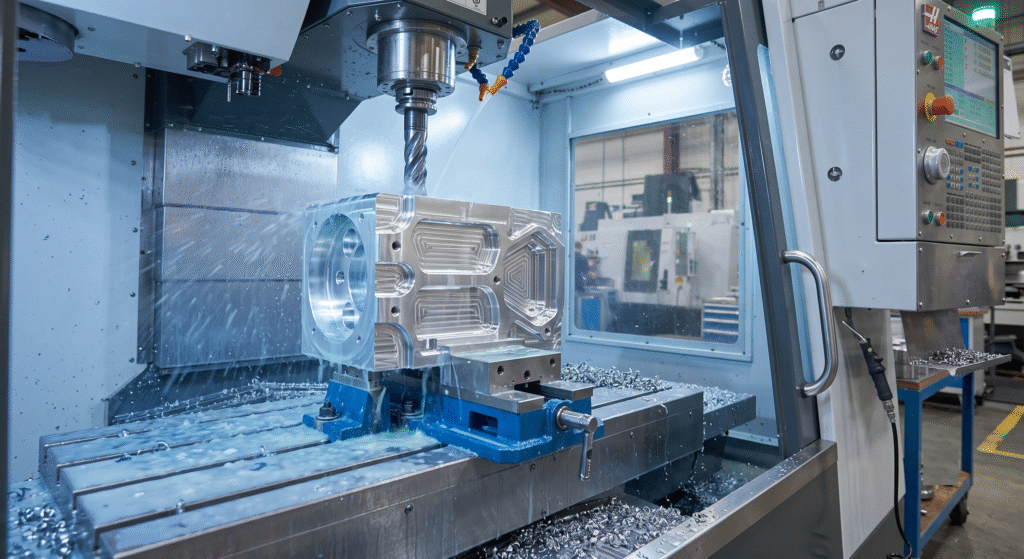
Turning vs. Milling vs. EDM: Cost by Process
Different processes carry different cost structures. Matching the part to the cheapest capable process is a real saving.
| プロセス | こんな方に最適 | Relative cost | 備考 |
| CNC旋盤加工 | Round parts, shafts, fittings | 低い | Fast material removal, single setup |
| CNCフライス加工 | Prismatic parts, housings, brackets | ミディアム | Flexible but more setups |
| ワイヤー放電加工機 | Hard metals, sharp corners, thin features | 高い | Slow but achieves what cutters cannot |
| Mill-turn | Complex parts needing both | Medium-high | Saves assembly, higher machine rate |
If your part is fundamentally round, CNC旋盤加工 is almost always the cheapest route. For hard materials or features a rotating cutter cannot reach, Wire EDM earns its higher rate — our Wire EDM cost guide explains when that premium is justified. And if you are still choosing between machining and additive, our CNC vs. 3D printing comparison lays out the cost trade-offs.
Ten Practical Ways to Cut Your CNC Cost
None of these compromise a well-designed part’s function:
- Loosen non-critical tolerances. Only tighten what fits or seals.
- Choose a cheaper, machinable material that still meets requirements.
- Avoid deep pockets and thin walls where you can.
- Add fillets to internal corners instead of demanding sharp ones.
- Use standard hole and thread sizes so common tooling applies.
- Reduce the number of setups by keeping features on fewer faces.
- Skip cosmetic finishing on internal or hidden surfaces.
- Order in sensible batches to spread setup cost.
- Consolidate parts where machining one piece beats assembling several.
- Send a clean, complete drawing so the shop does not pad for uncertainty.
Preventing rework matters too — the common defects we cover here are exactly the failures that force expensive second runs.
Why Cheap Quotes Sometimes Cost More
The lowest quote is not always the cheapest part. A shop that underquotes may cut corners on inspection, use a lesser material, or deliver parts that need rework. When you factor in scrap, delays, and failures in the field, a slightly higher quote from a capable supplier is frequently the lower total cost. Judging a quote on capability and communication — not just the number — is the mark of an experienced buyer, and it is the standard we hold ourselves to at ルーウェイ精密.
よくある質問
How much does CNC machining cost per hour?
Shop rates vary widely by region, machine type, and complexity, typically ranging from around $35 to $120 per hour for standard 3-axis work, with 5-axis and specialized machines costing more. However, the hourly rate alone tells you little, because a faster, more capable machine may finish the same part in less time and cost less overall. What ultimately matters is the total price for your specific part, which combines machine time, material, and setup. Always compare final part prices rather than raw hourly rates.
Why is my prototype so much more expensive than production parts?
A prototype carries the full weight of one-time setup and programming costs on a single unit, so the per-part price looks high. In production, those same fixed costs are divided across hundreds or thousands of parts, dramatically lowering the unit price. The machining itself is identical; only the cost distribution changes. This is why it is smart to ask for both prototype and production pricing so you can plan your budget as volumes grow.
Does tighter tolerance really cost that much more?
Yes, tolerance is one of the largest and most underestimated cost drivers in machining. Each step tighter forces slower cutting speeds, additional finishing passes, more frequent tool changes, and stricter inspection, all of which add time and scrap risk. A part specified at ±0.005 mm across every feature can cost roughly double the same part toleranced tightly only where it functionally matters. The best practice is to apply precise tolerances surgically and leave non-critical dimensions generous.
Which material is the cheapest to CNC machine?
Aluminum, especially grade 6061, is generally the most cost-effective metal to machine because it is inexpensive, cuts quickly, and is forgiving on tooling. Brass and some plastics like Delrin are also very economical and machine cleanly. Harder and exotic materials such as stainless steel, titanium, and nickel alloys cost more both in raw stock and in slower machine time. Choosing the least expensive material that still meets your strength and environmental requirements is one of the simplest ways to reduce cost.
How can I get a more accurate CNC machining quote?
Provide a complete, dimensioned drawing or 3D model that clearly states materials, tolerances, surface finish, and quantity, along with any critical features. Ambiguity forces suppliers to add a safety margin to their price, so clarity almost always lowers the quote. Indicating your expected annual volume also lets the shop offer volume pricing rather than one-off rates. The cleaner and more complete your request, the faster and more competitive the quote you will receive.
About the Author
Hasib Iftikhar has quoted enough parts to know that most “expensive” jobs were made expensive by the drawing, not the machine. He writes for Lewei Precision about the money side of manufacturing — where it goes, why two similar parts price so differently, and which design choices quietly hand cash back to the buyer. His pet peeve is a tolerance block that says ±0.005 mm on every dimension because someone copied it from the last part. Loosen what you can, he says, and spend where it counts.
 English
  简体中文
简体中文  Español
  Deutsch (Sie)
  日本語
日本語  Português