
There’s a specific look that says “quality” on a machined part – that even, soft, matte grey surface you see on camera bodies, laptop housings, and premium hardware. No shine, no visible tool marks, just a clean uniform texture. Nine times out of ten, that finish came from bead blasting. It’s one of the most common ways a raw machined part gets turned into something that looks finished and professional.
But bead blasting is widely misunderstood. People assume it does more than it does – that it tightens tolerances, or hardens the surface, or fixes a bad machining job. It doesn’t. Bead blasting is fundamentally a *cosmetic* process, and understanding exactly what it can and can’t do is the difference between speccing it well and wasting money on it. This guide covers how bead blasting works, what it’s genuinely good for, where its limits are, and when it’s the right call for your parts.
Quick answer: Bead blasting fires fine glass or ceramic beads at a machined part under air pressure to create a uniform matte, satin finish. It removes tool marks and gives parts a clean, non-reflective, professional appearance. It’s a cosmetic process – it doesn’t improve tolerances or strength – and on aluminum it’s frequently used as a pre-treatment before anodizing.
How Bead Blasting Works
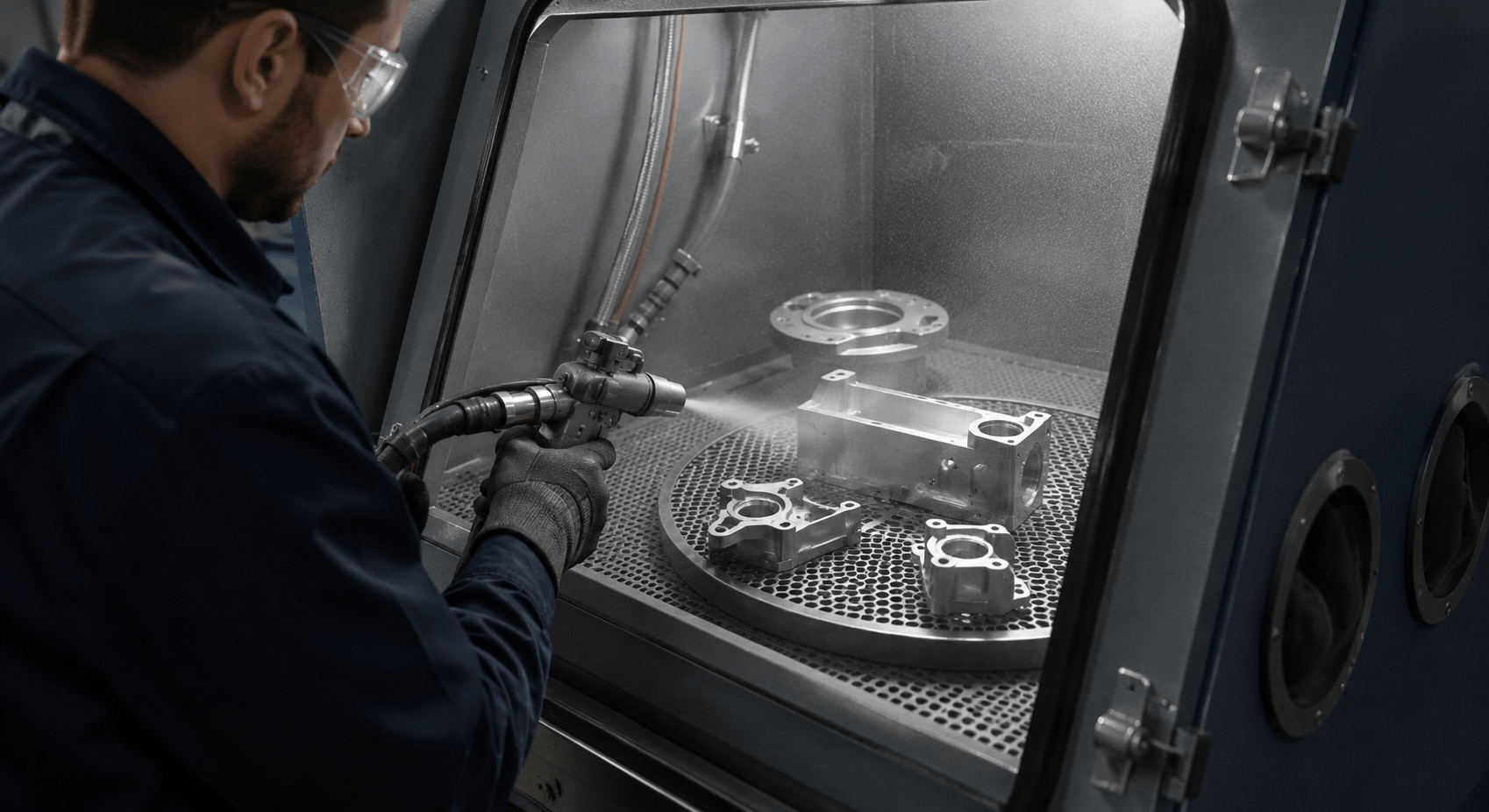
The process itself is simple. Fine spherical media – usually glass beads, sometimes ceramic – is propelled at the part’s surface through a nozzle using compressed air, inside an enclosed blast cabinet. Each bead is a tiny impact that deforms the very top of the surface. Do that across the whole part with millions of impacts and the result is an even, uniformly textured matte finish.
The key word is *spherical*. Because the media is round rather than angular, it opens the surface rather than cutting it – that’s what produces a soft satin look instead of an aggressive scratched one. It also means bead blasting removes very little material; it reworks the top few microns and no more. The finish you get depends on bead size and air pressure: finer beads at lower pressure give a smooth satin, coarser beads at higher pressure give a more textured matte. A skilled operator controls those variables to hit a consistent, repeatable result across a batch. For the full range of finishing options beyond blasting, our guide to surface finishes for CNC machined parts sets bead blasting in context.
What Bead Blasting Is Good For
Used for what it’s meant for, bead blasting earns its place. Its real strengths are specific.
- A uniform cosmetic finish. It erases visible tool marks and the slight variation between machined surfaces, giving the whole part one consistent, professional texture.
- A non-reflective matte look. The satin surface kills glare, which is why it’s standard on cameras, medical devices, and consumer electronics where shine is undesirable.
- Surface prep before coating. The lightly textured, clean surface is an excellent base for anodizing, painting, or powder coating – the finish keys into it better than a smooth machined face.
- Deburring and cleanup. Light blasting knocks down small burrs and removes surface contamination, though it’s not a substitute for proper deburring on heavy edges.
- Hiding minor blemishes. Small cosmetic imperfections and light scratches disappear under the uniform texture.
On aluminum in particular, bead blasting followed by anodizing is the classic combination behind that premium matte-anodized look – the blast creates the texture, the anodize adds color and a hard protective layer. Our comparison of aluminum grades for CNC machining is useful when planning parts headed for this finish, since the alloy affects how evenly it takes.
What Bead Blasting Can’t Do
This is where money gets wasted, so it’s worth being blunt about the limits.
| Expectation | Reality |
| Tightens tolerances | No — it removes almost no material and can’t correct dimensions |
| Improves strength | No — it’s a surface texture, not a structural treatment |
| Fixes bad machining | No — deep tool marks or gouges show through |
| Deburrs heavy edges | Only lightly — big burrs need proper deburring first |
| Adds corrosion resistance | No — bare metal still needs coating or anodizing |
| Produces a mirror finish | No — bead blasting is matte by definition |
The honest summary: bead blasting makes a part *look* uniform and professional, and prepares it for coating. That’s the job. It won’t rescue a part that’s out of tolerance, and it won’t add hardness or corrosion resistance on its own – for that you need a follow-on process like anodizing or plating, which is why it’s covered as a pre-treatment in our surface finishing service. Treat blasting as cosmetic and it’s great; expect it to fix functional problems and you’ll be disappointed.
Common Blast Media
The media choice shapes the result, so it’s worth a quick orientation.
| Media | Finish | Typical use |
| Glass beads | Smooth satin matte | General cosmetic finishing, most common |
| Ceramic beads | Fine, harder-wearing | Consistent finish, higher durability |
| Aluminum oxide | Aggressive, textured | Heavy cleaning, coarse texture (angular, cuts) |
| Walnut shell / plastic | Very gentle | Delicate parts, cleaning without etching |
Glass beads are the default for that classic uniform matte. Note that aluminum oxide is angular, not spherical — it actually cuts the surface, so it gives a coarser, more aggressive texture used for heavy cleaning rather than a fine cosmetic finish. Matching media to the intended look is part of speccing the finish correctly.
Getting a Consistent Result: What Controls Quality
Bead blasting looks simple, but the difference between a great finish and a blotchy one comes down to control. Uniformity is everything – the operator has to keep the nozzle at a consistent distance, angle, and dwell time across the whole surface, or you get visible patches where one area got hit harder than another. On parts with recesses and pockets, reaching every face evenly takes real skill, because the beads deflect off walls and can miss corners. Media condition matters too: as glass beads break down with use, they get finer and cut differently, so a shop that doesn’t refresh its media drifts toward an inconsistent finish over a batch.
That’s why bead blasting, cheap as it is per part, still rewards an experienced hand. It’s also why fixturing and masking are part of the job – areas that must stay untouched (threaded holes, sealing surfaces, critical dimensions) get masked off so the blast doesn’t texture them. When you spec a blasted finish, it’s worth telling the shop which surfaces are cosmetic and which must be protected, so the result is both uniform where it should be and clean where it matters. A well-controlled blast looks intentional; a careless one looks like an accident.
When to Choose Bead Blasting
Reach for bead blasting when appearance matters — when the part will be seen, handled, or sold, and you want that clean uniform matte. Reach for it when you’re about to anodize or coat aluminum and want the ideal surface underneath. And reach for it when you want to erase the cosmetic variation between machined faces so a part looks intentional rather than raw.
Skip it when the surface is hidden and purely functional, when you need a specific tight surface roughness for sealing (blasting gives a texture, not a controlled Ra), or when the part needs corrosion protection that blasting alone can’t provide. As with any finish, it should be a deliberate choice tied to what the part actually needs — and verifying that the delivered finish is uniform and correct is part of the quality inspection we run on finished parts. If you’re planning a blasted or blasted-then-anodized part, our CNC加工サービス handles the machining and finishing together so the result is consistent end to end.
よくある質問
What is bead blasting in CNC machining?
Bead blasting is a surface finishing process that fires fine spherical media — usually glass or ceramic beads — at a machined part using compressed air. The impacts create a uniform matte, satin texture that removes tool marks and gives the part a clean, non-reflective, professional appearance. It’s a cosmetic finish that removes almost no material.
Does bead blasting change part dimensions?
Practically no. Bead blasting removes only a few microns from the very top of the surface, so it doesn’t meaningfully affect dimensions or tolerances. This is why it can’t be used to correct an out-of-tolerance part — it changes the surface texture and appearance, not the size.
Is bead blasting done before or after anodizing?
Before. On aluminum, bead blasting is a common pre-treatment that creates a uniform textured surface, and anodizing is then applied on top to add color and a hard, corrosion-resistant layer. The blast produces the matte look and the anodize protects and colors it — together they create the classic premium matte-anodized finish.
What’s the difference between bead blasting and sandblasting?
Bead blasting uses round (spherical) media like glass beads, which peen the surface to a soft satin matte and remove very little material. Sandblasting and aluminum-oxide blasting use angular media that actually cut the surface, giving a coarser, more aggressive texture. Bead blasting is for fine cosmetic finishes; angular blasting is for heavier cleaning and surface prep.
Does bead blasting add corrosion resistance?
No. Bead blasting leaves bare metal with a matte texture and provides no corrosion protection on its own. To make a blasted part corrosion-resistant you need a follow-on process such as anodizing (on aluminum), plating, or painting. Bead blasting is often the surface-prep step before exactly those coatings.
________________________________________
About the author
Lewei Precision Engineering Team is a manufacturing writer and CNC process specialist with a focus on surface finishing and part presentation. He writes practical guides that help engineers and buyers specify finishes correctly – getting the look and protection a part needs without paying for treatments that don’t do what people assume they do.
 English
  简体中文
简体中文  Español
  Deutsch (Sie)
  日本語
日本語  Português