
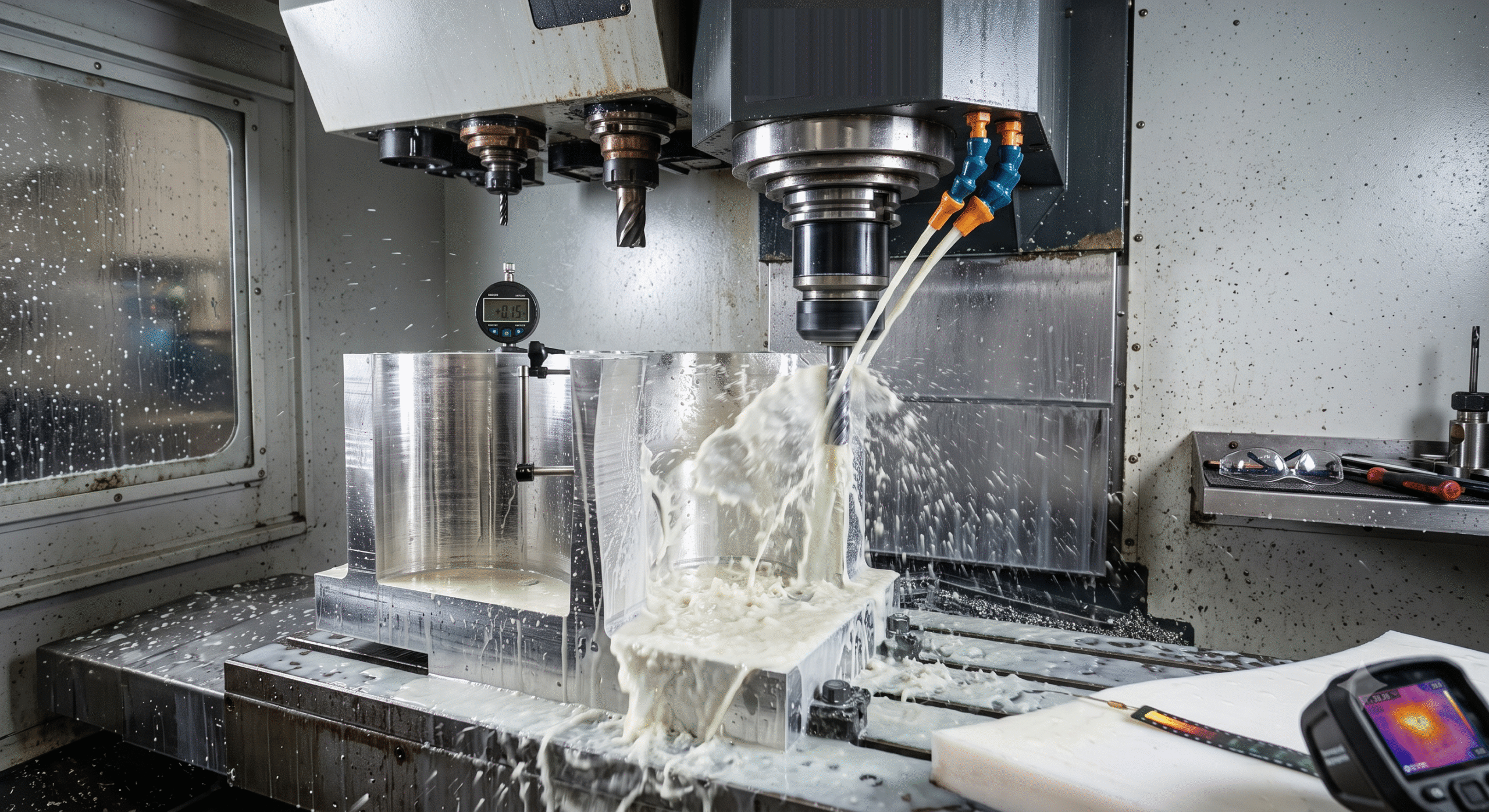
Want to blow up a machining quote in one move? Draw a wall that’s too thin. On screen it looks perfectly innocent — a crisp 0.4 mm rib, a nice lightweight pocket floor. Then it hits the machine and that thin section starts to sing. It buzzes, it flexes away from the tool, and it warps as the stress inside the metal lets go. Now the shop has three bad options: crawl the cut to save the wall, build extra fixturing to hold it still, or scrap the ones that distort. Guess who pays for all three? You do.
Wall thickness is one of those design calls that quietly decides the whole cost of a part. Nail it and the thing cuts fast and clean. Miss it and you’re buying the same part twice. So here’s what I want to give you: real minimums by material, a plain explanation of *why* thin walls fail, and the design moves that keep parts light and still make-able. These are honestly the first numbers I check when a drawing lands on my bench.
Quick answer: A safe minimum wall thickness for CNC machining is roughly 0.8 mm for metals and 1.5 mm for plastics. Thinner is achievable but risks vibration, deflection, and warping — which slow the cut and raise cost. The real limit depends on wall height, material stiffness, and fixturing.
Why Thin Walls Are a Machining Problem
Machining is a violent process, when you get down to it. The tool shoves sideways into the workpiece, and anything that isn’t stiff enough pushes back or simply gives way. A thin wall is fighting three things at once.
- Deflection. The wall bows away from the tool under pressure, so your finished dimension drifts. The cutter takes less than you asked for, the wall springs back, and you’re left with an inaccurate, slightly tapered face.
- Chatter. A thin section has a low natural frequency. The cutting force gets it vibrating, and that vibration prints straight onto the surface as ripples while it chews through your tool. Really bad chatter can just crack the part.
- Distortion. Raw stock is full of residual stress from rolling or forging. Strip material away and that stress rebalances — so thin walls warp, sometimes hours after the part is off the machine.
Notice that none of this is about the machine’s accuracy. You can own a machine good to a micron and it still can’t hold a wall that physically moves while you cut it. That’s the whole point: wall thickness is a *design* problem, not a tolerance problem. The precision discipline in our CNC machining tolerances explained guide only pays off once the geometry itself is stiff enough to hold still.
Minimum Wall Thickness by Material
Stiffness sets the floor. Rigid metals hold thin walls fine; soft plastics need more material to stay put. What follows are practical production minimums — not lab-record stunts.
| 素材 | Recommended minimum | Absolute minimum (with care) |
| Aluminum (6061) | 0.8 mm | 0.5 mm |
| Steel / stainless | 0.8 mm | 0.5 mm |
| Brass / copper | 0.8 mm | 0.5 mm |
| チタン | 1.0 mm | 0.7 mm |
| ABS / plastics | 1.5 mm | 1.0 mm |
| POM / nylon | 1.5 mm | 1.0 mm |
| PTFE (soft) | 2.0 mm | 1.5 mm |
Two things worth pulling out of that table. Metals take thinner walls than plastics because they’re stiffer and they dump heat instead of melting. And that “absolute minimum” column? It’s genuinely achievable — but it’s expensive, meaning slower cuts, special fixturing, and a real chance of scrap. Stick to the recommended column and you’re living in the cheap, repeatable zone. If your part mixes materials, or you’re not sure which alloy fits, our CNC machining materials guide helps line stiffness up against function.
The Height-to-Thickness Ratio That Actually Governs It
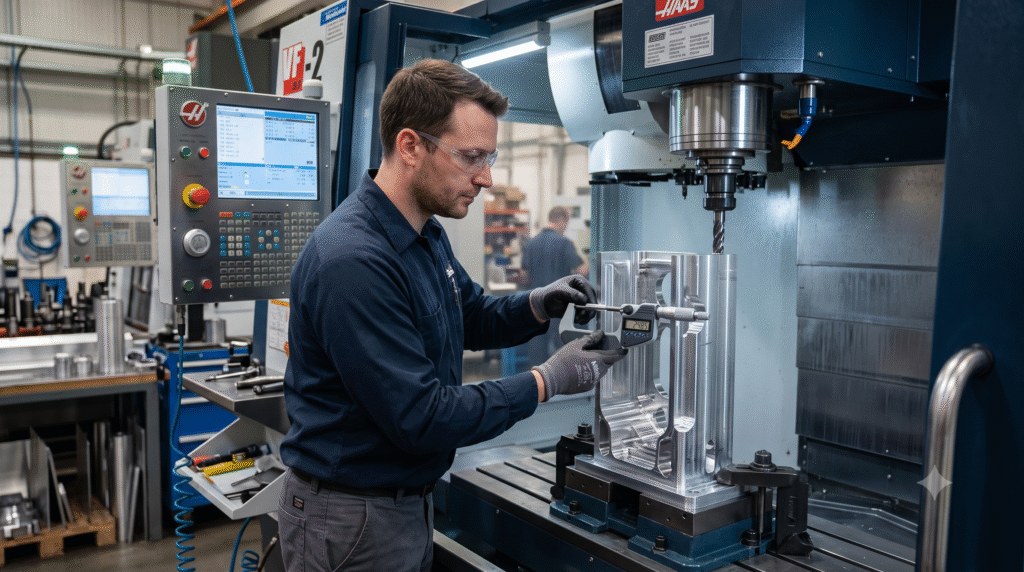
A single minimum number is a bit of a lie, honestly. The thing that really decides whether a wall lives or dies is its aspect ratio — height over thickness. A stubby 0.6 mm wall is fine. A tall 0.6 mm wall is basically a tuning fork.
Rule of thumb I use: keep height-to-thickness at about 4:1 or below and machining stays comfortable. Anywhere past 8:1, treat it as high-risk that needs real process planning. So a 0.8 mm wall is happy up to roughly 3.2 mm tall under the 4:1 rule. Stretch that same wall to 8 mm tall and now you’re into sacrificial supports, staged roughing, or changing the process entirely.
| Aspect ratio (height : thickness) | Risk level | Typical outcome |
| Up to 4:1 | 低い | Standard cutting, normal cost |
| 4:1 to 8:1 | 中程度 | Slower feeds, light finishing passes |
| Above 8:1 | 高い | Special fixturing or process change |
Design Rules to Make Thin Walls Work
When you truly need a thin wall — to shave weight, or clear a mating part — these are the tricks that keep it build-able.
- Add ribs or gussets. Brace a thin wall and it behaves like a much thicker one. For weight-critical parts, smart stiffening beats raw thickness every time.
- Cut the walls last. A good shop hogs out the bulk first, while the wall still has material around it holding it steady, then finishes the wall in light passes at the very end. Design so that sequence is even possible.
- Keep removal balanced. Symmetric machining lets residual stress relax evenly, so the part warps less. Don’t gut one side of a plate and leave the other solid.
- Give the shop something to grab. Little tabs, bosses, or a bit of extra stock that can be clamped and machined off later cut deflection dramatically.
- Loosen the tolerance on the thin bit. A wall that has to be thin doesn’t also have to be tight. Ease the tolerance and the shop can take lighter, faster finishing cuts.
All of that flows straight out of the broader design rules for CNC milling parts — build the part so the tool can reach it rigidly, and the cost quietly falls.
When to Change Process Instead of Fighting the Wall
Sometimes the honest answer is that machining is just the wrong tool. A part that’s basically a thin-walled shell might be far cheaper cast, extruded, or fabricated from sheet. If your design is thin *everywhere*, that struggle is the part telling you to rethink the process. For complex thin-walled shapes that genuinely have to stay machined, 5軸CNC加工 can tilt the part so the tool hits the walls with maximum rigidity and minimum overhang — often the whole difference between a scrapped run and a clean one. For prismatic parts with thin internal features, our CNCフライス加工サービス crew plans the roughing order specifically to protect them.
One more thing that helps: send a clean file. A model with proper solids and clear wall dimensions lets us flag thin-wall risk *before* we cut, not after — which is exactly why the best file format for CNC machining matters more than most engineers expect. And if you’re new to how a machine actually reads your geometry, start with our primer on what CNC machining is and how it works.
よくある質問
What is the minimum wall thickness for CNC machining?
The practical minimum is about 0.8 mm for metals and 1.5 mm for plastics. Thinner walls — down to roughly 0.5 mm in metal — are achievable but require slower cutting, special fixturing, and carry higher scrap risk. The safe value also depends on how tall the wall is relative to its thickness.
Why do thin walls increase machining cost?
Thin walls flex, vibrate, and warp under cutting force. To control that, a shop slows feeds, adds finishing passes, and builds extra fixturing to support the part. Each of those adds machine time and labor, and any walls that distort become scrap — all of which raise the price per part.
How does wall height affect minimum thickness?
A lot. The governing factor is the height-to-thickness ratio. A wall is comfortable to machine up to about a 4:1 ratio; beyond 8:1 it becomes high-risk. So a 0.8 mm wall that is 3 mm tall is easy, but the same thickness at 10 mm tall needs special process planning or a design change.
Can ribs replace thick walls to save weight?
Yes. Adding ribs or gussets to a thin wall dramatically increases its stiffness without the weight of a solid thick section. This is the standard way to keep a part light and rigid at the same time, and it is usually cheaper to machine than an equivalently strong solid wall.
Are minimum wall thicknesses the same for every material?
No. Stiffer materials tolerate thinner walls. Aluminum, steel, and brass work down to about 0.8 mm, titanium needs closer to 1.0 mm, and plastics like ABS or nylon need at least 1.5 mm because they are softer and can melt or deflect during cutting.
About the author
Lewei Precision Engineering Team — Manufacturing engineers at Lewei PrecisionThe Lewei Precision engineering team has spent more than 21 years machining and molding parts for aerospace, medical, automotive, and semiconductor customers across 120-plus countries. Our factory runs 3-axis through 5-axis CNC machining, turning, injection molding, and sheet metal fabrication under ISO 9001:2015, ISO 13485, ISO 14001, and IATF 16949 quality systems. The guidance here reflects what we see on real production floors and in customer DFM reviews every week, not textbook theory. Have a part in front of you? Send us the CAD file and we will tell you exactly how we would make it.
 English
  简体中文
简体中文  Español
  Deutsch (Sie)
  日本語
日本語  Português