
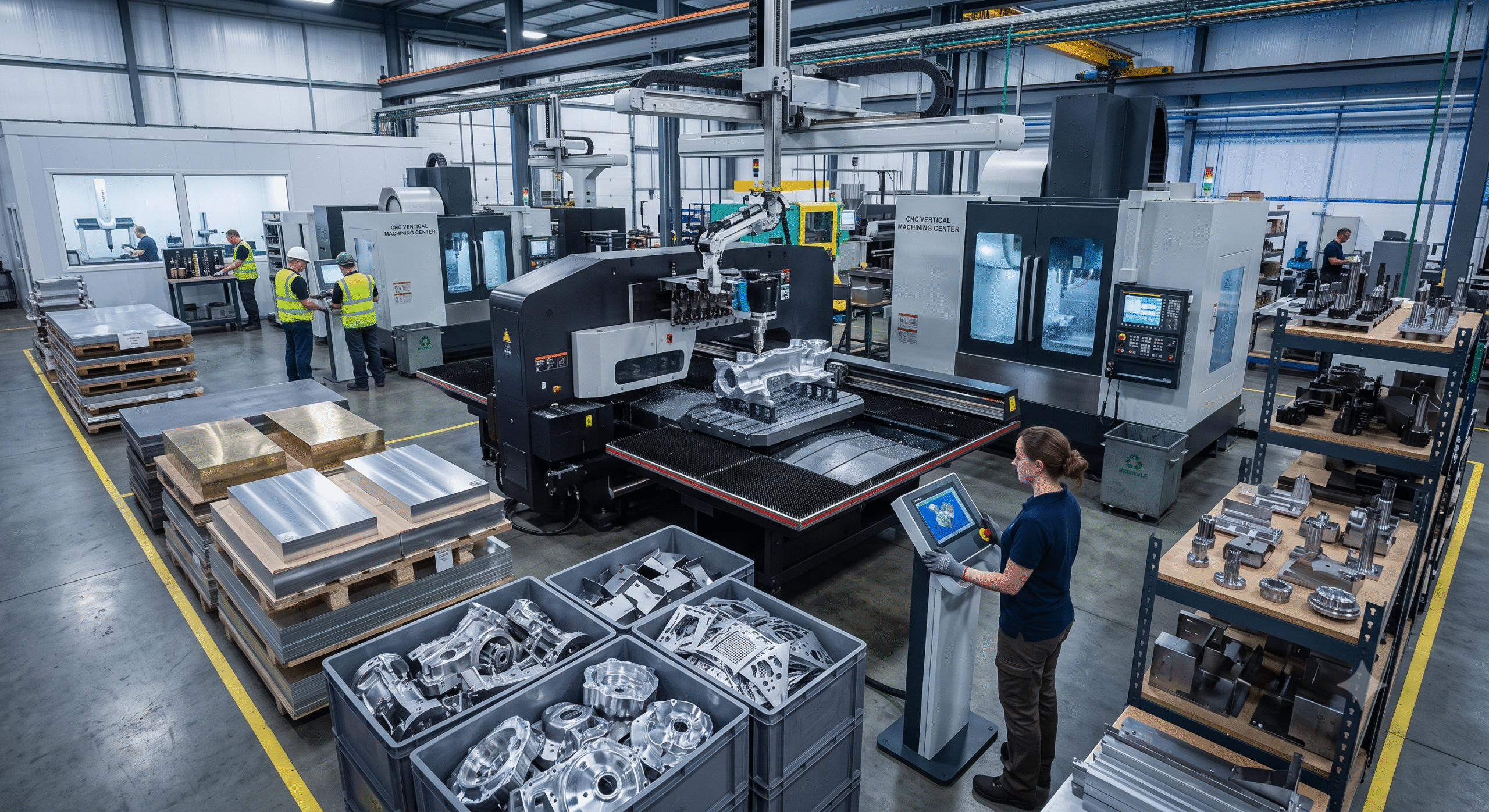
Here’s something most buyers never hear: the shop usually isn’t the reason your part costs too much. The overrun was baked into the drawing before anyone even quoted it. A tolerance tightened out of pure habit. A material picked by reflex. A sharp inside corner that quietly forces a tiny, slow tool. Each one adds minutes to the cycle and dollars to the invoice — and here’s the maddening part, the part works exactly the same without any of them.
Which is actually good news, if you think about it. Cost that gets designed *in* can just as easily be designed back *out*. You don’t have to trade quality for a lower price. You have to stop paying for precision and complexity the part never asked for in the first place. I’ve quoted thousands of components, and the same short list of levers explains nearly every dollar you could’ve saved. Here are ten of them, roughly in order of how much they move the number.
Quick answer: The biggest savings in CNC machining come from loosening non-critical tolerances, choosing machinable materials, simplifying geometry, ordering larger batches, and finishing only the surfaces that need it. These reduce machine time and setup — the two dominant cost drivers — without changing how the part functions.
First, Know What You Are Paying For
Any CNC quote comes down to four ingredients: machine time, material, setup and programming, and secondary operations. Everything else is just a modifier riding on top of those four. So cutting cost means trimming one of them without hurting the part. Keep that in your head and every tip below points at an obvious target. If you want the full anatomy of a quote, our CNC machine cost guide breaks down exactly where the money goes.
| Cost lever | Attacks | Typical saving | Quality risk |
| Loosen tolerances | Machine time, inspection | 高い | None if scoped |
| Easier material | Machine time, tooling | 高い | None if suitable |
| Simplify geometry | Machine time | 高い | なし |
| Larger batch | Setup per part | 高い | なし |
| Standard tool sizes | Machine time | ミディアム | なし |
| Reduce finishing | Secondary ops | ミディアム | None if scoped |
| Standard stock sizes | 素材 | ミディアム | なし |
| Fewer setups | Setup, labor | ミディアム | なし |
| Combine parts / DFM | Assembly, setup | ミディアム | なし |
| Clean CAD file | Programming | Low–medium | なし |
1. Loosen Every Tolerance That Doesn’t Fit or Seal
This is the big one. Every tolerance you tighten drags in slower cutting, extra finishing passes, and more inspection. A part toleranced at ±0.005 mm all over can run close to double the same part toleranced only where it counts. So be surgical about it — tight on the surfaces that mate, fit, or seal, and generous absolutely everywhere else. Our CNC machining tolerances explained guide helps you sort one from the other. Loosening a tolerance you never needed strips out cost and removes exactly zero function.
2. Choose the Easiest Material That Still Works
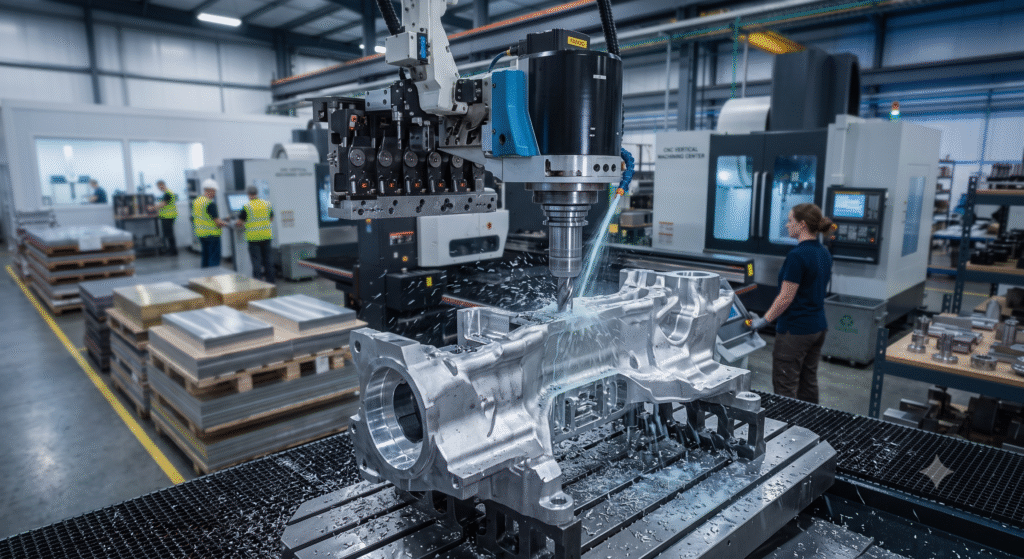
Material hits you twice — on stock price and on cutting speed. Aluminum 6061 and free-machining brass cut fast and cheap. Titanium and the nickel superalloys cost several times more per kilo *and* cut far slower, so the machine time piles on too. Pick the grade that just clears your mechanical, thermal, and corrosion needs — not the toughest thing on the shelf. Over-specifying material is one of the most common, and most expensive, reflexes in the whole field.
3. Simplify the Geometry
Deep pockets, tall skinny walls, fiddly internal features — they all slow the machine or drag in special tooling. So ask a blunt question of every feature: does the part still work without it? Rounding a decorative corner, shallowing a pocket, deleting a boss nobody uses — each one can shave real cycle time. Simplicity here isn’t a compromise on quality. It’s just deleting the cost that was never buying you anything.
4. Add Radii to Match Standard Tools
A rotating cutter physically cannot make a sharp internal corner. Ask for one and you force the shop into a tiny end mill crawling along, or an extra EDM operation. Give internal corners a radius that matches a standard cutter instead — even a small one — and the cut transforms. This single habit, pulled straight from good design-for-manufacturing practice, routinely knocks time off pocket machining.
5. Order in Larger Batches
Setup and programming are one-time costs. On a single prototype, that whole fixed cost lands on one lonely part, which is why prototype unit prices look brutal. Spread it across 200 parts and the per-part number drops through the floor. If you know volume is coming, quote it up front — or commit to a batch. It’s one of the easiest discounts on the table, so always ask what the price break looks like higher up the quantity curve.
6. Finish Only the Surfaces That Need It
A blanket “polish all over,” or one tight Ra across the whole part, pays for finishing that nobody will ever see. Default the part to a standard as-machined finish — around Ra 3.2 µm — and call out the smoother stuff only on the faces that actually do something. Every unnecessary finishing operation is pure removable cost with zero effect on how the part works.
7. Design Around Standard Stock Sizes
Machine a part from a block only a hair smaller than the next standard bar or plate, and most of that pricey material ends up as chips on the floor. Nudge your dimensions so the part nests neatly into standard stock and you save on both material and roughing time. The shop is buying standard sizes anyway — you might as well design to use them.
8. Minimize the Number of Setups
Every time a part gets unclamped, re-fixtured, and re-zeroed, you’re paying setup labor and rolling the dice on a small alignment error. Parts that can be cut from fewer directions cost less and hold tighter relationships between their features. This is exactly where 5軸加工 earns its higher hourly rate — reaching several faces in one setup often beats three separate 3-axis setups on total cost, and it’s more accurate to boot.
9. Consolidate Parts and Rethink Assembly
Sometimes the cheapest machined part is the one you stop making. Merge two simple components into one and you delete an assembly step. Flip it around — split one absurdly complex part into two simple ones — and you can cut total machine time. Good DFM looks at the whole assembly, not just the part in front of you, which is the lens our 精密加工サービス brings to a project review.
10. Send a Clean, Complete CAD File
A model with broken solids, missing dimensions, or an ambiguous format makes the programmer either guess or bounce the file back to you — either way, time and delay. A clean solid model with a clear drawing lets us program fast and quote accurately. If you’re weighing up who to work with, our guide on 適切なCNC加工サービスプロバイダーの選び方 covers what a good shop should be doing with your file, and the wider payoff of all these habits is spelled out in the top benefits of CNC machining.
Where Not to Cut
Two places where chasing a cheaper number blows up in your face. Never loosen a tolerance on a surface that genuinely fits or seals. And never drop to a material below the mechanical requirement just to save a few bucks of stock. Both invite field failures that dwarf whatever you saved at the machine. Cost reduction is about deleting waste, not deleting function — and the second a change touches how the part performs, it stops being a saving and turns into a liability.
よくある質問
What is the biggest driver of CNC machining cost?
Machine time is usually the single largest cost, followed by material and setup. Anything that keeps the part in the machine longer — tight tolerances, complex geometry, hard materials, fine finishes — drives the price up. That is why loosening non-critical tolerances and simplifying geometry deliver the largest savings.
Can I reduce CNC cost without reducing quality?
Yes. Most cost reductions target waste, not function — loosening tolerances that never needed to be tight, choosing a suitable easier-to-machine material, or finishing only functional surfaces. These leave the part performing identically while cutting machine time and setup. Quality only suffers if you cut a tolerance or material that the part genuinely requires.
Does ordering more parts lower the price per part?
Yes, significantly. Setup and programming are one-time costs spread across the batch. A single prototype carries the entire setup cost, so its unit price is high; ordering 100 or 200 identical parts spreads that fixed cost thin and can cut the per-part price by a large margin. Always ask for volume price breaks.
How do tolerances affect machining cost?
Tighter tolerances force slower cutting, additional finishing passes, and more inspection, all of which add time. A part toleranced tightly everywhere can cost nearly twice one toleranced tightly only where needed. The fix is to specify precision only on surfaces that fit, seal, or mate, and leave the rest generous.
Which materials are cheapest to CNC machines?
Aluminum 6061 and free-machining brass are among the cheapest machines because they cut fast, wear tools slowly, and produce clean finishes. Stainless steel is moderate, while titanium and nickel superalloys are expensive because they cut slowly and cost far more per kilogram. Choosing the easiest material that meets requirements saves on both stock and machine time.
About the author
Lewei Precision Engineering Team — Manufacturing engineers at Lewei PrecisionThe Lewei Precision engineering team has spent more than 21 years machining and molding parts for aerospace, medical, automotive, and semiconductor customers across 120-plus countries. Our factory runs 3-axis through 5-axis CNC machining, turning, injection molding, and sheet metal fabrication under ISO 9001:2015, ISO 13485, ISO 14001, and IATF 16949 quality systems. The guidance here reflects what we see on real production floors and in customer DFM reviews every week, not textbook theory. Have a part in front of you? Send us the CAD file and we will tell you exactly how we would make it.

 English
  简体中文
简体中文  Español
  Deutsch (Sie)
  日本語
日本語  Português