
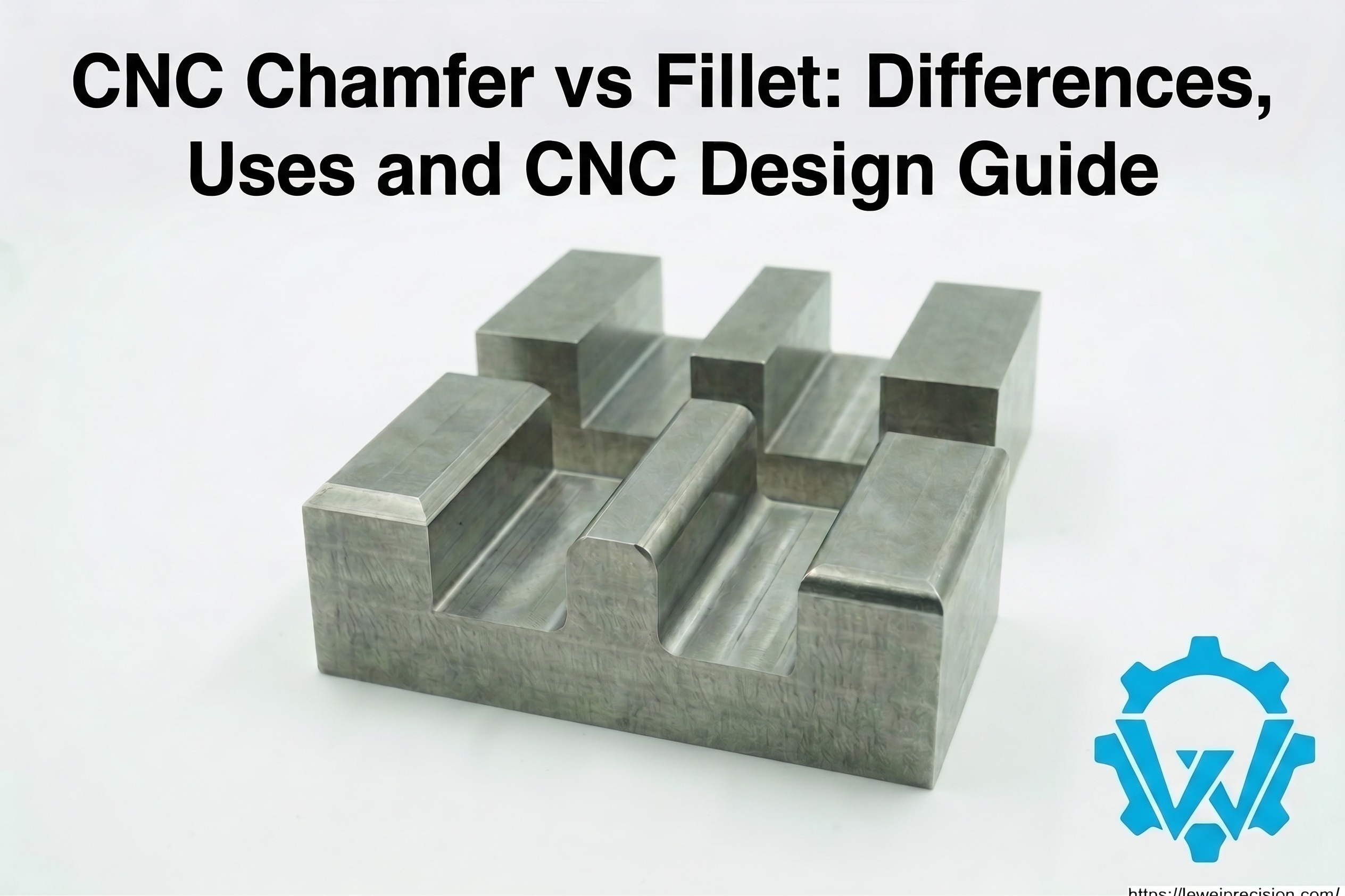
Engineers and manufacturers often search queries like: What is the difference between CNC chamfer and fillet? When should a CNC chamfer design be used instead of a CNC fillet radius? Which edge treatment provides better strength, appearance, and machining performance? These questions are common during product design and CNC manufacturing planning because edge selection affects cost, durability, safety, and final part quality.
The short answer is that a CNC chamfer creates a straight angled edge by removing material from a corner, while a CNC fillet creates a smooth curved transition by adding a radius to the corner. Chamfers are usually preferred for easier assembly, deburring, and lower machining costs, while fillets are better for improving stress distribution, strength, and surface appearance. The right choice depends on the part function, material, machining process, and performance requirements.
What Is a CNC Chamfer?
A CNC chamfer is an angled cut made on the edge of a machined component. Instead of leaving a sharp 90 degree corner, the CNC machine removes a small amount of material to create a sloped surface.
Chamfers are widely used in precision manufacturing because they solve several practical problems. Sharp edges can create safety risks, make assembly difficult, and increase the chance of damage during handling. A chamfer creates a smoother edge that improves usability.
For example, a threaded hole may include a chamfer at the entrance. This allows screws or bolts to enter more easily and reduces the chance of cross threading.
In CNC machining, common chamfer angles include 45 degrees, although other angles can be created depending on design requirements.
Manufacturers commonly use CNC chamfer design in:
- Aerospace components
- Automotive parts
- Industrial machinery
- 电子外壳
- 医疗设备
A properly designed chamfer also helps machinists remove burrs after cutting operations, making the manufacturing process faster and more efficient.
What Is a CNC Fillet?
A CNC fillet is a rounded transition between two surfaces. Instead of cutting away a corner at an angle, machining creates a curved edge with a specific radius.
The CNC fillet radius is an important design measurement because it affects part strength, machining capability, and tool selection. A larger radius generally creates smoother stress distribution and improves durability.
Sharp internal corners can become weak points because forces concentrate in these areas. A fillet spreads those forces over a larger surface area, reducing the possibility of cracking or failure.
CNC fillets are commonly used in:
- Structural components
- High load mechanical parts
- Aerospace applications
- Automotive components
- Long life industrial products
Designers often add fillets when strength and reliability are more important than simple manufacturing speed.
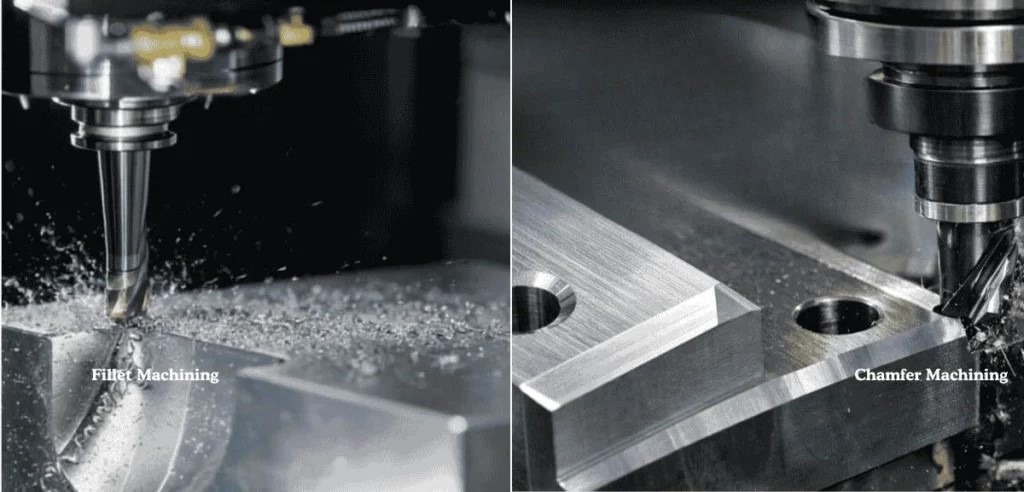
CNC Chamfer vs Fillet Difference
Understanding the chamfer vs fillet difference helps engineers select the correct edge treatment before production begins.
| 特点 | CNC Chamfer | CNC Fillet |
| Shape | Straight angled edge | Rounded curved edge |
| Main purpose | Edge finishing and easier assembly | Strength improvement and stress reduction |
| Machining difficulty | Usually easier | More complex |
| Production cost | Lower in many cases | 可以更高 |
| Appearance | Sharp modern look | Smooth premium appearance |
| Stress handling | Limited improvement | Better stress distribution |
| Common use | Holes, external edges, assembly areas | Structural and load bearing parts |
The decision between chamfer and fillet should not be based only on appearance. Engineers must consider how the component will work after manufacturing.
When Should You Use CNC Chamfer Design?
A CNC chamfer design is the better option when the main goal is improving usability, reducing sharp edges, or simplifying manufacturing.
Chamfers are ideal for:
Easier Assembly
Chamfered edges guide components into position. This is useful for pins, screws, shafts, and connecting parts.
Faster Machining
Most CNC machines can create chamfers quickly because the tool movement is simple. This can reduce machining time and production costs.
Removing Sharp Edges
Sharp metal edges can be dangerous during handling. A chamfer creates a safer surface without adding significant complexity.
Improving Thread Entry
Many threaded holes use chamfers because they help fasteners align correctly before installation.
For parts where extreme mechanical stress is not a concern, chamfers provide a practical and economical solution.
When Should You Use CNC Fillet Radius?
A CNC fillet radius is recommended when strength, durability, and smooth transitions are important.
Fillets are commonly used when:
Reducing Stress Concentration
A sharp corner creates a stress point. A rounded fillet spreads force more evenly across the component.
Improving Part Strength
Heavy duty components often require fillets because they can handle repeated loads better than sharp corners.
Improving Surface Quality
Fillets create a smoother appearance, which is useful for consumer products and visible components.
Supporting Complex CNC Designs
Modern CNC machining can create accurate curved surfaces, allowing designers to produce advanced geometries.
The correct radius depends on the material, cutting tool size, machine capability, and product requirements.
Design Factors Engineers Should Consider
Choosing between a chamfer and fillet requires looking at several design factors.
| Design Factor | Chamfer Consideration | Fillet Consideration |
| Manufacturing cost | 通常较低 | May require additional machining |
| Part strength | Suitable for low to medium stress areas | Better for high stress applications |
| 工具访问 | Easier for many operations | Requires proper tool radius planning |
| Appearance | Industrial and sharp finish | Smooth and premium finish |
| Assembly | Excellent for guiding components | Limited assembly benefit |
A good CNC design balances function, cost, and manufacturing limitations. Poor edge selection can increase production time or reduce part performance.
Impact on CNC Machining Cost
Edge design directly affects CNC machining costs. A simple chamfer normally requires less machine movement and fewer programming steps. Fillets may require additional tool paths, especially when large curved surfaces are involved.
However, using a fillet can reduce long term costs if it improves product durability and prevents failure.
Professional CNC manufacturers evaluate the complete application before recommending a design approach. Companies providing services such as 数控加工服务 help customers optimize designs before production.
How Lewei Precision Helps With CNC Edge Design
Selecting between CNC chamfer and fillet requires manufacturing knowledge, not only CAD design skills. Lewei Precision works with engineers and businesses to produce accurate CNC machined components based on performance requirements.
From prototype development to production manufacturing, expert machining guidance helps avoid common design mistakes. Proper selection of edge treatments can improve machining efficiency, reduce unnecessary costs, and create better final products.
Lewei Precision provides solutions for different manufacturing needs, including 数控铣削服务 and precision machining applications.
CNC Chamfer vs Fillet: Final Recommendation
There is no universal winner between chamfer and fillet. Both serve different purposes.
Choose a CNC chamfer when you need:
- Easy assembly
- Lower machining cost
- Safer edges
- Simple finishing
Choose a CNC fillet when you need:
- Higher strength
- Better stress resistance
- Smooth transitions
- Improved durability
The best CNC design combines engineering requirements with manufacturing practicality. Discussing edge selection early with a machining expert can prevent expensive redesigns later.
常见问题
What is the main difference between CNC chamfer and fillet?
A CNC chamfer creates a straight angled edge by cutting away material from a corner, while a CNC fillet creates a smooth curved transition using a specific radius. Chamfers are commonly used for easier assembly and edge finishing, whereas fillets are preferred when strength and stress reduction are important.
Is a fillet stronger than a chamfer?
A fillet is generally stronger than a chamfer in parts exposed to heavy loads or repeated stress. The curved surface helps distribute forces more evenly and reduces stress concentration at corners. This makes CNC fillet radius designs suitable for structural and high performance components.
Does a chamfer reduce CNC machining cost?
Yes, a chamfer can often reduce CNC machining costs because it requires simpler tool movements and less machining time. Chamfer operations are usually faster to program and produce compared with complex curved fillet features, making them a practical choice for many production parts.
What is CNC fillet radius?
CNC fillet radius is the measurement of the rounded curve created between two surfaces of a machined part. The selected radius affects part strength, tool selection, machining time, and final appearance. A proper radius helps improve durability while maintaining manufacturing efficiency.
Should every CNC part have chamfers?
No, every CNC part does not require chamfers. A chamfer should be added when it improves assembly, removes sharp edges, supports safety, or makes manufacturing easier. Engineers should select chamfers based on the function and requirements of the final component.
Can CNC machines create both chamfers and fillets?
Yes, modern CNC machines can accurately produce both chamfers and fillets using suitable cutting tools and programming methods. The choice depends on the CAD design, material, machine capability, and required part performance. Professional CNC manufacturers can recommend the best edge treatment for each application.
 English
  简体中文
简体中文  Español
  Deutsch (Sie)
  日本語
日本語  Português