
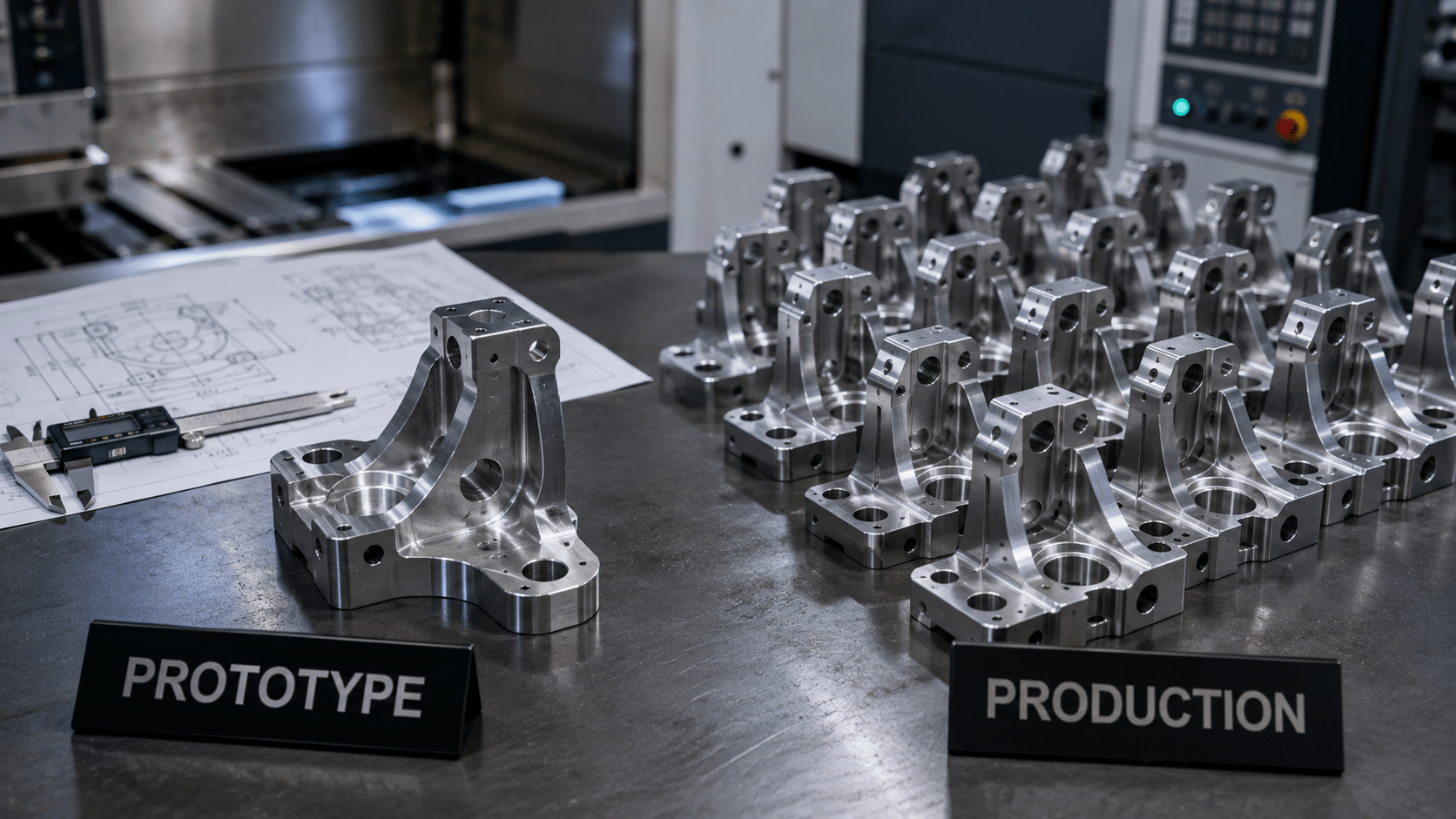
Here’s a question I hear all the time: “Is CNC for prototypes or for production?” And the honest answer is – yes. Both. The very same machine that cuts a single proof-of-concept part on Tuesday can run a batch of 2,000 on Wednesday. What actually changes between the two isn’t the machine. It’s how much time and money you sink into setup before the chips start flying, and how that cost gets spread across the parts you make.
Get that distinction wrong and you overpay. Order a “prototype” when you really need production pricing and your per-part cost stays sky-high. Tool up for “production” on a design that’s still changing and you’ve just spent money optimizing a part you’re about to redraw. This guide lays out how prototype and production machining really differ – cost, speed, tolerances, volume – and, more usefully, how to know which stage your project is actually in. Because that’s the decision that saves or wastes real money.
Quick answer: Prototype CNC machining produces one or a few parts quickly to validate a design, so the per-part cost is high because setup isn’t spread out. Production CNC machining runs larger batches with optimized fixturing and programming, pushing per-part cost down. The machines are the same – the difference is how much you invest in setup up front and over how many parts it’s amortized.
The One Cost That Explains Everything
Before comparing the two, you need the single idea that makes the whole thing click: fixed setup cost versus per-part cost.
Every machined job carries a one-time cost – writing and proving the toolpath, building or setting the fixture, dialling in offsets. Call it setup. Then there’s the cost that repeats for every part: the machine time to actually cut it, plus material. Now watch what happens to the math. On a single prototype, the entire setup cost lands on that one lonely part, so its price looks brutal. Spread the identical setup across 500 parts and it barely registers per unit. That’s the whole story. Prototype and production aren’t different technologies — they’re different points on that amortization curve. If you want the full anatomy of a quote, our primer on what CNC machining is and how it works sets the foundation.
Prototype CNC Machining: Fast, Flexible, Pricey Per Part
Prototype machining is built for one goal – get a real, functional part in your hands fast so you can test it. Speed and flexibility matter more than unit cost, because you’re going to change the design anyway.
The trade-offs make sense once you see the goal. Setup is quick and minimal because you’re not optimizing for a run that may never happen. Programming is fast, fixturing is simple, and if the part needs three revisions in two weeks, so be it – nothing was over-invested. The cost you pay is per-part price: with setup landing on just a handful of parts, each one is expensive. But you’re not buying cheap parts at this stage. You’re buying speed and the freedom to iterate.
Prototype machining shines when the design is still moving, when you need parts for fit-and-function testing, or when you’re chasing a deadline for a demo or a funding milestone. It’s also how you de-risk before committing real money to production tooling.
Production CNC Machining: Optimized, Repeatable, Cheap Per Part
Production machining flips every priority. Now the design is frozen, the volume is real, and the whole game is driving down cost per part while holding quality dead steady across the run.
That justifies investment that would’ve been wasteful on a prototype. The shop builds dedicated fixtures so parts load fast and identically. Programmers optimize toolpaths for cycle time, shaving seconds that add up over thousands of parts. Processes get validated so quality holds part after part, and inspection moves to sampling or SPC rather than checking every dimension by hand. All that up-front effort costs money – but spread across a big batch, it collapses the per-part price and buys you consistency you can build a product on.
Production is the right call once the design is locked, the volume justifies the setup investment, and repeatable quality matters more than turnaround on the first piece.
Prototype vs. Production: Side by Side
| Factor | Prototype | Producción |
| Volumen | 1–50 parts | Hundreds to thousands |
| Setup investment | Mínimo | Extensive, optimized |
| Cost per part | Alta | Bajo |
| Lead time (first parts) | Rápido | Slower to start, fast once running |
| Design flexibility | High — expects changes | Low — design frozen |
| Fijación | Simple, generic | Dedicated, custom |
| Inspection | Often 100% on first parts | Sampling / SPC |
| Ideal para | Testing, iteration, demos | Committed, repeatable manufacturing |
The table makes the pattern obvious. These aren’t competing services you choose between once – they’re sequential stages most parts pass through. You prototype to get the design right, then move to production to make it economically. The skill is knowing when you’ve crossed from one to the other, which the next section is about.
How to Know Which Stage You’re In
Forget the labels and answer three blunt questions.
- Is the design finished? If you might still change a dimension, feature, or material, you’re prototyping – don’t pay to optimize a moving target.
- Do you have real volume? Setup investment only pays back across quantity. If you need 10 parts, production tooling makes no sense; if you need 5,000, skipping it is leaving money on the table.
- What matters more right now – speed or unit cost? Racing to a demo says prototype. Shipping a product at margin says production.
Most projects walk this path in order: a few prototype iterations to lock the design, then a shift to production once it’s frozen and volume is confirmed. Our deeper comparison of CNC machining for prototypes vs. production parts walks through the transition in more detail, and it’s worth reading before you commit either way.
When Another Process Beats Production Machining
One more honest point. At very high volumes, machining every part can stop being the cheapest route. If you’re making tens of thousands of identical plastic parts, injection molding will beat machining once the mold cost is amortized – which is exactly the calculus behind our injection molding service. And for parts that combine a molded body with a metal insert, sobremoldeado can consolidate what would otherwise be a machined assembly. Machining stays king for metal parts, complex geometry, tight tolerances, and low-to-mid volumes – but part of good production planning is knowing when to hand off to a different process entirely. If you’re not sure where your volume tips the balance, send the part through our Servicio de mecanizado CNC and we’ll tell you straight.
Preguntas frecuentes
What is the difference between prototype and production CNC machining?
They use the same machines but optimize for different goals. Prototype machining makes one or a few parts fast with minimal setup, so per-part cost is high but you get parts quickly and can change the design freely. Production machining invests in optimized fixturing and programming to run large batches at low per-part cost with consistent quality.
Is CNC machining good for prototypes?
Yes. CNC machining is excellent for prototypes because it needs no dedicated tooling – the same program that makes one part makes a thousand. You get a real, functional part in the actual material fast, which is ideal for fit-and-function testing and design iteration before committing to production.
When should I switch from prototype to production machining?
Switch once the design is frozen, the volume justifies the setup investment, and repeatable quality matters more than first-part turnaround. If you might still change the design, stay in prototyping – optimizing a moving target wastes money. Real, committed volume is the signal that production setup will pay back.
Why does prototype machining cost more per part?
Because the one-time setup cost – programming, fixturing, and dialing in the job – lands on only a handful of parts. In production, that same setup is spread across hundreds or thousands of parts, so it barely affects each unit. You’re paying for speed and flexibility on a prototype, not for cheap unit pricing.
Can the same CNC machine do both prototype and production?
Yes. The machine doesn’t change between prototype and production – what changes is how much you invest in setup and over how many parts it’s amortized. A shop can cut a single prototype and later run full production of the same part on the same equipment, which is why CNC scales so smoothly from one stage to the next.
________________________________________
About the author
Lewei Precision Engineering Team is a manufacturing writer and CNC process specialist who has quoted and produced thousands of machined parts, from one-off prototypes to full production runs. He writes practical, cost-focused guides that help engineers and buyers make the right manufacturing call at the right stage – and avoid paying for the wrong one.
 English
  简体中文
简体中文  Español
  Deutsch (Sie)
  日本語
日本語  Português