
Two of the most useful — and most confused — processes in modern manufacturing are overmolding and insert molding. Both let you combine materials into a single, stronger part instead of making pieces separately and assembling them later. Both save labor, cut assembly errors, and produce parts that feel more finished. Yet they are not interchangeable, and picking the wrong one can quietly add cost or cause parts to fail in the field.
I have seen buyers order overmolding services when insert molding was the obvious answer, simply because the terms sound similar. This guide clears that up. By the end you will know exactly what each process does, when to use it, and how to brief a supplier so you get a quote that reflects what you actually need.
¿Qué es el sobremoldeo?
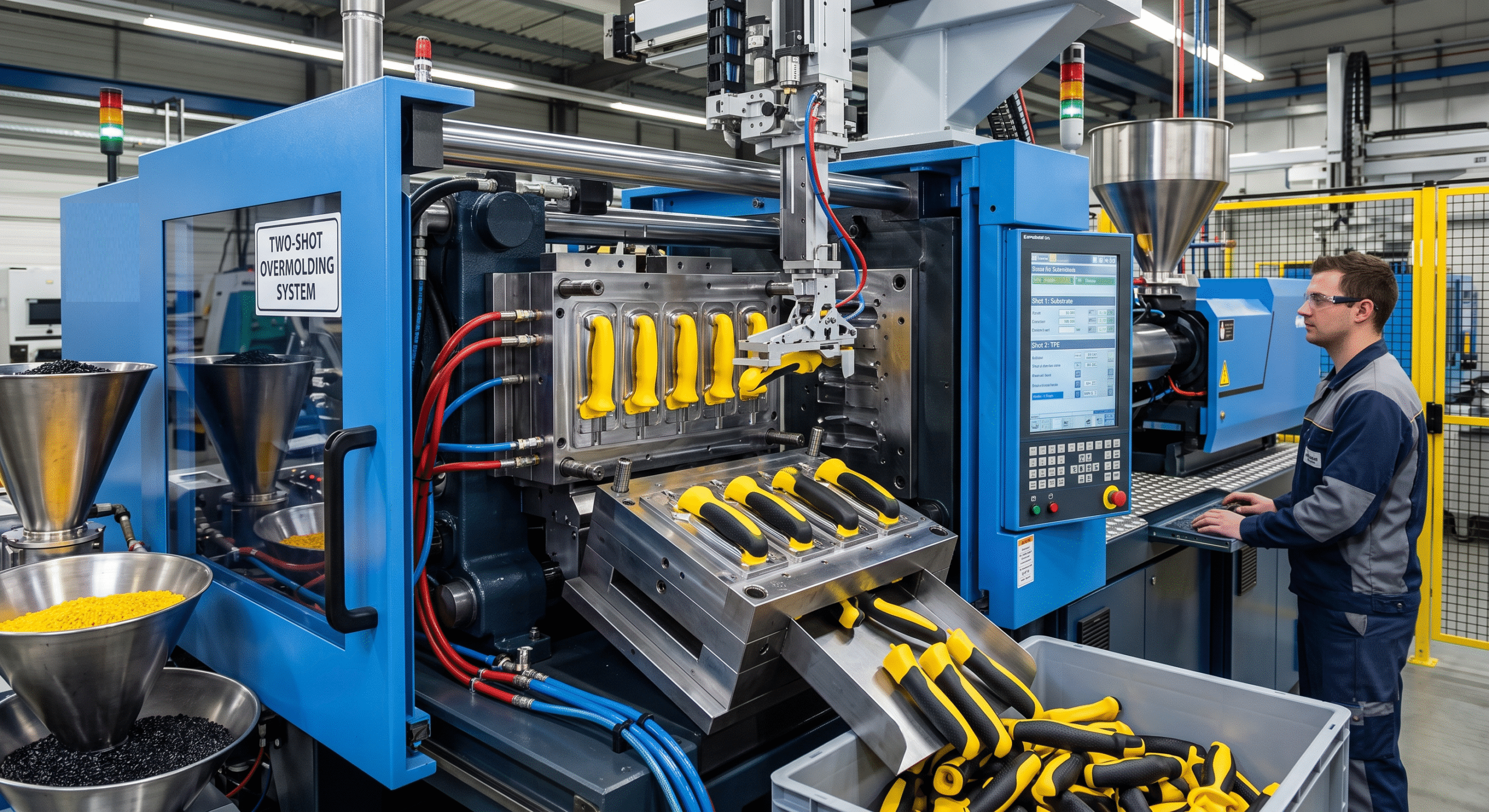
Overmolding is a two-step injection molding process where a second material is molded directly over a first, already-molded part. The first part is called the substrate, and the second layer bonds to it — either chemically or mechanically — to form one integrated component.
The most familiar example is a toothbrush or a power-tool handle: a rigid plastic core with a soft, grippy rubber (usually a thermoplastic elastomer, or TPE) molded over the areas your hand touches. That soft-touch layer is overmolding at work.
Quick answer: Overmolding molds a second material — often soft rubber-like TPE — over an existing plastic part to add grip, sealing, color, or protection, creating a single bonded component.
¿Qué es el moldeo por inserción?
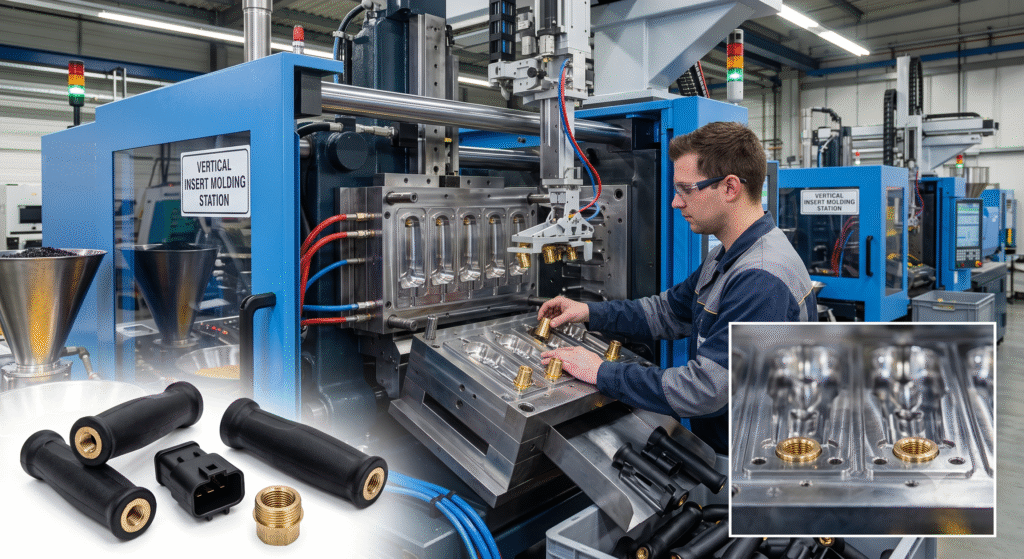
Insert molding is a single-shot process where a pre-made insert — usually metal, but sometimes plastic or ceramic — is placed into the mold cavity first, and molten plastic is then injected around it. When the plastic cools, it locks the insert permanently in place.
Think of a threaded metal bushing embedded in a plastic housing, a screwdriver blade set into its handle, or the metal contacts inside an electrical connector. The insert is fully or partially encapsulated by the plastic in a single molding cycle.
Quick answer: Insert molding places a pre-made component (typically metal) into the mold and injects plastic around it, embedding the insert in one shot — common for threaded bosses, terminals, and blades.
The Core Difference in One Sentence
Here is the cleanest way to hold both processes in your head: overmolding puts a molded layer over a molded part; insert molding puts molded plastic around a non-molded insert. Overmolding is usually plastic-on-plastic (or rubber-on-plastic). Insert molding is usually plastic-around-metal.
Overmolding vs. Insert Molding: Side-by-Side
| Factor | Sobremoldeado | Moldeo por inserción |
| Number of shots | Two (substrate, then overmold) | One (plastic around insert) |
| Typical materials | Rigid plastic + TPE / rubber | Plastic + metal insert |
| Objetivo principal | Grip, sealing, cushioning, aesthetics | Strength, threads, electrical contact |
| Bond type | Chemical + mechanical | Mechanical encapsulation |
| Common products | Handles, grips, seals, connectors | Threaded inserts, terminals, blades |
| Tooling complexity | Higher (multi-shot) | Moderate (insert placement) |
| Assembly saved | Eliminates a bonding/gluing step | Eliminates press-fitting or tapping |
When to Choose Overmolding
Overmolding earns its keep whenever the value is in the surface — how a part feels, seals, or looks. Reach for it when you need:
- A soft-touch grip on tools, handles, or consumer electronics.
- A weatherproof seal or gasket molded directly onto a housing.
- Vibration or impact damping around a rigid core.
- Two-color or multi-material aesthetics without painting or assembly.
- Strain relief where a cable meets a connector.
The success of any overmold hinges on material compatibility. Not every TPE bonds to every rigid plastic, so this is exactly the kind of detail worth confirming with your molder before tooling is cut — a conversation that mirrors the material-selection thinking in our guide to machinable alloys.
Here is how common overmold pairings typically behave, as a starting reference for design conversations:
| Substrate (rigid) | Overmold (soft) | Bond quality | Uso habitual |
| Polipropileno (PP) | TPE / TPV | Good chemical bond | Grips, seals, closures |
| ABS | TPU | Bien | Tool handles, housings |
| Policarbonato (PC) | TPE (bondable grade) | Moderate–good | Electronics, wearables |
| Nylon (PA) | TPE (grafted grade) | Variable — verify | Automotive, industrial |
| Metal / dissimilar plastic | TPE | Mechanical only | Requires undercuts/holes |
When to Choose Insert Molding
Insert molding is the right tool when a part needs the strength or conductivity of metal but the shape and light weight of plastic. Choose it when you need:
- Durable threads in a plastic part that will be assembled and disassembled repeatedly.
- Electrical contacts or terminals locked into an insulating body.
- A metal reinforcement — a shaft, pin, or blade — anchored in plastic.
- Reduced assembly by eliminating separate press-fitting or heat-staking steps.
Because the insert is often a precision-machined metal component, insert molding pairs naturally with services like Torneado CNC and milling, which produce the bushings, pins, and terminals that get encapsulated. If your insert is a turned metal part, the accuracy of that machining directly affects how well it seats in the mold.
Cost and Design Considerations
Both processes cost more upfront than single-material molding because tooling is more complex, but they usually win on total cost by removing downstream assembly. A few realities worth planning around:
- Tooling investment is higher. Multi-shot overmold tools and insert-loading fixtures cost more than basic molds, so both processes favor medium-to-high volumes.
- Cycle time matters. Insert molding can slow the cycle if inserts are loaded by hand; automation offsets this at scale.
- Design for retention. Overmolds need bonding surfaces or mechanical undercuts; inserts need knurls or grooves so the plastic grips and the insert cannot spin or pull out.
- Tolerances stack up. When metal and plastic meet, their different shrink rates and thermal expansion must be accounted for — the same discipline that prevents the defects we cover here.
For a broader view of how process choice drives price across manufacturing, our CNC machining cost guide walks through the same economic logic.
Quality and Reliability
A well-executed overmold or insert mold should behave as one part for the life of the product. The failure modes to watch are delamination (the overmold peeling from the substrate) and insert pull-out or spin. Both are almost always design or material problems, not process problems — which is why the briefing stage matters so much. Sharing your part’s real service conditions (temperature, chemical exposure, load, cycle count) with your molder upfront is the single best way to avoid a field failure. This is the same E-E-A-T-driven, “tell us how the part is actually used” philosophy we apply across every project at Precisión Lewei.
Which Should You Choose?
If your goal is feel, grip, sealing, or aesthetics, overmolding is almost certainly your answer. If your goal is strength, threads, or electrical function from an embedded metal part, insert molding is the one. And if you are still unsure, describe the part’s job — not its shape — to your supplier, and the right process usually becomes obvious in a single conversation.
Preguntas frecuentes
Can overmolding and insert molding be combined in one part?
Yes, and it happens more often than people expect. A part might have a metal insert molded into a rigid substrate, then a soft TPE grip overmolded on top, combining strength, function, and comfort in a single component. This layered approach is common in power tools, medical devices, and premium consumer electronics. It does raise tooling and process complexity, so it is best reserved for products where the combined benefit clearly justifies the investment. A capable molder can advise whether combining the two makes sense for your volume and budget.
What materials bond best in overmolding?
Bonding success depends on pairing a substrate and an overmold material that are chemically compatible, such as certain TPEs designed to adhere to polypropylene, ABS, or polycarbonate. When chemical bonding is weak, designers add mechanical interlocks like undercuts, holes, or textured surfaces so the overmold grips physically. Material suppliers publish bonding compatibility charts, and your molder can confirm the right pairing before tooling is committed. Getting this right upfront is the difference between a part that lasts and one that delaminates in use.
Why use insert molding instead of tapping threads directly into plastic?
Threads cut directly into plastic wear out quickly and strip after only a few assembly cycles, especially in softer resins. A metal threaded insert molded into the part provides durable, reusable threads that withstand repeated fastening and higher torque. This makes insert molding the standard choice for products that will be opened, serviced, or reassembled during their life. The embedded metal also spreads clamping loads, reducing the risk of cracking the surrounding plastic.
Is insert molding cost-effective for low volumes?
Insert molding carries higher tooling and setup costs, so very low volumes can be expensive on a per-part basis. As quantities rise, the fixed tooling cost spreads across more parts and the savings from eliminated assembly steps become significant. For prototypes or tiny runs, press-fitting or heat-staking inserts after molding is sometimes more economical. A supplier can help you compare the break-even point based on your annual volume and part complexity.
How do I prevent an insert from spinning or pulling out?
The insert’s surface geometry does the work. Features like knurling, grooves, hex flats, or undercuts give the molten plastic something to grip, locking the insert against both rotation and axial pull-out. The insert must also be positioned and held securely in the mold so plastic flows evenly around it without gaps. Good insert design plus proper mold support virtually eliminates spin-out, which is why precision-machined inserts perform so reliably in demanding applications.
Sobre el autor
SOBRE EL AUTOR
Equipo de Ingeniería de Precisión de Lewei — Ingenieros de fabricación de Lewei Precision: El equipo de ingeniería de Lewei Precision lleva más de 21 años dedicándose al mecanizado y moldeado de piezas para clientes de los sectores aeroespacial, médico, de la automoción y de los semiconductores en más de 120 países. Nuestra fábrica lleva a cabo mecanizados CNC de 3 a 5 ejes, torneado, moldeo por inyección y fabricación de chapa metálica bajo los sistemas de calidad ISO 9001:2015, ISO 13485, ISO 14001 e IATF 16949. Las orientaciones que aquí ofrecemos reflejan lo que observamos cada semana en las plantas de producción reales y en las revisiones de DFM (diseño para la fabricación) de nuestros clientes, no son meras teorías de manual. ¿Tienes una pieza delante? Envíanos el archivo CAD y te diremos exactamente cómo la fabricaríamos.

 English
  简体中文
简体中文  Español
  Deutsch (Sie)
  日本語
日本語  Português