
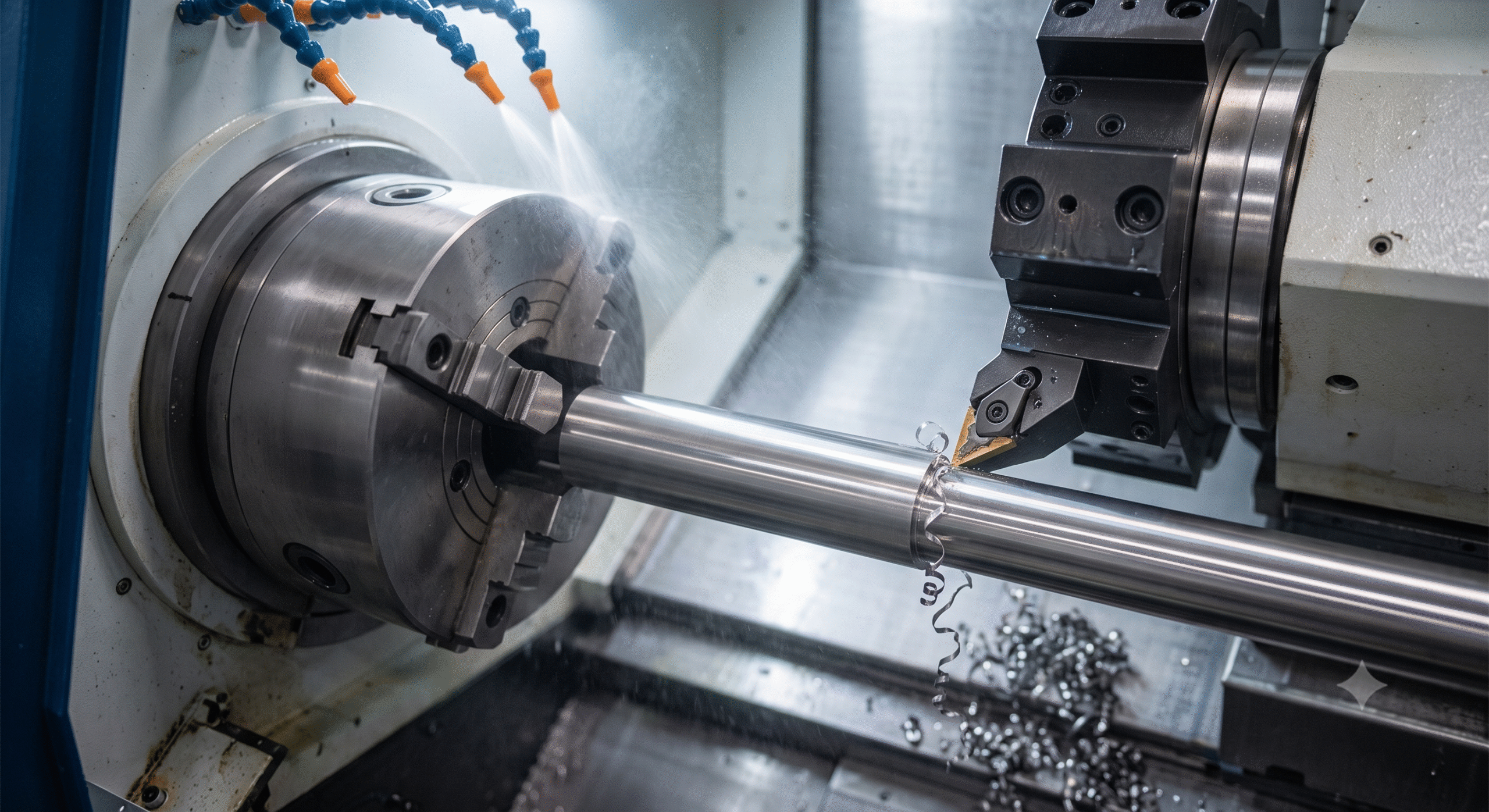
If you have ever held a metal shaft, a threaded fitting, or a smooth aluminum knob and wondered how it was made so precisely round, the answer is almost always CNC turning. It is one of the oldest ideas in manufacturing — spin the material, hold a cutter against it — married to modern computer control. I have spent years on shop floors watching a rough bar of steel become a finished part in a single setup, and turning still feels like the closest thing machining has to magic.
This guide walks through what CNC turning actually is, how a CNC lathe works, the parts you can and cannot make with it, and what drives the price. No fluff, no sales pitch — just the practical detail you need before you send a drawing to a supplier.
¿Qué es el torneado CNC?
CNC turning is a subtractive machining process where the workpiece rotates at high speed while a stationary cutting tool removes material to create a cylindrical or rounded shape. The “CNC” part — Computer Numerical Control — means the machine follows a coded program instead of a human turning handwheels.
Here is the key mental model: in turning, the part spins and the tool stays still; in milling, the tool spins and the part stays still. That single difference explains almost everything about which process suits which job. Turning is built for anything with an axis of rotation — shafts, pins, bushings, rollers, nozzles, and fittings. If you can imagine the part spinning cleanly on a spit, turning is likely the right call.
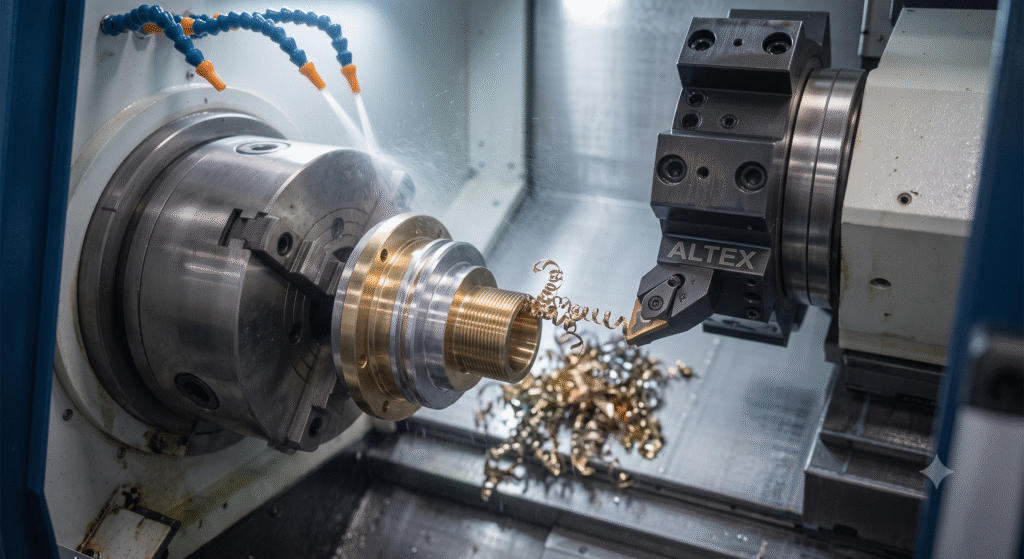
The process happens on a machine called a CNC lathe or turning center. Modern turning centers blur the line with milling by adding driven tools and a rotating axis (called live tooling and C-axis), so a single machine can turn a shaft and then drill a cross-hole or mill a flat without moving the part to a second machine.
Quick answer: CNC turning shapes a rotating workpiece with a fixed cutting tool to produce round parts like shafts, bushings, and threaded components — fast, repeatable, and accurate to within a few microns.
How a CNC Lathe Works, Step by Step
The sequence is simple to describe and genuinely satisfying to watch.
- Material loading. A bar of stock — aluminum, brass, steel, titanium — is clamped in the chuck or fed through a collet.
- Spindle rotation. The spindle spins the material, often between 1,000 and 6,000 RPM depending on diameter and material.
- Tool engagement. The turret indexes the correct tool into position and the cutter moves along the Z-axis (length) and X-axis (diameter).
- Roughing. Heavy passes remove the bulk of the material quickly, leaving a little stock for the finish.
- Finishing. Light, precise passes bring the part to its final dimension and surface finish.
- Secondary features. Live tooling drills, taps, or mills any off-axis features.
- Parting off. The finished part is cut from the bar and drops into a bin, ready for the next cycle.
Because everything is programmed, the hundredth part is identical to the first. That repeatability is the whole reason turning scales so well for production runs.
Operaciones comunes de torneado CNC
Turning is not a single motion — it is a family of them. Each operation earns its place on a different part feature.
| Operation | What it does | Uso habitual |
| Straight turning | Reduces the outer diameter along the length | Shafts, pins, dowels |
| Frente a | Cuts a flat surface on the end of the part | Squaring stock, setting length |
| Ranurado | Cuts a narrow channel around the diameter | O-ring seats, snap-ring grooves |
| Enhebrado | Cuts internal or external threads | Bolts, fittings, adjusters |
| Perforación | Enlarges an existing internal hole | Bushings, sleeves, bearing bores |
| Moleteado | Presses a textured pattern into the surface | Grips, knobs, thumbwheels |
| Parting | Cuts the finished part off the bar | Every bar-fed job |
A well-planned part uses these in a logical order so the machine never has to grip a finished, delicate surface — a small planning detail that separates a clean job from a scratched one.
Materials You Can Turn
One of turning’s strengths is how material-agnostic it is. In practice, the material choice is driven by the part’s job, not by whether it can be turned.
- Aluminum (6061, 7075): Fast, cheap, corrosion-resistant. The default for prototypes and lightweight parts. If you want a deeper look at a high-strength grade, our guide on 7075 and similar aerospace alloys is a useful companion.
- Brass and bronze: Superb machinability and a clean finish. For lead-free options, see our bismuth bronze guide.
- Steel and stainless: Strong, durable, and the backbone of most functional parts. Alloys like 4340 steel turn well and heat-treat to high strength.
- Titanium and exotics: Excellent strength-to-weight, but slow and demanding to cut.
- Plastics (Delrin, PEEK, nylon): Light, insulating, and quiet — common in valves and consumer parts.
CNC Turning vs. CNC Milling: When to Choose Which
This is the question I get most often, so let me answer it plainly. Choose turning when your part is fundamentally round and its main features share one axis. Choose milling when your part is prismatic — blocks, brackets, plates, housings with pockets and faces going in many directions. Most complex parts actually need both, which is exactly why mill-turn centers exist. If your project leans toward prismatic parts, our guide to types of CNC milling machines is the better starting point, and our CNC machining vs. 3D printing comparison helps if you are still weighing processes entirely.
What Drives the Cost of a Turned Part
Buyers are often surprised by why two similar-looking shafts quote at very different prices. Here is what actually moves the number.
| Cost driver | Low cost | Coste elevado |
| Material | Aluminum, brass | Titanium, exotic alloys |
| Tolerancia | ±0,1 mm | ±0,005 mm |
| Acabado superficial | Como mecanizado | Mirror / polished |
| Cantidad | 500+ parts | 1–5 prototypes |
| Secondary features | Ninguno | Cross-holes, milling, threads |
| Setup complexity | Single setup | Multiple re-clamps |
The biggest lever is tolerancia. Every extra decimal place of precision adds finishing passes, inspection, and scrap risk. A smart designer only tightens the tolerances that actually matter for fit and function, and leaves everything else generous. For a fuller breakdown of pricing logic across processes, our Wire EDM cost guide explains the same economics from another angle.
How to Design Better Parts for Turning
A few habits will save you money and headaches:
- Avoid deep, thin bores. Long boring tools chatter and leave poor finishes.
- Add generous fillets at internal corners so the tool nose can follow the geometry.
- Keep length-to-diameter ratios sensible. Very long, slender parts flex and vibrate under the tool.
- Standardize thread sizes so common tooling can be used.
- Loosen non-critical tolerances. Precision you do not need is money you do not get back.
These principles echo the same design thinking we cover in our design rules for machined parts, and following them upfront prevents the common machining defects that force expensive re-runs.
Where CNC Turning Shines
Turning is everywhere once you start looking. Automotive drive shafts and pistons, hydraulic fittings, medical bone screws, firearm components, plumbing valves, electrical connectors, and the humble threaded fastener all begin their life spinning in a lathe. Anywhere a part needs to be round, concentric, and produced in volume with tight repeatability, turning is the default answer — and often the cheapest route to a finished, functional component.
Preguntas frecuentes
¿Cuál es la diferencia entre torneado CNC y fresado CNC?
In CNC turning, the workpiece rotates while a fixed cutting tool shapes it, which makes it ideal for round, symmetrical parts like shafts and bushings. In CNC milling, the cutting tool rotates while the workpiece stays clamped in place, which suits flat, prismatic parts with pockets and multiple faces. Many real-world parts need both processes, and modern mill-turn centers combine them so a single machine can turn a diameter and then mill a feature without re-fixturing. Choosing correctly comes down to whether your part is fundamentally round or fundamentally blocky.
¿Cuál es la precisión del torneado CNC?
A well-maintained CNC lathe routinely holds tolerances of ±0.025 mm, and precision turning centers can reach ±0.005 mm or tighter on critical diameters. The achievable accuracy depends on the material, the part geometry, the rigidity of the setup, and how many finishing passes the program includes. Very tight tolerances raise cost because they demand slower cutting, extra inspection, and sometimes temperature-controlled conditions. The practical advice is to specify tight tolerances only where fit and function genuinely require them.
Which materials can be CNC turned?
Almost any solid, machinable material can be turned, including aluminum, brass, bronze, mild and stainless steel, titanium, and engineering plastics like Delrin and PEEK. Aluminum and brass are the fastest and cheapest to cut, while titanium and hardened steels are slower and more tool-intensive. What settles the pick is the part’s job — strength, weight, corrosion, temperature — not whether the metal can physically be turned, because nearly all of them can. If you are unsure, tell your machinist what the part has to survive and let them steer you to the cheapest grade that clears the bar.
¿Es el torneado CNC más barato que el fresado?
For genuinely round parts, turning is usually cheaper than milling because it removes material faster and completes many features in a single setup. Milling becomes the more economical choice when a part is prismatic or has features on multiple non-cylindrical faces. The real cost drivers are material, tolerance, finish, and quantity rather than the process name itself. A good manufacturing partner will quote the process, or combination of processes, that produces your specific part for the lowest total cost.
How many parts do I need to make CNC turning worthwhile?
CNC turning is economical across a wide range, from a handful of prototypes to production runs in the tens of thousands. For very small quantities, the setup and programming time dominates the per-part price, so unit costs are higher. As quantities rise, that fixed cost spreads across more parts and the price per unit drops sharply. Bar-fed automatic lathes make high-volume turning especially cost-effective, which is why fasteners and fittings are so inexpensive.
Sobre el autor
SOBRE EL AUTOR
Equipo de Ingeniería de Precisión de Lewei — Ingenieros de fabricación de Lewei Precision: El equipo de ingeniería de Lewei Precision lleva más de 21 años dedicándose al mecanizado y moldeado de piezas para clientes de los sectores aeroespacial, médico, de la automoción y de los semiconductores en más de 120 países. Nuestra fábrica lleva a cabo mecanizados CNC de 3 a 5 ejes, torneado, moldeo por inyección y fabricación de chapa metálica bajo los sistemas de calidad ISO 9001:2015, ISO 13485, ISO 14001 e IATF 16949. Las orientaciones que aquí ofrecemos reflejan lo que observamos cada semana en las plantas de producción reales y en las revisiones de DFM (diseño para la fabricación) de nuestros clientes, no son meras teorías de manual. ¿Tienes una pieza delante? Envíanos el archivo CAD y te diremos exactamente cómo la fabricaríamos.

 English
  简体中文
简体中文  Español
  Deutsch (Sie)
  日本語
日本語  Português