
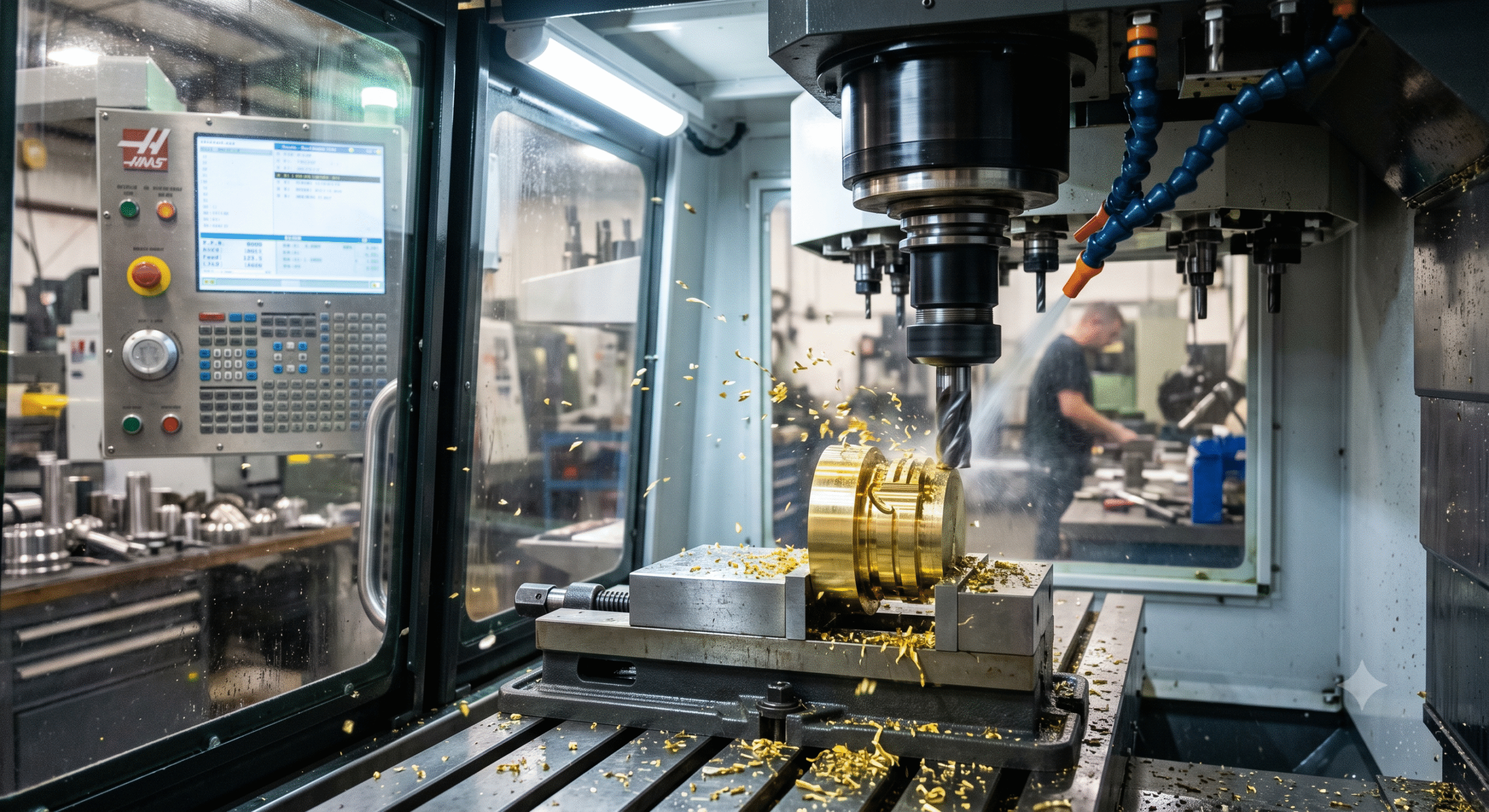
Watch a lathe turn a brass fitting and the first thing you notice is the sound. It’s different. The chips snap off short, the tool barely loads up, and the part comes off looking like someone already polished it. None of that is luck. Brass is simply the friendliest metal we run, and I’ll admit the whole shop breathes a little easier when a drawing calls for it — because brass forgives the stuff that harder metals punish you for.
Here’s the catch, though. “Brass” isn’t one material. It’s a whole family of copper-zinc alloys, and they don’t all behave the same way under a cutting edge. Pick the wrong one and you can lose the finish, the strength, or the corrosion resistance you were counting on. So this guide is about the grades that actually matter for CNC work, where brass earns its keep, what tolerances you can realistically hold, and the design calls that keep your parts cheap without wrecking their function. I’ve cut brass for plumbing, for electronics, for marine hardware — and honestly, the same handful of rules keeps showing up every time.
Quick answer: Brass CNC machining is the subtractive cutting of copper-zinc alloys — usually free-machining C360 — into precision parts such as valves, fittings, and connectors. Brass runs faster than steel or aluminum, holds tight tolerances, and produces excellent finishes, which lowers machining time and cost per part.
Why Brass Machines So Well
Machinability is really just a question of how a metal behaves when the edge shears it. Free-machining brass has a little lead in it — or bismuth, in the newer alloys — scattered through the copper-zinc. Those tiny particles do something clever: they act like built-in chip-breakers. Instead of the long stringy swarf aluminum throws at you, the material crumbles into short, tidy chips. Those chips clear the flutes, carry heat away, and let you push the feeds and speeds hard.
And the payoff is real, not marketing. Brass will often cut two to three times faster than mild steel, and it holds that near-mirror finish straight off the tool — the kind of surface other metals need a second operation to reach. Lower cutting forces help everywhere else too: less tool wear, less flex on skinny features, tighter repeatability part after part. If you want to see where brass sits against the wider field, our CNC machining materials guide lays out the alternatives side by side.
Brass Grades That Matter for CNC
Not every brass belongs on a machine. The trade-off is nearly always the same: machinability against strength or ductility. These are the ones you’ll actually run into.
| Grade (UNS) | Common name | Machinability (C360=100%) | Am besten geeignet für |
| C360 | Free-cutting brass | 100% | Fittings, valves, fasteners, gears |
| C260 | Cartridge brass | 30% | Deep-drawn, formed, ammunition cases |
| C272 | Yellow brass | 30% | Architectural, hardware |
| C464 | Naval brass | 30% | Marine parts, corrosion resistance |
| C385 | Architectural bronze | 65–75% | Extruded shapes, trim |
| C230 | Red brass | 30% | Plumbing, corrosion-prone service |
C360 is the default, and for good reason. If a part *can* be made from C360, it usually should be — faster to cut, better finish, lower cost than anything else on that list. C260 and C272 give up machinability for ductility, which is why you see them in parts that get formed or drawn rather than cut clean. C464 naval brass and C230 red brass are the corrosion answers, for saltwater and plumbing service where plain yellow brass would slowly dezincify and fall apart. And when the spec says lead-free — which is getting common in drinking-water and electronics parts — bismuth brasses step in. The regulatory pressure driving that shift is the same one we cover in our rundown of lead-free bronze alloys.
Where Brass CNC Parts Show Up
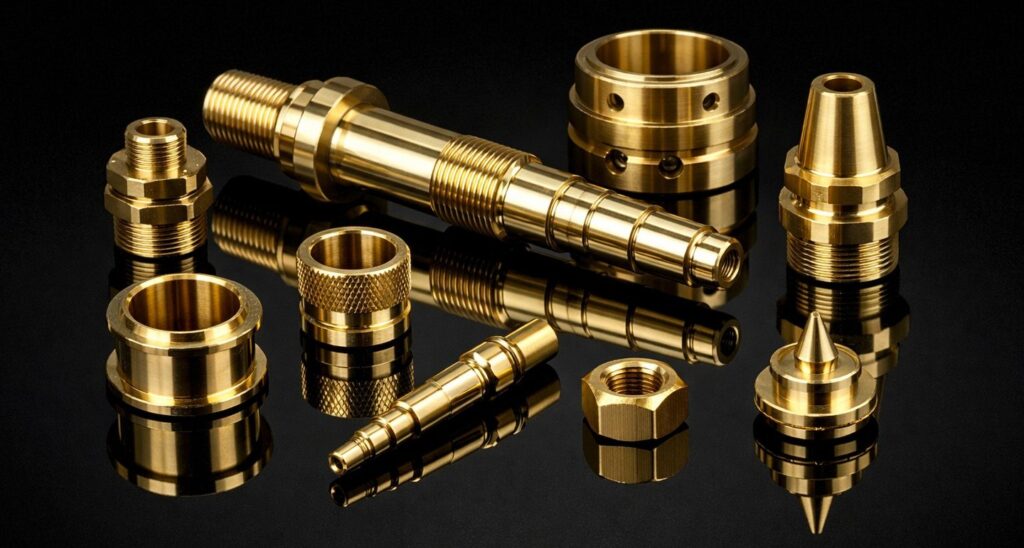
People sometimes forget that brass isn’t picked only because it’s easy to cut. It also happens to resist corrosion, conduct electricity well, run with low friction, and shrug off bacteria on its surface. That combination lands it in some very specific places.
- Plumbing and fluid control — valves, fittings, manifolds, hose barbs. Anything that has to resist corrosion and stay pressure-tight.
- Electrical and electronics — connectors, terminals, pins, riding on brass’s conductivity and how nicely it takes solder.
- Marine hardware — naval brass fittings that laugh off saltwater without the price tag of bronze.
- Instruments and gears — low-friction moving parts that need to stay dimensionally put.
- Decorative and architectural — hardware and trim, where that warm gold tone is the whole point.
The thread running through all of it: brass solves a real functional problem — conductivity, corrosion, friction — and it usually does it while costing less to make than the same part in steel.
Tolerances and Surface Finish You Can Expect
Because it cuts with such low force and sheds heat well, brass holds tolerance better than most metals you’ll put on a machine. On standard equipment, here’s roughly what you can bank on.
| Merkmal | Erreichbare Toleranz | Anmerkungen |
| Turned diameters | ±0,01 mm | Excellent thermal stability |
| Milled features | ±0.025 mm | Low deflection on thin walls |
| Reamed holes | ±0.008 mm | Clean, burr-light finish |
| Surface finish (as-machined) | Ra 0.4–0.8 µm | Often no secondary finishing needed |
| Themen | Class 2B / 3B | Rolls or cuts cleanly |
That as-machined finish is the part that surprises people. Where aluminum or steel would need bead-blasting or a polish to look presentable, brass often walks off the machine ready to ship. Push the spec tighter than the table above and the same rule kicks in that we spell out in our CNC machining tolerances guide: tighten only what fits, seals, or mates. Leave everything else alone.
Design Tips That Cut Cost on Brass Parts
Brass forgives a lot, but a smart drawing still saves you money. These are the habits that separate a clean quote from a painful one.
- Default to C360 unless a property rules it out. Every step away from free-cutting brass slows the cut and adds cost. Make the alternative earn its place first.
- Ease off the tolerances. Brass holds precision so easily that engineers get tempted to spec ±0.005 mm all over. Don’t. Save the tight numbers for surfaces that actually do something.
- Give internal corners a radius. A round tool can’t cut a sharp inside corner — physics. Match the radius to a standard cutter and you skip the custom tooling and the slow passes. Same logic runs through our design rules for machined parts.
- Keep walls sensible. Brass fights deflection better than aluminum, sure, but drop below 0.5 mm and you’re still inviting chatter and distortion.
- Batch it. Setup and programming are one-time costs. Run 100 parts instead of 5 and the per-part price falls off a cliff — in a good way.
- Be honest about finish. If the as-machined Ra works, say so, and skip the secondary op you’d otherwise be paying for.
Brass vs. Aluminum vs. Steel: A Quick Reality Check
I get asked all the time whether to move a part from aluminum or steel over to brass. The real answer is: it depends what the part has to do. Brass wins on machinability, corrosion, and conductivity. It loses on weight and raw stock cost, because copper isn’t cheap. Steel wins on strength-for-the-money but cuts slower and usually needs finishing to fend off rust. For a small, precise, corrosion-sensitive part in moderate numbers, brass often turns out cheapest once you tally up finishing and scrap — even though the bar costs more up front. For a big structural bracket? Aluminum, every time. Matching metal to job is the whole point of our Präzisionsbearbeitung, and if you’ve already got a drawing, the fastest way to see the trade-off in dollars is to run it through our CNC-Bearbeitungsdienst for a quote.
Common Mistakes With Brass Machining
Even an easy metal has traps. Three of them come up over and over. First, specifying a yellow brass for marine or drinking-water service, where it’ll dezincify and quietly fail. Second, over-tolerancing a decorative part that never needed precision. Third, assuming any old brass is lead-free when the regulation demands certified low-lead stock. Every one of these costs pennies to catch at the drawing stage — and real money to discover after the chips are already on the floor.
Häufig gestellte Fragen
Is brass easy to CNC machine?
Yes — free-machining C360 brass is the most machinable common metal, rated at 100% on the standard machinability scale. It cuts with low force, breaks into short chips, and produces an excellent finish straight off the machine, which is why brass parts are usually faster and cheaper to cut than steel or aluminum equivalents.
What is the best brass grade for CNC parts?
C360 free-cutting brass is the best all-round choice for machined parts because of its outstanding machinability and finish. Choose C464 naval brass for saltwater corrosion resistance, C260 for parts that will be formed rather than cut, and a certified bismuth brass when a lead-free material is required for potable water or electronics.
Does brass need surface finishing after machining?
Often not. Brass typically leaves the machine with a Ra of 0.4–0.8 µm — a bright, near-polished surface that many applications accept as-is. Secondary finishing such as polishing, plating, or lacquering is added only for appearance, extra corrosion protection, or a specific cosmetic tone.
Is brass CNC machining more expensive than aluminum?
The raw material costs more per kilo because brass contains copper, but the faster cutting speeds, lower tool wear, and reduced need for finishing often close the gap. For small precision parts in moderate volumes, brass can end up cheaper overall once finishing and scrap are counted.
Can brass be machined lead-free for drinking-water parts?
Yes. Lead-free brass and bismuth brass alloys are made specifically for potable-water fittings and comply with low-lead regulations such as the U.S. Safe Drinking Water Act. They machine slightly slower than leaded C360 but still cut well and are the correct choice for any part in contact with drinking water.
About the author
Lewei Precision Engineering Team — Manufacturing engineers at Lewei PrecisionThe Lewei Precision engineering team has spent more than 21 years machining and molding parts for aerospace, medical, automotive, and semiconductor customers across 120-plus countries. Our factory runs 3-axis through 5-axis CNC machining, turning, injection molding, and sheet metal fabrication under ISO 9001:2015, ISO 13485, ISO 14001, and IATF 16949 quality systems. The guidance here reflects what we see on real production floors and in customer DFM reviews every week, not textbook theory. Have a part in front of you? Send us the CAD file and we will tell you exactly how we would make it.

 English
  简体中文
简体中文  Español
  Deutsch (Sie)
  日本語
日本語  Português