
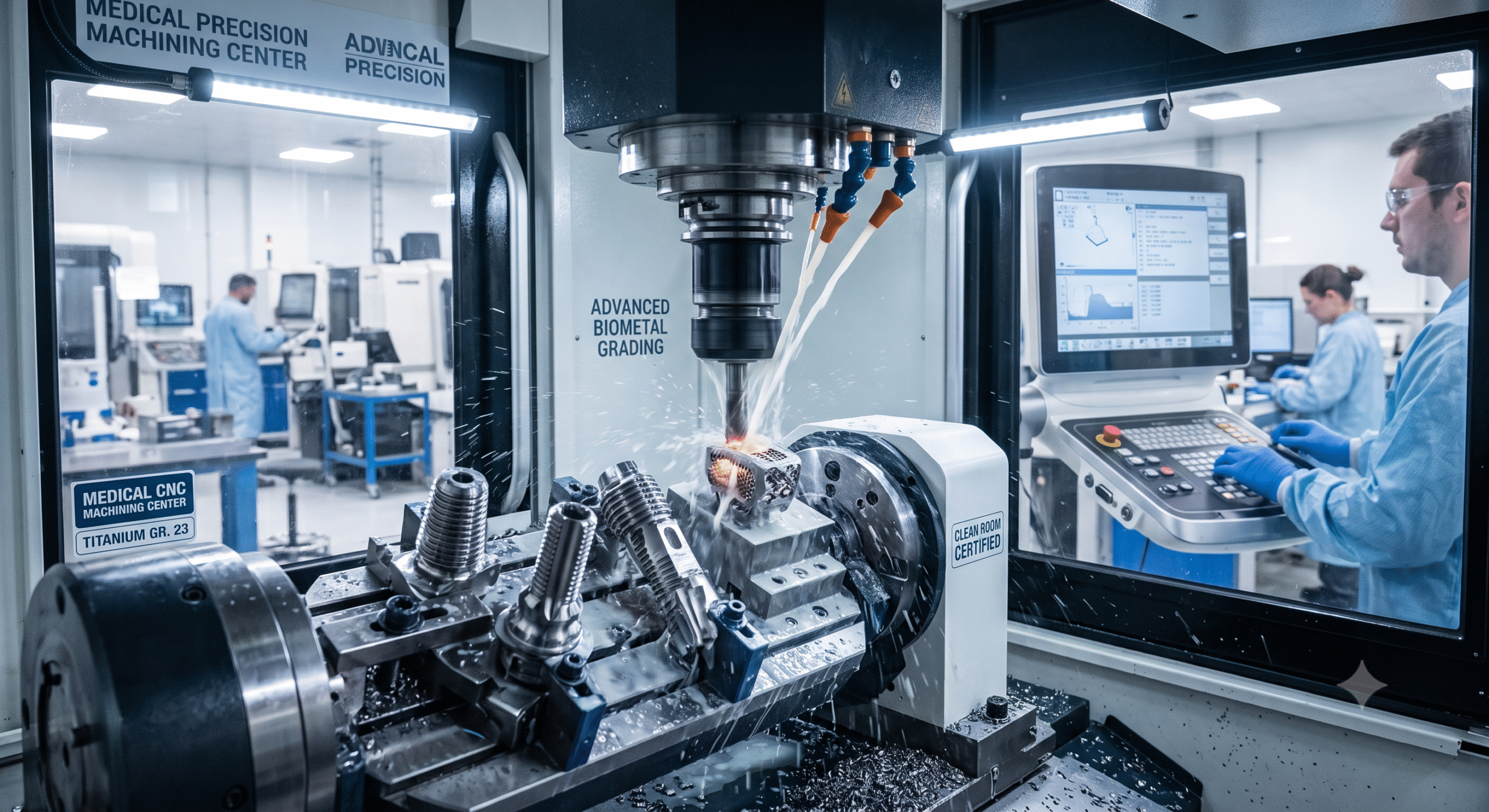
Think about what these parts actually become. A hip implant. A surgical drill guide. A bone screw threaded finer than anything you’d find in a hardware store. Every one of them starts life as a plain bar of biocompatible metal and ends up either living inside a human body or cutting into one. There’s no room anywhere in that chain for a part that’s merely “close enough.” This is where precision manufacturing runs straight into patient safety, and the margin for error is, for all practical purposes, zero.
That single fact raises the bar on everything else. The materials have to be biocompatible and traceable. The tolerances have to be tight and actually verified, not just drawn. And the whole process has to be documented well enough that a regulator can walk in and audit it. I’ve watched how much rides on getting these components right, and that surrounding discipline — more than the cutting itself — is what really separates a medical supplier from a general machine shop.
Quick answer: Medical CNC machining is the precision manufacture of medical components — implants, surgical instruments, and device housings — from biocompatible materials such as titanium, stainless steel, and PEEK. It requires tight tolerances, full material traceability, and quality systems like ISO 13485 to satisfy regulatory and patient-safety requirements.
What Makes Medical Machining Different
The machining part, honestly, isn’t exotic. It’s turning, milling, and Wire EDM — same as any other precision work. What changes is everything wrapped around it. Three demands really define the field.
- Biocompatibility and traceability. Every material has to be safe in the body *and* traceable back to a certified mill batch. If a part ever fails, you need to reconstruct its entire history.
- Validated, repeatable processes. Making one good part proves nothing. You have to prove the process makes good parts every single time, with documented controls so nothing quietly drifts.
- Regulatory documentation. Material certs, inspection records, the whole paper trail — it isn’t paperwork *about* the product, it’s part of the product. A flawless part with an incomplete file can’t be used.
That combination is why medical work carries a premium, and why it belongs with a supplier whose precision machining service is built around quality systems from the ground up rather than bolted on afterward.
Biocompatible Materials for Medical Parts
Material choice here runs backwards from most industries: biocompatibility comes first, then mechanical and sterilization needs. These are the ones you’ll actually see on the floor.
| Material | Key property | Typical use |
| Titânio Ti-6Al-4V | Biocompatible, strong, light | Implants, bone screws, plates |
| CP Titanium (Grade 2/4) | Excellent biocompatibility | Dental, osseointegration |
| 316L stainless steel | Corrosion-resistant, sterilizable | Surgical instruments, trays |
| 17-4 PH stainless | High strength, hardenable | Instruments needing edge retention |
| Cobalt-chrome | Wear-resistant, biocompatible | Joint bearing surfaces |
| PEEK | Radiolucent, bone-like modulus | Spinal cages, trauma parts |
| Titanium alloys (general) | Strength-to-weight, MRI-friendly | Broad implant use |
Titanium owns the implant world — biocompatible, strong, light, and it actually bonds with bone over time. It’s also a pain to machine, cutting slowly and work-hardening as it goes, which is why we gave it its own titanium CNC machining guide. For reusable surgical instruments, 316L stainless is the everyday workhorse; it resists corrosion and survives autoclave cycle after autoclave cycle. And then there’s PEEK, the polymer that keeps surprising people — radiolucent, so it doesn’t fog up an X-ray, with a stiffness close to real bone, which makes it a natural fit for spinal implants.
Standards That Govern Medical Machining
Standards are the spine of medical manufacturing. You can own the best machines on earth and still be legally unable to supply a single device component without the right quality system behind you.
| Padrão | Scope | Why it matters |
| ISO 13485 | Medical device quality management | The baseline QMS for medical suppliers |
| FDA 21 CFR 820 | US device manufacturing regulation | Required to supply the US market |
| ISO 10993 | Biocompatibility testing | Proves materials are body-safe |
| ISO 14971 | Risk management | Governs how risk is assessed and controlled |
| ASTM F136 | Ti-6Al-4V for implants | Material spec for surgical titanium |
ISO 13485 is the ticket in. It’s a quality-management standard written specifically for medical devices — traceability, process validation, documentation, all of it. Sitting next to it, ISO 10993 governs biocompatibility testing, and ASTM specs like F136 pin down exactly what an implant-grade titanium bar is allowed to contain. Meeting any of this is inseparable from a genuinely rigorous garantia de qualidade process — because inspection, documentation, and validation are how you *prove* compliance, one part at a time.
Tolerances and Precision in Medical Parts
Medical parts routinely ask for tolerances tighter than general industry, and the reason is simple: fit inside the body, or between a device and the parts it mates with, leaves you no slack at all.
| Caraterística | Typical medical tolerance | Comparison to general machining |
| Implant mating surfaces | ±0,005 mm | 2–5× tighter |
| Instrument features | ±0,01 mm | Tighter |
| Surface finish (implants) | Ra 0.2–0.4 µm | Much smoother |
| Threads (bone screws) | Class 3B+ | Tighter, verified |
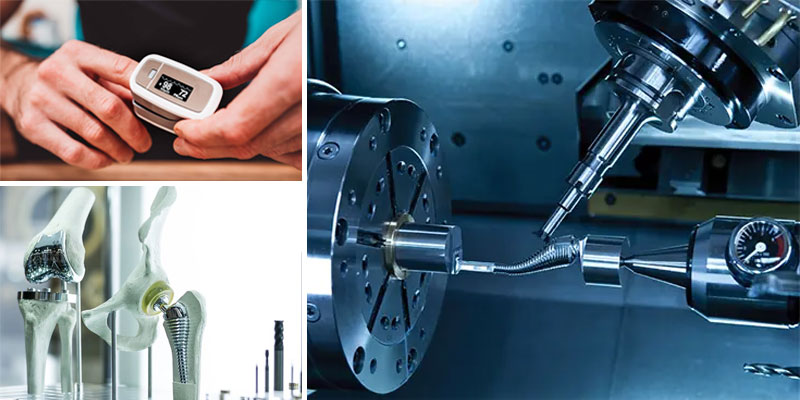
Hitting those numbers consistently usually pulls in multi-axis work, so the part can be reached and finished in fewer setups with less repositioning error creeping in. Complex implant shapes especially benefit from Maquinação CNC de 5 eixos, which tilts the part for rigid, single-setup cutting — and when a few microns decide whether a device seats properly, that rigidity isn’t a nicety. The smooth finishes implants demand feed straight into how they behave in the body, too: a polished bearing surface wears slower and gives bacteria less to cling to.
Sterilization and Post-Machining Considerations
A medical part isn’t usable the moment it comes off the machine. It still has to get through cleaning, sterilization, and often a surface treatment — and the machining decisions you made earlier ripple all the way through those steps. Reusable instruments go through repeated autoclave cycles at high heat and pressure, so both the material and the finish have to take that thermal beating without corroding or degrading. It’s a big part of why 316L stainless, with its low carbon and strong corrosion resistance, keeps winning for instruments that’ll be sterilized hundreds of times.
Cleanliness carries just as much weight. Machining leaves cutting fluid, fine chips, and burrs behind, and all of it has to be gone before the part ever touches tissue. Deburring, passivating the stainless surfaces, validating the cleaning — these are standard steps, not optional extras. Titanium implants often pick up a surface treatment on top of that, like anodizing or micro-texturing to coax bone into integrating, and those treatments assume a known, controlled machined finish waiting underneath. Design a part without thinking about any of this downstream reality and you’ve set a trap for yourself: a geometry that traps fluid or fights off cleaning can fail validation even when every dimension on it is perfect. Planning the whole route, from bar to sterile package, is a good chunk of what separates true medical machining from ordinary precision work.
Real Medical Applications
Machined parts turn up right across the medical field, and CNC gets the call wherever precision, material integrity, and small-batch flexibility all matter at once.
- Orthopedic implants — hip and knee components, bone screws, plates, spinal cages.
- Instrumentos cirúrgicos — forceps, drill guides, cutting tools, handpieces.
- Dental — implants, abutments, prosthetic components.
- Device housings — enclosures for diagnostic and monitoring equipment.
- Prototypes — one-off parts for testing a new device before anyone commits to tooling.
This breadth is really just one slice of a bigger pattern across regulated industries, which we map out in our overview of CNC machining applications across aerospace, medical, and automotive. The common thread is that none of these fields can stomach variability — and machining, kept under proper control, delivers repeatable precision at the volumes medical devices actually run. You can see how that plays out on real components in our estudos de caso.
Perguntas mais frequentes
What materials are used in medical CNC machining?
The most common are titanium and its alloy Ti-6Al-4V for implants, 316L and 17-4 PH stainless steel for surgical instruments, cobalt-chrome for wear surfaces, and PEEK for radiolucent implants like spinal cages. All must be biocompatible, traceable to a certified batch, and able to withstand sterilization.
What standards apply to medical device machining?
The core standard is ISO 13485, a quality-management system specific to medical devices. In the US, FDA 21 CFR 820 governs manufacturing, ISO 10993 covers biocompatibility testing, ISO 14971 handles risk management, and ASTM specs like F136 define implant-grade materials. A supplier generally needs ISO 13485 certification to make device components.
Why is titanium used for medical implants?
Titanium is biocompatible, strong, lightweight, corrosion-resistant, and MRI-compatible, and it integrates directly with bone through osseointegration. Ti-6Al-4V offers the best strength-to-weight ratio for load-bearing implants, while commercially pure titanium is used where maximum biocompatibility matters, such as dental work.
How tight are tolerances for medical parts?
Medical tolerances are typically much tighter than general machining — often ±0.005 mm on implant mating surfaces, two to five times tighter than standard parts. Surface finishes on implants also reach Ra 0.2–0.4 µm. These are achieved with multi-axis machining, sharp tooling, and full dimensional inspection of every critical feature.
Can CNC machining make custom or one-off medical parts?
Yes. CNC machining is well suited to prototypes and low-volume custom parts because it needs no dedicated tooling — the same machine makes one part or a thousand from a program. This makes it ideal for patient-specific implants, device prototypes, and short instrument runs where injection molding or casting would be uneconomical.
About the author
Lewei Precision Engineering Team — Manufacturing engineers at Lewei PrecisionThe Lewei Precision engineering team has spent more than 21 years machining and molding parts for aerospace, medical, automotive, and semiconductor customers across 120-plus countries. Our factory runs 3-axis through 5-axis CNC machining, turning, injection molding, and sheet metal fabrication under ISO 9001:2015, ISO 13485, ISO 14001, and IATF 16949 quality systems. The guidance here reflects what we see on real production floors and in customer DFM reviews every week, not textbook theory. Have a part in front of you? Send us the CAD file and we will tell you exactly how we would make it.
 English
  简体中文
简体中文  Español
  Deutsch (Sie)
  日本語
日本語  Português