
Can ChatGPT make 3D models? Can it generate STL files, create printable designs, or turn a text prompt into a usable 3D object? What tools can work with ChatGPT for 3D modeling, and can AI-generated models be used for professional 3D printing?
Yes, ChatGPT can help create 3D models, but there is an important distinction between generating a 3D model concept, producing model code, and creating a production-ready CAD file. ChatGPT can describe geometry, write scripts for tools such as OpenSCAD or Blender, help modify existing model logic, and guide users through converting and preparing files. However, the final model should be checked for dimensions, geometry, watertightness, wall thickness, tolerances, and manufacturing requirements before it is sent for production.
Can ChatGPT Really Create 3D Models?
ChatGPT is not a traditional CAD program such as SolidWorks, Fusion 360, or CATIA. It does not replace engineering CAD software for every professional modeling task. Instead, it can act as an AI design assistant that helps translate a written idea into geometry instructions, parametric code, modeling steps, or a structured design workflow.
For example, a user could describe a simple enclosure with a specific length, width, height, wall thickness, screw holes, and rounded corners. ChatGPT can turn those requirements into an OpenSCAD script or provide Python-based geometry instructions. The generated result can then be opened in compatible software, reviewed, modified, and exported to a manufacturing format.
This makes ChatGPT particularly useful for simple mechanical parts, brackets, holders, enclosures, adapters, fixtures, educational models, and early-stage prototypes. More complex engineering components still require proper CAD modeling, design validation, and engineering review.
For projects that move from an AI-generated concept to an actual physical component, Lewei Precision’s 3D printing services can be used for prototypes and low-volume production. Lewei lists SLA, HP MJF, SLS, and SLM capabilities and provides specifications for wall thickness, layer height, build size, and dimensional tolerance.
How Does ChatGPT Create a 3D Model?
ChatGPT generally creates 3D geometry indirectly rather than functioning like a conventional interactive CAD workstation. The most practical workflow is to provide detailed design requirements and ask ChatGPT to generate instructions or code for a compatible 3D modeling tool.
A simple workflow looks like this:
Idea → dimensions → AI-generated modeling instructions → CAD/3D software → geometry validation → export → manufacturing
For example, imagine you need a wall-mounted electronics enclosure. Instead of asking only, “Make an enclosure,” provide dimensions such as 120 mm × 80 mm × 40 mm, a 3 mm wall thickness, four mounting holes, a removable cover, and ventilation slots.
ChatGPT can use those requirements to generate an OpenSCAD script. The script can then create the geometry, which you can inspect and adjust. After validation, the model can be exported as STL or another suitable format.
The quality of the result depends heavily on the quality of the instructions. Precise dimensions and functional requirements generally produce a much more useful result than a vague text description.
What Types of 3D Models Can ChatGPT Help Create?
ChatGPT is most effective when the geometry can be clearly described using dimensions, repeated features, geometric relationships, and basic mechanical operations.
| Model Type | ChatGPT Usefulness | Typical Application |
| Brackets | Elevado | Mounting and support parts |
| Simple enclosures | Elevado | Electronics and product prototypes |
| Spacers and washers | Muito elevado | Mechanical assemblies |
| Parametric parts | Elevado | Adjustable engineering designs |
| Simple gears | Moderado | Educational and prototype applications |
| Organic sculptures | Moderado | Concept and creative modeling |
| Complex industrial components | Limited without CAD review | Engineering production |
| Highly detailed freeform surfaces | Limitada | Advanced product and industrial design |
This means ChatGPT is not equally effective for every 3D modeling requirement. A simple cylindrical spacer can be generated using a few dimensions. A turbine component with complex aerodynamic surfaces, tight tolerances, and material-specific requirements requires much more than a text prompt.
For manufacturing, the model must also satisfy the requirements of the selected process. A shape that looks correct on screen may not be printable or machinable.
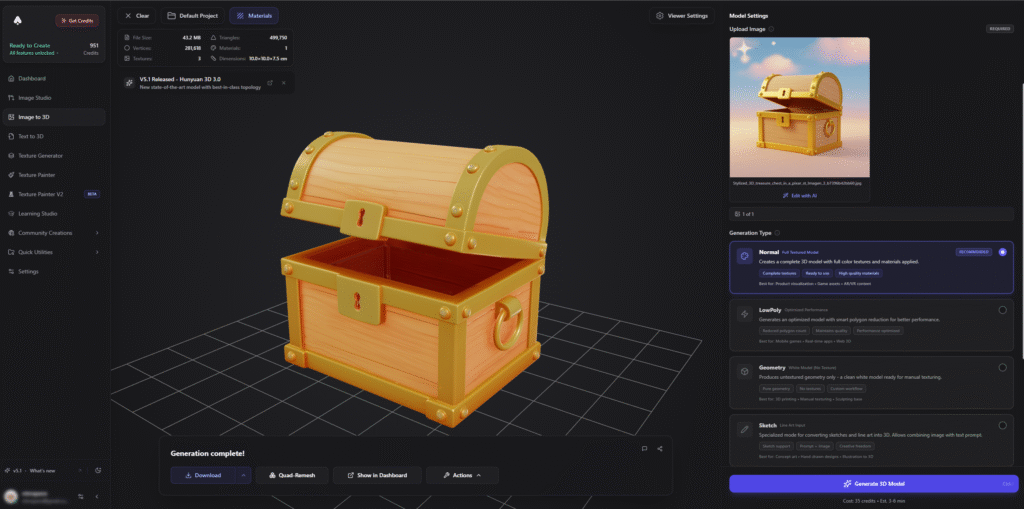
Which Tools Can Be Used With ChatGPT for 3D Modeling?
ChatGPT becomes more useful when paired with dedicated 3D modeling software. The best tool depends on the type of geometry and the required level of control.
OpenSCAD is particularly useful for parametric models because objects can be defined through code. This makes it suitable for brackets, boxes, adapters, mechanical fixtures, and other dimension-driven parts.
Liquidificador is better suited to organic shapes, visual models, artistic objects, and complex mesh manipulation. ChatGPT can help write Python scripts for Blender and explain modeling operations.
Fusion 360, SolidWorks, and similar CAD platforms are more appropriate when engineering drawings, assemblies, parametric features, tolerances, and professional design workflows are required. ChatGPT can assist with modeling logic and troubleshooting, but it should not replace engineering judgment.
The important point is that ChatGPT and CAD software serve different roles. ChatGPT can help generate ideas, logic, scripts, and instructions, while CAD software provides the visual and engineering environment needed to validate the actual geometry.
Can ChatGPT Generate STL Files?
ChatGPT can help generate or prepare information that can ultimately become an STL file, but an STL file is not the same thing as a complete engineering CAD model.
STL represents the surface of a three-dimensional object using a triangular mesh. It is widely used for additive manufacturing because slicing software can convert the mesh into printer instructions.
However, STL has limitations. It does not normally preserve important CAD information such as design history, feature relationships, material specifications, or parametric dimensions.
This is why the workflow matters. If ChatGPT creates a model through OpenSCAD or another modeling environment, the resulting geometry should first be checked before exporting it to STL.
If your design begins in OBJ format, you may also need to convert it to STL depending on your manufacturing workflow. Lewei Precision has a dedicated guide explaining how to convert OBJ to STL, including file differences, conversion methods, and common mesh problems.
What Should You Check Before 3D Printing an AI-Generated Model?
An AI-generated model should never automatically be considered production-ready. A model can look correct visually while containing geometry problems that cause slicing errors, weak areas, incorrect dimensions, or failed prints.
The first check should be scale and dimensions. Confirm that the model uses the intended units and that the exported file has the correct physical size.
Next, check whether the model is watertight. Open surfaces, internal faces, duplicate geometry, non-manifold edges, and inverted normals can cause problems during slicing.
Wall thickness is another important consideration. Extremely thin sections may not print reliably, depending on the selected technology and material. Lewei’s 3D printing specifications show that minimum wall thickness varies between technologies such as SLA, MJF, SLS, and SLM.
You should also inspect overhangs, holes, sharp internal corners, support requirements, tolerances, and part orientation.
For functional components, dimensional validation is even more important. A hole that is modeled at exactly 10 mm may require a different manufacturing strategy if a 10 mm mating component must fit accurately.
ChatGPT 3D Models vs Traditional CAD Modeling
The biggest difference is control. Traditional CAD software provides a structured environment for creating precise features, constraints, assemblies, drawings, and manufacturing documentation. ChatGPT provides language-based assistance and can generate modeling logic much faster.
| Fator | ChatGPT-Assisted Modeling | Traditional CAD |
| Initial concept generation | Muito rápido | Depends on designer |
| Simple parametric models | Excelente | Excelente |
| Engineering constraints | Requires validation | Strong built-in control |
| Complex assemblies | Limited without CAD | Excelente |
| Freeform modeling | Depends on connected software | Excelente |
| Production drawings | Needs CAD software | Standard workflow |
| Design verification | Human/CAD review required | Stronger integrated workflow |
| Manufacturing readiness | Requires DFM review | Better control |
The best approach is often not ChatGPT versus CAD, but ChatGPT plus CAD. AI can reduce the time required to start a design, while CAD software provides the precision and control needed to finish it.
Can AI-Generated 3D Models Be Used for Manufacturing?
Yes, but only after proper engineering and manufacturing validation.
A model created with ChatGPT can become the starting point for a prototype. Once the geometry is validated, the file can be prepared for 3D printing, CNC machining, or another manufacturing process.
The selected process makes a major difference. 3D printing is generally useful for complex geometry, rapid prototypes, customization, and low-volume production. CNC machining is often preferred when tighter dimensional control, specific material properties, or high-quality machined surfaces are required.
Lewei Precision provides both Serviços de impressão 3D e Serviços de maquinagem CNC, allowing a validated digital design to move into different manufacturing workflows. Its CNC service includes engineering review, CAM programming, multi-axis machining, and CMM inspection.
The difference between these processes is explained further in Lewei’s guide to CNC machining vs. 3D printing, which compares the two technologies based on process, materials, accuracy, speed, volume, and cost.
What Are the Main Benefits of Using ChatGPT for 3D Modeling?
The biggest advantage is speed during the early design stage. Instead of starting with a blank CAD workspace, a designer can describe the required object and ask ChatGPT to generate a starting point.
It can also help users who understand the design they need but are less familiar with CAD software. ChatGPT can explain modeling steps in plain language, generate parametric code, identify potential modeling errors, and suggest ways to modify dimensions.
Another benefit is rapid iteration. If a bracket needs a larger hole, thicker walls, additional mounting points, or a different overall dimension, those changes can be described in natural language and translated into updated modeling instructions.
For manufacturers, this can shorten the distance between concept, prototype, testing, and revision.
However, speed should not be confused with engineering accuracy. AI can make incorrect assumptions, misunderstand dimensions, generate invalid geometry, or produce a model that does not satisfy real-world manufacturing constraints.
Is ChatGPT Good Enough for Professional 3D Printing?
ChatGPT can be valuable in professional workflows, but it should not be treated as the final authority for engineering design.
For a prototype bracket, enclosure, fixture, or simple mechanical component, AI-assisted modeling can save significant design time. For safety-critical components, medical devices, aerospace parts, pressure-bearing components, or precision assemblies, professional CAD modeling, engineering review, material selection, tolerance analysis, and inspection remain essential.
The manufacturing provider should also review the final model. Design for manufacturability can identify issues that are not obvious from the digital geometry alone.
For large components, specialized production may also be necessary. Lewei’s large 3D printing guide explains how large-format additive manufacturing can support prototypes and production parts while considering build size, materials, post-processing, and production timelines.
Best Workflow for Using ChatGPT to Create a 3D Model
A practical workflow starts with defining the part instead of immediately asking AI to “make a 3D model.”
Describe the dimensions, intended use, material, required tolerances, mounting points, moving interfaces, wall thickness, and manufacturing method. Ask ChatGPT to identify missing information before generating the model.
Next, generate the model using a suitable environment such as OpenSCAD or Blender. Open the result in the relevant software and inspect the geometry.
After that, validate dimensions and repair mesh problems. Export the appropriate manufacturing file, such as STL when required for 3D printing.
Finally, submit the model for manufacturing review. A professional manufacturer can assess whether the geometry, material, tolerances, orientation, and finishing requirements are suitable for the selected production process.
This workflow combines AI’s speed with engineering validation, which is much safer than sending an unverified AI-generated model directly to production.
Final Answer
Yes, ChatGPT can help create 3D models, especially simple and parametric designs, but it is not a complete replacement for professional CAD software or engineering validation. It can generate modeling scripts, guide users through 3D software, modify design logic, and help prepare models for formats such as STL.
The most effective approach is to use ChatGPT as a 3D modeling assistant, not as the only design tool. Generate the initial geometry with AI, validate it in CAD software, check dimensions and manufacturability, and then send the finalized design to a qualified manufacturing provider.
For prototypes and low-volume production, Lewei Precision’s 3D printing service supports multiple industrial printing technologies and provides manufacturing specifications to help turn validated digital designs into physical parts.
Conclusão
ChatGPT has made 3D modeling more accessible by allowing users to describe designs in natural language and generate modeling logic without starting every project from scratch. Its strongest role is as an assistant that accelerates concept development, parametric modeling, troubleshooting, and design iteration.
For reliable results, the process should continue beyond AI generation. Validate the geometry in CAD software, confirm dimensions and manufacturing requirements, and obtain professional DFM feedback before production.
When the validated design is ready, the next step can be professional 3D printing for prototypes and low-volume parts or Maquinação CNC when the application requires machined materials, tight tolerances, or specific surface finishes. This combination of AI-assisted design and professional manufacturing can make the path from an idea to a physical part faster without removing the engineering checks that quality production requires.
FAQs About ChatGPT and 3D Modeling
Can ChatGPT create an STL file?
ChatGPT can help create the code or modeling instructions needed to produce a 3D object that can later be exported as an STL file. The resulting geometry should be opened in compatible 3D software and checked for scale, mesh errors, wall thickness, and printability before manufacturing.
Can ChatGPT make a 3D model from a text prompt?
Yes. A detailed text prompt can describe dimensions, shape, holes, thickness, curves, and other features. ChatGPT can then generate modeling instructions or code for compatible software. The more precise the input specifications are, the more useful the resulting model is likely to be.
Is ChatGPT better than CAD software for 3D modeling?
No. ChatGPT and CAD software have different strengths. ChatGPT is useful for generating concepts, scripts, explanations, and design logic, while CAD software provides precise geometry control, constraints, assemblies, drawings, and engineering workflows. For professional manufacturing, they work better together than as direct alternatives.
Can ChatGPT create models that are ready for 3D printing?
It can help create models that are suitable for 3D printing, but the model should be validated first. Check scale, wall thickness, watertight geometry, overhangs, supports, tolerances, and the requirements of the selected printing technology before sending the file to production.
What is the best file format for 3D printing?
STL remains a widely used format for 3D printing because it represents the surface geometry as a triangular mesh. However, other formats can preserve more design information depending on the workflow. The correct format depends on the modeling software, slicer, manufacturing provider, and project requirements.
Can ChatGPT create complex mechanical parts?
ChatGPT can assist with complex mechanical designs, but complexity increases the need for professional CAD and engineering validation. Parts involving tight tolerances, complex assemblies, moving interfaces, safety requirements, or critical loads should be designed and reviewed using appropriate engineering software and professional expertise.
Can an AI-generated 3D model be CNC machined?
Yes, if the final geometry is suitable for CNC machining and contains the information required by the manufacturing workflow. CNC machining has different design requirements from additive manufacturing, including tool access, internal features, material selection, tolerances, and workholding. A manufacturing engineer should review the final design before machining.
Sobre o autor
SOBRE O AUTOR
Equipa de Engenharia de Precisão da Lewei — Engenheiros de produção da Lewei Precision. A equipa de engenharia da Lewei Precision conta com mais de 21 anos de experiência na usinagem e moldagem de peças para clientes dos setores aeroespacial, médico, automóvel e de semicondutores em mais de 120 países. A nossa fábrica realiza usinagem CNC de 3 a 5 eixos, torneamento, moldagem por injeção e fabricação de chapas metálicas, em conformidade com os sistemas de qualidade ISO 9001:2015, ISO 13485, ISO 14001 e IATF 16949. As orientações aqui apresentadas refletem o que observamos semanalmente nas linhas de produção reais e nas análises de DFM (Design for Manufacturing) dos clientes, e não a teoria dos livros. Tem uma peça à sua frente? Envie-nos o ficheiro CAD e dir-lhe-emos exatamente como a fabricaríamos.
 English
  简体中文
简体中文  Español
  Deutsch (Sie)
  日本語
日本語  Português