
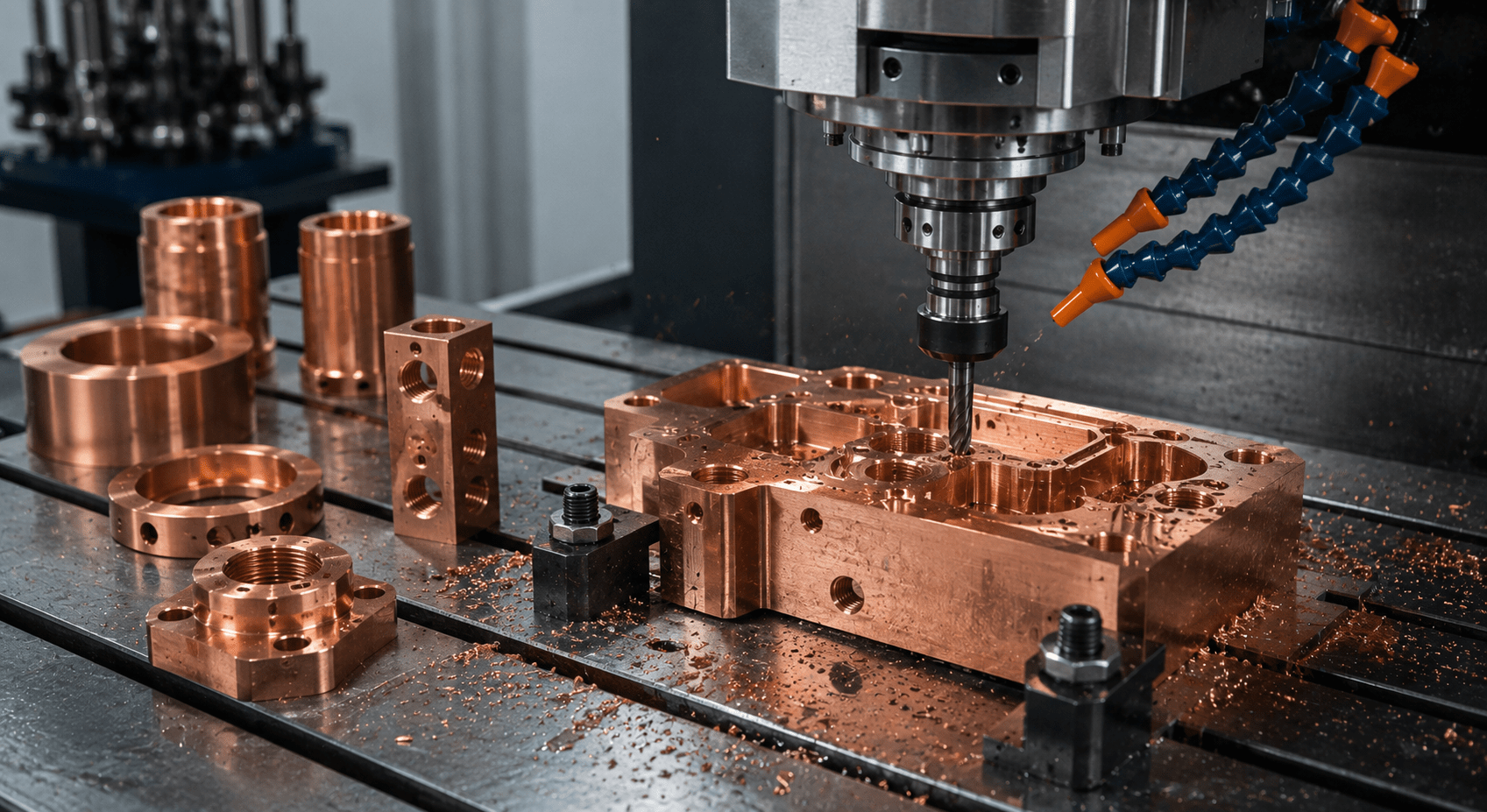
Cut your first piece of pure copper and you will understand why machinists have opinions about it. The chips do not break clean. They smear. A long sticky ribbon of red metal wraps around the tool before you can react, and the surface finish that was supposed to be bright ends up looking like something dragged through wet clay.
That is not a tool problem or a speeds problem. That is copper being copper. Once you understand what is actually happening under the cutting edge, the fixes become obvious and the material stops being a nightmare.
This guide covers the grades that matter for machining, why copper behaves the way it does, where copper parts are actually required, what tolerances you can hold, and how to design parts that do not cost more than they have to.
Resposta rápida: Copper CNC machining turns and mills copper alloys – primarily C101 (oxygen-free) and C110 (ETP) – into busbars, connectors, heat sinks, and RF components. Copper cuts slower than brass due to its ductility but offers electrical and thermal conductivity no other common metal can match.
Why Copper Is Actually Hard to Machine
The problem is not hardness. Hard materials can be difficult, but at least they chip. Copper is so soft and ductile that instead of fracturing into manageable chips, the material stretches under the cutting edge. The tool shears through it but the chip keeps elongating rather than breaking off.
The result is built-up edge: smeared copper that welds onto the tool face and changes the effective cutting geometry mid-pass. Instead of a clean shearing action you get something closer to tearing. Finish suffers, the tool wears in the wrong way, and your chip evacuation goes from a controlled system to a fight.
Three things happen when this goes wrong:
- Built-up edge forms on the tool face and changes your cutting geometry without warning.
- Lascas longas e fibrosas clog flutes and wrap the tool, stopping chip evacuation.
- Heat stays in the workpiece rather than leaving with the chip, which accelerates tool wear.
Sharp, high-rake tooling fixes the root cause. A genuinely sharp tool shears copper rather than dragging through it. Add good coolant flow to flush chips continuously, and sensible speeds that generate heat without burning the edge, and Serviços de maquinagem CNC can produce clean, repeatable copper parts. It is not as forgiving as brass and never will be. But a shop that knows what it is doing gets clean, repeatable parts.
Copper Grades That Matter for CNC Work
Most copper machining comes down to two grades, with a handful of specialty alloys worth knowing about when the application demands something different.
| Grade (UNS) | Common name | Conductivity (%IACS) | Best application |
| C101 | Oxygen-free (OFHC) | 101% | High-purity electrical, vacuum, RF |
| C110 | ETP (electrolytic tough pitch) | 100% | Busbars, wiring, general electrical |
| C145 | Tellurium copper | 90-95% | High conductivity with much better machinability |
| C172 | Beryllium copper | 22% | Springs, tooling, high-strength wear parts |
| C182 | Chromium copper | ~80% | Resistance welding electrodes |
C101 and C110 are the everyday choices for electrical work and they machine almost identically. Both are soft, both throw gummy chips, both are chosen for near-perfect conductivity. The split matters when purity does: C101 is oxygen-free and goes into vacuum equipment, sensitive RF hardware, and high-reliability electrical assemblies where any contamination creates problems. C110 covers general electrical work well and costs less.
The smart pick when the design allows it is C145 tellurium copper. A small addition of tellurium gives copper chip-breaking behavior it does not naturally have, bringing it much closer to how free-machining brass cuts. You give up a few percent of conductivity. For most applications that trade is entirely worth it, and machining time drops noticeably.
C172 beryllium copper is a completely different animal. It is chosen for strength, springiness, and hardness, not conductivity. It machines more like a tough alloy than pure copper and is used for springs, precision wear parts, and tooling that needs copper’s non-sparking character in a harder format.
Where Copper CNC Parts Actually Go
Copper parts almost always trace back to one of two properties: moving electricity or moving heat. Those two requirements narrow the real applications considerably.
- Power electrical: Busbars, terminals, connectors, and contacts in switchgear, motor control centers, and power distribution. Copper wins here because no other material comes close to its conductivity at the current densities these components carry.
- Electronics and RF: Waveguides, cavity resonators, and shielding for RF systems. C101 purity matters when the application is sensitive to contamination. Machined waveguides need dimensional precision that casting cannot reliably deliver.
- Thermal management: Heat sinks and liquid-cooled cold plates for power electronics, rectifiers, and computing hardware. Copper transfers heat faster than aluminum. When the thermal requirement is serious enough, copper is the specification.
- Welding electrodes: Resistance welding electrodes, usually in C182 chromium copper or C172 beryllium copper where the electrode must hold shape under repeated clamping pressure and heat cycling.
- Vacuum and scientific: Oxygen-free copper for UHV chambers, particle accelerator hardware, and MRI components where purity and outgassing limits are strict.
The common thread is that no cheaper metal does the job adequately. Aluminum conducts electricity at about 61% of copper’s level and heat at roughly 60%. For applications where that gap matters, copper is not a preference. It is the only answer.
Tolerances and Surface Finish on Copper
Copper holds dimensional tolerance well. The challenge is not dimensional accuracy. It is surface quality and burr formation.
| Caraterística | Achievable tolerance | Notas |
| Turned OD | ±0,02mm | Stable with sharp tooling |
| Milled features | ±0.03mm | Tool sharpness is critical for clean edges |
| Bored holes | ±0,02mm | Good results with high-rake boring bars |
| Surface finish (as-machined) | Ra 0.8-1.6 µm | Requires fresh tooling |
| Burrs | Expect them | Budget a deburring step in every copper job |
Two things matter in practice. First, tool sharpness: a fresh high-rake cutter produces a nearly bright surface on copper, while a tool that has been running all day tears it. With copper you do not run tools until they fail. You change them on a schedule.
Second, deburring is almost always necessary. Copper’s ductility means burrs form on every edge and they hold on. Design your parts with accessible edges and include a deburring step in the quote. Parts where this is not accounted for end up costing more in secondary operations than the machining itself.
Design Tips That Keep Copper Costs Under Control
Copper machining will always cost more than brass or aluminum. Smart design keeps the premium reasonable.
- Spec C145 when conductivity allows it. If your application can tolerate a drop from 100% to 90-95% IACS, tellurium copper will cut your machining time noticeably. It is the biggest single cost lever available with copper parts.
- Do not over-tighten tolerances. Copper holds precision well, which tempts people to call out tight tolerances across the whole part. Reserve them for mating and sealing surfaces only.
- Give generous internal radii. Sharp internal corners force small, slow tools — and in a gummy material that compounds the problem. Match your corner radii to standard cutter sizes, the same logic that applies to design rules for machined parts generally.
- Plan for deburring. Do not design a copper part and assume it comes off the machine clean. Design edges to be accessible and include a deburring step rather than treating it as a surprise at delivery.
- Keep walls reasonable. Copper’s ductility means thin features deflect more than you would expect. Do not design to the ragged edge of what is physically possible.
- Batch it. Setup is a one-time cost. Copper’s slower cutting makes volume discounts even more worthwhile than usual. If you can order in batches, do it.
Copper vs. Brass vs. Aluminum
The question comes up constantly. Here is the honest answer.
Brass is the right choice when you want decent conductivity but also care about machining cost. Brass cuts roughly three times faster than pure copper and costs less per kilogram. If your part does not strictly need maximum conductivity, brass saves real money and produces a better surface without extra effort. Our brass CNC machining guide covers the grades and applications in detail.
Aluminum conducts electricity at about 61% of copper’s level and heat at roughly 60%. It is much lighter and far cheaper to machine. For thermal management where the heat load is manageable, aluminum cold plates are common. For high-current busbars, aluminum gets used but at larger cross-sections to compensate for the lower conductivity. Materiais de maquinagem CNC cover aluminum, copper, brass, and other options for different performance requirements.
Copper wins when the application cannot tolerate the performance gap. When the busbar has to fit in a specific space and carry 1000A. When the waveguide dimension is set by the wavelength. When the heat sink has to move a specific power density into a constrained volume. In those cases copper is not a preference. It is the spec, and you machine it because nothing else passes the requirement.
Perguntas mais frequentes
Is copper hard to CNC machines?
Harder than it looks. Copper is soft and extremely ductile, so instead of breaking into chips it forms a long stringy swarf that wraps the tool and leaves a torn finish if the setup is not right. It is manageable with sharp high-rake tooling, good chip evacuation, and sensible speeds, but it cuts slower than brass and almost always needs deburring.
What is the difference between C101 and C110 copper?
Both are high-conductivity coppers that machine almost identically. C101 is oxygen-free (OFHC) with very high purity, used for vacuum systems, RF hardware, and high-reliability electrical assemblies where purity matters. C110 is electrolytic tough pitch (ETP), the standard choice for busbars, terminals, and general electrical work. C101 costs more; C110 covers most everyday needs.
Which copper is easiest to machine?
C145 tellurium copper by a significant margin. A small tellurium addition gives it chip-breaking behavior similar to free-machining brass while keeping around 90-95% conductivity. If the application can tolerate that small drop, C145 cuts machining time and cost noticeably.
What are copper CNC parts used for?
Primarily: busbars, terminals, and connectors in power systems; waveguides and shielding in RF electronics; heat sinks and cold plates in thermal management; and resistance welding electrodes. Oxygen-free copper also goes into vacuum and scientific equipment.
Does copper need finishing after machining?
Almost always needs deburring because copper’s ductility produces stubborn burrs on every edge. The as-machined surface finish depends heavily on tool sharpness — a fresh tool leaves a bright surface, a worn tool tears it. Additional finishing like plating is added only for corrosion protection or solderability, not by default.
________________________________________
Sobre o autor
Lewei Precision Engineering Team is a manufacturing writer and CNC process specialist with hands-on experience across turning, milling, and material selection for precision components. He has helped buyers and design engineers quote and produce thousands of machined parts, and writes practical, engineer-first guides that help teams match material and process to the real requirement the first time.
 English
  简体中文
简体中文  Español
  Deutsch (Sie)
  日本語
日本語  Português