
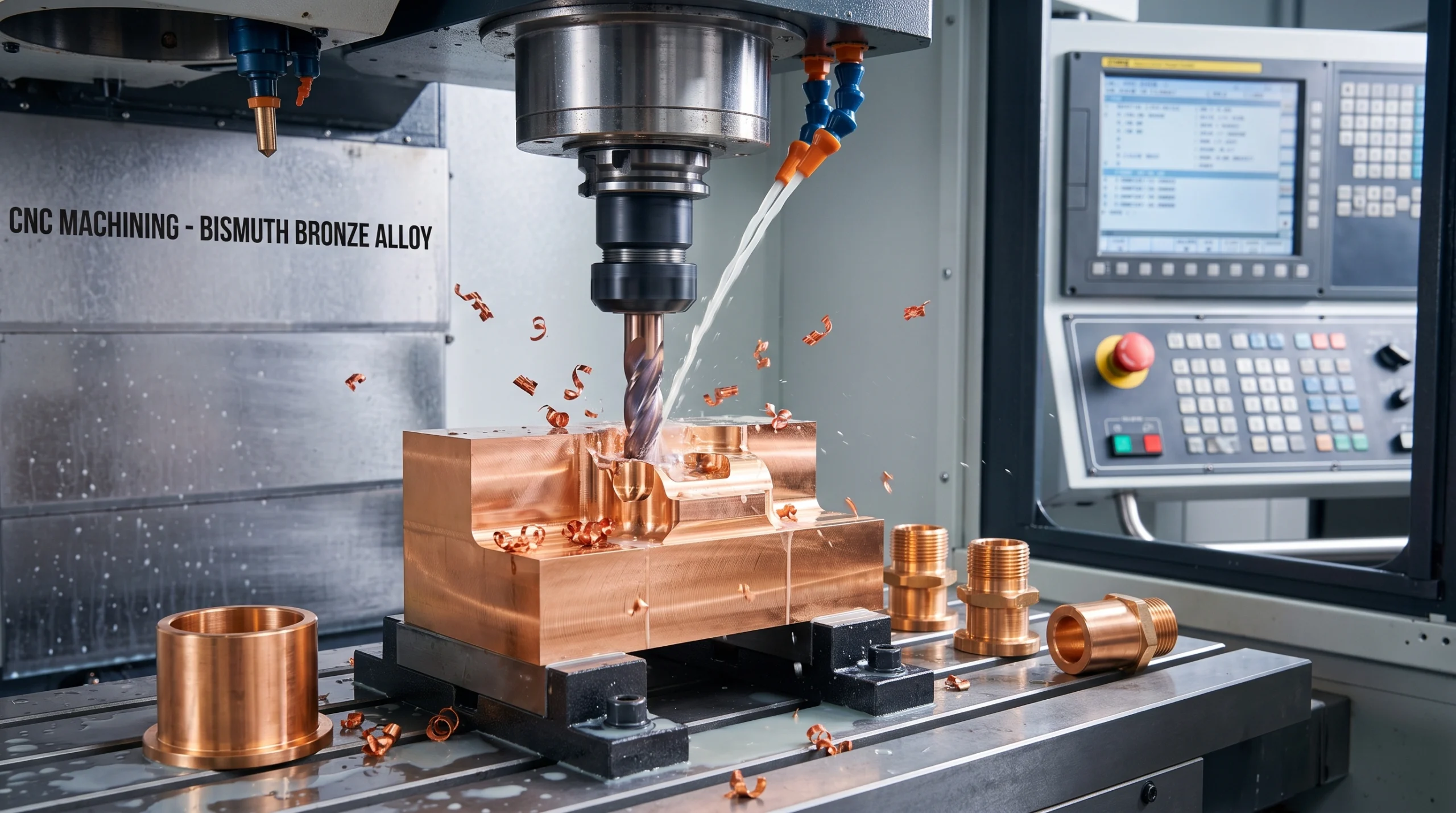
What are the main properties of bismuth bronze, and why is this copper-based alloy increasingly considered for lead-free plumbing, bearings, bushings, valves, fittings, and precision-machined components? How strong is bismuth bronze, how well does it resist corrosion, and is it easy to machine compared with other bronze alloys?
Bismuth bronze is a lead-free copper alloy family designed to provide a useful combination of machinability, corrosion resistance, strength, wear performance, and suitability for applications where traditional leaded bronze may not meet modern requirements. Common lead-free bismuth bronze grades include C89320, C89833, and C89835, with different grades selected according to the required mechanical performance and application.
What Is Bismuth Bronze?
Bismuth bronze is a copper-based alloy that uses bismuth as an alternative to lead in specific bronze compositions. Traditional leaded bronze benefited from lead because it improved machinability and acted as a solid lubricant during cutting. Bismuth can provide similar machining benefits while helping manufacturers meet lead-reduction requirements for applicable products.
This makes bismuth bronze particularly relevant to components used around potable water, plumbing systems, valves, fittings, bearings, and other applications where material composition and regulatory requirements matter.
The term “bismuth bronze” does not describe one single chemical composition. Different grades contain different proportions of copper, tin, bismuth, and other alloying elements. Therefore, engineers should always select the grade based on the application’s mechanical, environmental, regulatory, and manufacturing requirements rather than treating all bismuth bronzes as identical.
For a broader understanding of lead-free bronze families, Lewei Precision’s guide on lead-free bronze alloys compares bismuth bronze with silicon bronze and aluminum bronze and explains where different grades are appropriate.
Main Properties of Bismuth Bronze
The most important properties of bismuth bronze include good machinability, corrosion resistance, moderate-to-good strength, wear resistance, dimensional stability, and suitability for lead-free applications. Its exact performance varies considerably by grade.
| Property | Typical Characteristic | Why It Matters |
| Base metal | Copper-based alloy | Provides conductivity and corrosion resistance |
| Machinability | Good | Supports efficient CNC machining |
| Corrosion resistance | Good to excellent | Useful in water and marine environments |
| Strength | Moderate to high, depending on grade | Determines load-bearing capability |
| Wear resistance | Good for suitable grades | Useful for bushings, bearings, and moving parts |
| Lead content | Designed for lead-free applications | Important for regulated products |
| Thermal conductivity | Generally good compared with many steels | Useful for heat-transfer applications |
| Appearance | Copper-bronze color | Suitable for functional and decorative components |
These properties should be treated as general characteristics rather than universal values. Grade, heat treatment, casting condition, product form, and manufacturing process can all affect final performance.
Good Machinability
One of the most important advantages of bismuth bronze is machinability. Bismuth is used in some lead-free bronze compositions to retain favorable cutting behavior without relying on the higher lead levels found in older bronze alloys.
During CNC machining, good machinability can help produce cleaner chips, reduce cutting difficulty, and support efficient production. This is especially valuable when a component contains multiple holes, grooves, threads, pockets, or other detailed features.
However, “easy to machine” does not mean that every bismuth bronze grade can be processed using exactly the same parameters. Cutting speed, feed rate, tooling, workholding, coolant, and tool geometry should be selected according to the specific alloy and part geometry.
For manufacturers producing precision bismuth bronze components, CNC machining services can support milling, turning, drilling, threading, and complex multi-axis operations. Lewei Precision states that its CNC workflow includes engineering review, CAM programming, multi-axis machining, and CMM inspection.
Corrosion Resistance
Bismuth bronze offers good corrosion resistance, which is one reason copper-based alloys are widely used in water-handling and marine-related applications.
Unlike ordinary carbon steel, copper alloys do not develop the same type of red rust. Instead, copper-based materials can develop surface oxidation or patina over time. The behavior depends on the alloy and environmental conditions.
This corrosion resistance can make bismuth bronze suitable for valves, fittings, bushings, and components exposed to moisture. The actual resistance should still be evaluated against the specific water chemistry, chemicals, temperature, pressure, and service environment.
For potable-water applications, material compliance should be confirmed for the specific alloy and product rather than assumed from the general term “bismuth bronze.” Lewei Precision’s lead-free bronze guide explains that bismuth bronze grades such as C89320, C89833, and C89835 are used as lead-free alternatives in relevant applications.
Strength and Mechanical Performance
Bismuth bronze provides useful mechanical strength, but strength varies substantially between grades. Engineers should therefore avoid using one generic tensile-strength value for every bismuth bronze alloy.
The required mechanical performance depends on whether the component is carrying a static load, experiencing repeated movement, resisting wear, or simply functioning as a corrosion-resistant fitting.
For example, a low-load plumbing component has different requirements from a heavily loaded industrial bushing. The latter may require a bronze alloy with higher strength, hardness, and wear resistance.
This is why grade selection should begin with the component’s actual service conditions. Load, temperature, lubrication, contact pressure, speed, and expected service life should all be considered before selecting the material.
Wear Resistance
Bismuth bronze can provide useful wear performance, particularly in applications involving sliding or rotating contact. This makes suitable grades relevant to bushings, bearings, gears, valve components, and other mechanical parts.
However, wear resistance is not determined by alloy name alone. Surface pressure, lubrication, mating material, operating speed, temperature, surface finish, and alignment can have a major effect on component life.
For a bushing, for example, the correct bronze grade must be matched with the shaft material, operating load, lubrication conditions, and expected movement.
In precision manufacturing, these considerations should be incorporated into the engineering review before machining begins.
Thermal and Electrical Conductivity
Because bismuth bronze is primarily copper-based, it retains useful thermal and electrical conductivity compared with many ferrous engineering materials.
Copper is naturally an excellent conductor, although alloying elements such as tin and bismuth reduce conductivity compared with pure copper. The resulting balance can still be useful where moderate conductivity is combined with mechanical strength and corrosion resistance.
This property can be relevant to components that experience heat transfer or require some degree of electrical conductivity. However, if maximum electrical or thermal conductivity is the primary design requirement, engineers should compare bismuth bronze directly with copper and specialized copper alloys.
Material selection should therefore be based on the complete set of requirements rather than one property.
Lead-Free Characteristics
The lead-free characteristic is one of the reasons bismuth bronze has become important in modern manufacturing.
Traditional leaded copper alloys used lead to improve machinability and wear characteristics. Regulatory requirements have reduced the acceptable lead content for certain products, particularly components associated with drinking-water systems.
Lewei Precision’s published lead-free bronze guide explains that the U.S. Reduction of Lead in Drinking Water Act established a 0.25% weighted-average lead limit for wetted surfaces of applicable pipes, fittings, and fixtures. It also identifies bismuth bronze as a major lead-free replacement family.
However, “lead-free” should always be understood in the context of the applicable regulation and product. Manufacturers should obtain material documentation and verify the exact grade and compliance requirements for the intended market.
Dimensional Stability
Dimensional stability is important when bismuth bronze is used for precision components.
A material’s ability to maintain its dimensions during manufacturing and service affects how well a finished component fits with mating parts. This becomes particularly important for bushings, valve components, threaded fittings, and precision mechanical assemblies.
Machining strategy also influences dimensional accuracy. Tool deflection, thermal effects, workholding, material condition, and finishing operations can all affect the final dimensions.
For precision applications, Lewei Precision uses CMMs, optical scanners, digital micrometers, and GD&T verification as part of its inspection process. Its CNC machining service states that critical dimensions can be inspected and documented according to project requirements.
Surface Finish and Appearance
Bismuth bronze can provide an attractive copper-based appearance and can be finished for both functional and visual applications.
The required surface finish depends on the component’s purpose. A bearing or bushing may require a controlled functional surface, while a visible architectural or decorative component may require polishing or another cosmetic treatment.
For CNC-machined parts, surface finish is influenced by cutting parameters, tool condition, tool geometry, material behavior, machine rigidity, and post-processing.
Lewei Precision’s CNC machining service reports surface-roughness measurement capabilities ranging from Ra 3.20 to 0.8 μm for applicable parts and projects.
Bismuth Bronze Grades and Their Properties
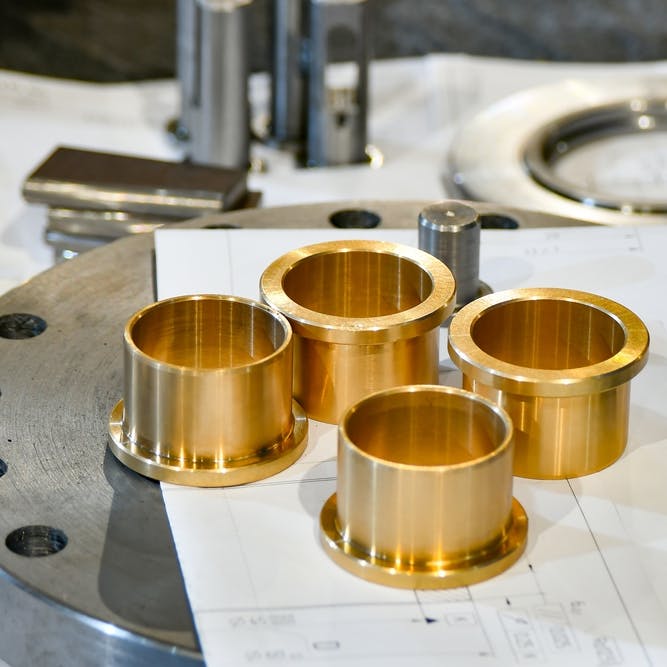
Not all bismuth bronze grades are interchangeable. Three grades commonly discussed in lead-free bronze applications are C89320, C89833, and C89835.
C89833 is associated with applications where manufacturers are looking for a lead-free alternative to C83600 red brass. C89835 is used as a lead-free alternative for applications traditionally served by C93200 bearing bronze. C89320 is another bismuth-containing lead-free copper alloy used for suitable applications.
| Bismuth Bronze Grade | General Position | Typical Application Direction |
| C89320 | Lead-free bismuth-containing bronze | Fittings and engineered components |
| C89833 | Lead-free replacement for C83600-type applications | Valves, fittings, water-related components |
| C89835 | Lead-free replacement for C93200-type applications | Bearings, bushings, mechanical components |
Exact chemical composition and mechanical requirements should always be confirmed using the applicable material standard and supplier documentation.
Bismuth Bronze vs. Other Bronze Alloys
Bismuth bronze is only one category within the larger bronze family. Aluminum bronze can provide higher strength and excellent wear resistance, while silicon bronze is known for corrosion resistance and useful strength.
The best material depends on the application.
Bismuth bronze can be attractive when machinability and lead-free requirements are important. Aluminum bronze may be more appropriate for high-load components. Silicon bronze can be a strong candidate for marine environments and applications requiring corrosion resistance.
Lewei Precision’s lead-free bronze guide compares these families and notes that aluminum bronze grades such as C95400, C95500, and C95900 are suited to demanding load and wear applications, while silicon bronze grades such as C87600 and C87850 provide another lead-free option.
Is Bismuth Bronze Easy to CNC Machine?
Yes, suitable bismuth bronze grades are generally considered machinable and can be processed using CNC milling and turning. The presence of bismuth is intended, in part, to improve cutting behavior compared with some other lead-free copper alloys.
The machining process still requires appropriate tooling and parameters. Engineers should consider the alloy grade, part geometry, wall thickness, feature size, tolerance, surface-finish requirement, and production volume.
For rotational components such as bushings, shafts, rings, and fittings, CNC turning services can be particularly suitable. Lewei Precision’s turning service supports custom metal and plastic parts and lists general and precision tolerance capabilities based on drawing and GD&T requirements.
For components requiring pockets, slots, holes, complex profiles, or multiple faces, CNC milling may be more appropriate. Lewei Precision supports 3-axis, 4-axis, and 5-axis milling for different part geometries.
What Factors Affect Bismuth Bronze Performance?
The performance of a bismuth bronze component depends on much more than the material label. Alloy grade, manufacturing condition, heat treatment where applicable, part geometry, machining quality, surface finish, operating environment, and load all influence final performance.
For this reason, engineers should define the required properties before ordering material. If the component will operate in water, corrosion resistance and regulatory compliance may be priorities. If it will function as a bushing, wear resistance, hardness, load, and lubrication may matter more.
The manufacturing process should then be selected around those requirements.
Conclusion
Bismuth bronze offers a useful combination of properties that makes it relevant to modern engineering and manufacturing. Its key advantages include good machinability, corrosion resistance, useful strength, wear performance, dimensional stability, and suitability for many lead-free applications.
However, there is no single set of properties that applies equally to every bismuth bronze grade. C89320, C89833, and C89835 serve different application requirements, so material selection should be based on the component’s environment, loading conditions, regulatory requirements, machining process, and expected service life.
For manufacturers producing bismuth bronze components, CNC process selection is equally important. Milling, turning, inspection, surface finishing, and tolerance control all contribute to the performance of the finished part. Lewei Precision provides custom CNC machining services for metal components and uses engineering review, multi-axis machining, and dimensional inspection to support precision manufacturing.
Understanding the material before machining helps engineers make better decisions about grade selection, tolerances, tooling, finishing, and production requirements. Bismuth bronze is not simply a replacement for traditional leaded bronze. When the correct grade is selected for the right application, it can provide a practical balance between machinability, corrosion resistance, mechanical performance, and modern material-compliance requirements.
Frequently Asked Questions About Bismuth Bronze
What are the main properties of bismuth bronze?
The main properties include good machinability, corrosion resistance, useful mechanical strength, wear resistance, copper-based thermal and electrical conductivity, and suitability for many lead-free applications. Exact properties depend on the grade.
Is bismuth bronze stronger than brass?
It depends on the specific grades being compared. Bismuth bronze and brass have different compositions and mechanical properties. Engineers should compare the exact material specifications, tensile strength, yield strength, hardness, and application requirements.
Is bismuth bronze corrosion resistant?
Yes. Bismuth bronze generally offers good corrosion resistance, making suitable grades useful for water-related, marine, and industrial applications. Actual performance depends on the alloy and service environment.
Is bismuth bronze easy to machine?
Yes. Bismuth is used in certain bronze compositions to improve machinability and provide cutting behavior suitable for CNC manufacturing. The correct cutting parameters still depend on the grade and part design.
Is bismuth bronze lead-free?
Bismuth bronze is commonly used as a lead-free bronze option, but the exact lead content and regulatory compliance must be confirmed for the specific grade and application. Lead-free requirements can vary by market and product category.
What is bismuth bronze used for?
Common applications include valves, fittings, bushings, bearings, gears, and other components where corrosion resistance, machinability, mechanical performance, and lead-reduction requirements are important.
About the Author
ABOUT THE AUTHOR
Lewei Precision Engineering Team — Manufacturing engineers at Lewei PrecisionThe Lewei Precision engineering team has spent more than 21 years machining and molding parts for aerospace, medical, automotive, and semiconductor customers across 120-plus countries. Our factory runs 3-axis through 5-axis CNC machining, turning, injection molding, and sheet metal fabrication under ISO 9001:2015, ISO 13485, ISO 14001, and IATF 16949 quality systems. The guidance here reflects what we see on real production floors and in customer DFM reviews every week, not textbook theory. Have a part in front of you? Send us the CAD file and we will tell you exactly how we would make it.
 English
  简体中文
简体中文  Español
  Deutsch (Sie)
  日本語
日本語  Português