
CNC turning suppliers serving the U.S. market in 2026 include LEWEI Precision, Protolabs, Xometry, Fictiv, Pioneer Service, Cox Manufacturing, Owens Industries, Wisconsin Metal Parts, Petersen Precision, and Vescio Manufacturing.
Finding the right CNC turning manufacturers in USA depends on much more than searching for the largest machine shop or the lowest quoted price.
A supplier that is ideal for a 20-piece aluminum prototype may not be the right choice for 100,000 Swiss-turned stainless steel pins. Likewise, a company equipped for conventional two-axis turning may not be suitable for a component requiring live tooling, cross-holes, milled flats, tight concentricity, complex threads, or several operations completed in a single setup.
For U.S. engineers, product developers, OEMs, and procurement teams, the strongest CNC turning manufacturers are therefore those whose machines, quality systems, material experience, production model, inspection capability, and capacity match the actual part.
This guide compares these companies specifically from a CNC turning perspective and explains what to evaluate before sending an RFQ.
Compare Top CNC Turning Manufacturers in USA
| CNC Supplier | Main Turning Strength | Best Fit |
| Protolabs | Fast CNC turning with live tooling | Rapid prototypes and quick-turn parts |
| Xometry | Large distributed manufacturing network | Flexible prototype-to-production sourcing |
| Fictiv | Managed manufacturing and engineering support | Product development and supply-chain programs |
| Pioneer Service | CNC Swiss machining | Small, intricate turned components |
| Cox Manufacturing | High-volume Swiss and multi-axis turning | Large-volume precision production |
| Owens Industries | Precision CNC lathe machining | Complex, tight-tolerance work |
| Wisconsin Metal Parts | Multi-axis CNC turning with live tooling | Production parts and integrated metal manufacturing |
| Petersen Precision | High-volume Swiss-style CNC turning | Large-volume precision turned metal parts |
| Vescio Manufacturing | Precision CNC and mill-turn machining | Aerospace, defense, and demanding production |
| LEWEI Precision | Precision CNC turning, live tooling, Swiss-style turning, and mill-turn machining | U.S. buyers sourcing prototypes and production parts internationally |
Each supplier has a different manufacturing model, equipment mix, ideal quantity range, and technical focus.
1. Protolabs
Protolabs is one of the most recognizable rapid digital manufacturing providers serving American product developers and engineering teams.
Its CNC turning service is particularly suitable when speed is a major purchasing factor.
Protolabs states that its CNC turning process uses lathes with live tooling, allowing more than conventional outside- and inside-diameter turning. Features such as axial holes, radial holes, flats, grooves, and slots can also be produced within the turning workflow. It advertises turned prototypes and production parts with lead times as fast as one day.
2. Xometry
Xometry uses a different manufacturing model.
Rather than operating solely as a traditional machine shop, its platform connects buyers to a large manufacturing network. Xometry currently states that its network includes more than 5,000 shops, including companies equipped with CNC turning centers and lathes.
This model can be useful when a procurement team needs access to different machines, materials, capacities, or production locations without qualifying a new independent shop for every job.
Its CNC turning services support both metal and plastic parts and are aimed at applications ranging from rapid prototypes to production quantities.
3. Fictiv
Fictiv combines digital manufacturing sourcing with engineering and supply-chain support.
Its CNC turning service is intended for cylindrical parts such as shafts, pins, spacers, and other components with rotational symmetry. The company also discusses the use of live tooling for parts that need features beyond conventional turning.
This makes Fictiv particularly relevant to product development organizations that want a managed manufacturing process rather than simply locating an individual machine shop.
4. Pioneer Service
Pioneer Service is a U.S.-based precision manufacturing company located in Illinois and has a strong focus on CNC Swiss machining.
Swiss turning is particularly useful for small-diameter, slender, or intricate components that benefit from support close to the cutting zone.
Compared with conventional turning, a Swiss-type machine can be a better manufacturing choice for certain small precision parts, especially when several features must be produced efficiently during one production cycle.
Pioneer Service specifically positions itself around CNC Swiss machining and precision components.
5. Cox Manufacturing
Cox Manufacturing is another supplier with a major emphasis on CNC turning and Swiss machining.
Its published capabilities include two-axis turning, multi-axis turning centers, and CNC Swiss turning. Cox states that some of its multi-axis equipment provides up to 12 axes of motion and describes its operation as being oriented toward significant production capacity.
This makes the company particularly interesting to buyers sourcing high-volume precision components.
6. Owens Industries
Owens Industries offers precision CNC lathe and turning services for customers requiring more technically demanding components.
The company describes its CNC turning capability as supporting complex components requiring tight tolerances, concentricity, and repeatability, including both shorter runs and production work.
This makes Owens different from rapid digital services focused primarily on quoting convenience and speed.
7. Wisconsin Metal Parts
Wisconsin Metal Parts operates CNC turning alongside other metal manufacturing processes.
Its current published CNC capabilities include turning with live tooling and multi-axis equipment. The company lists CNC turning equipment with sub-spindles, bar feeders, live tooling, and Y-axis capabilities, making it suitable for components requiring more than simple OD turning.
This can be beneficial when a customer needs turned parts integrated with additional manufacturing processes.
8. Petersen Precision
Petersen Precision is especially relevant for high-volume CNC turning.
The California manufacturer describes its operation as focused on large production quantities and uses Swiss-style CNC lathes for precision turned metal components. Its published CNC turning information discusses automated production, bar-stock machining, DFM support, and inspection with coordinate measuring machines.
This is a noticeably different use case from rapid prototype suppliers.
9. Vescio Manufacturing
Vescio Manufacturing provides precision CNC machining from U.S. facilities and describes capabilities that include CNC turning and advanced mill-turn operations.
The company operates manufacturing facilities in California and Illinois, as well as an additional operation in Mexico, and focuses heavily on precision industries such as aerospace and defense.
10. LEWEI Precision
LEWEI Precision is a CNC machining manufacturer based in Dongguan, China that serves U.S. and international customers with custom CNC turning, milling, and related precision manufacturing services.
Its CNC turning services support prototype and production parts in metals and engineering plastics. Published capabilities include conventional CNC turning, live tooling, Swiss-style turning, and mill-turn machining for components that combine rotational and milled features.
Where LEWEI Precision Fits Best
LEWEI can be a practical option for:
- Custom CNC turned parts
- Prototype and production orders
- Parts requiring live tooling
- Swiss-style turned components
- Mill-turn parts with both rotational and milled features
- Metal and engineering plastic components
- U.S. buyers comparing domestic and international CNC sourcing options
Because LEWEI is not a U.S.-based manufacturer but work for U.S. peoples, buyers should compare total landed cost, freight, lead time, inspection documentation, communication requirements, and any domestic-sourcing restrictions alongside machining price.
For projects where international sourcing is acceptable, LEWEI Precision provides a direct alternative for buyers seeking precision CNC turning from prototype through production.
What Is CNC Turning?
CNC turning is a subtractive machining process in which the workpiece rotates while cutting tools remove material.
This makes the process particularly efficient for components dominated by cylindrical or rotational geometry.
Common CNC turned parts include:
- Shafts
- Pins
- Bushings
- Sleeves
- Spacers
- Rollers
- Fittings
- Nozzles
- Connectors
- Valve components
- Threaded adapters
- Fasteners
- Knobs
- Hydraulic components
Modern CNC turning centers can perform considerably more than basic turning.
With live tooling, sub-spindles, Y-axis movement, and mill-turn configurations, a supplier can sometimes complete drilled holes, slots, flats, threads, and milled features without moving the component to a separate milling machine.
For a deeper look at the process, materials, tolerances, finishes, and manufacturing capabilities, review LEWEI Precision’s CNC turning services.
LEWEI states that its CNC turning capabilities include metal and plastic parts, live-tool machining, prototyping and production, and tight-tolerance work according to drawing requirements. Its service page also describes Swiss-style turning and mill-turn capability for parts combining rotational and milled features.
CNC Turning vs. Swiss CNC Machining
The terms are sometimes used interchangeably, but the processes are not identical.
Conventional CNC Turning
In a conventional CNC lathe, stock is generally held in a chuck while the unsupported section of the workpiece extends toward the cutting tool.
It works extremely well for a wide range of:
- Shafts
- Housings
- Bushings
- Flanges
- Fittings
- Threaded parts
Swiss CNC Machining
A Swiss-type machine uses a guide bushing to support the material close to where cutting occurs.
This configuration can be beneficial for small or slender components where deflection would otherwise become a problem.
Swiss turning is commonly considered for:
- Small-diameter shafts
- Medical components
- Precision pins
- Electrical contacts
- Connectors
- Miniature fasteners
- Long slender components
However, choosing Swiss machining purely because it sounds “more precise” is a mistake.
The most economical process depends on geometry, stock diameter, quantity, tolerances, cycle time, required tooling, and the actual machines available.
What Makes a Good CNC Turning Manufacturer in U.S.?
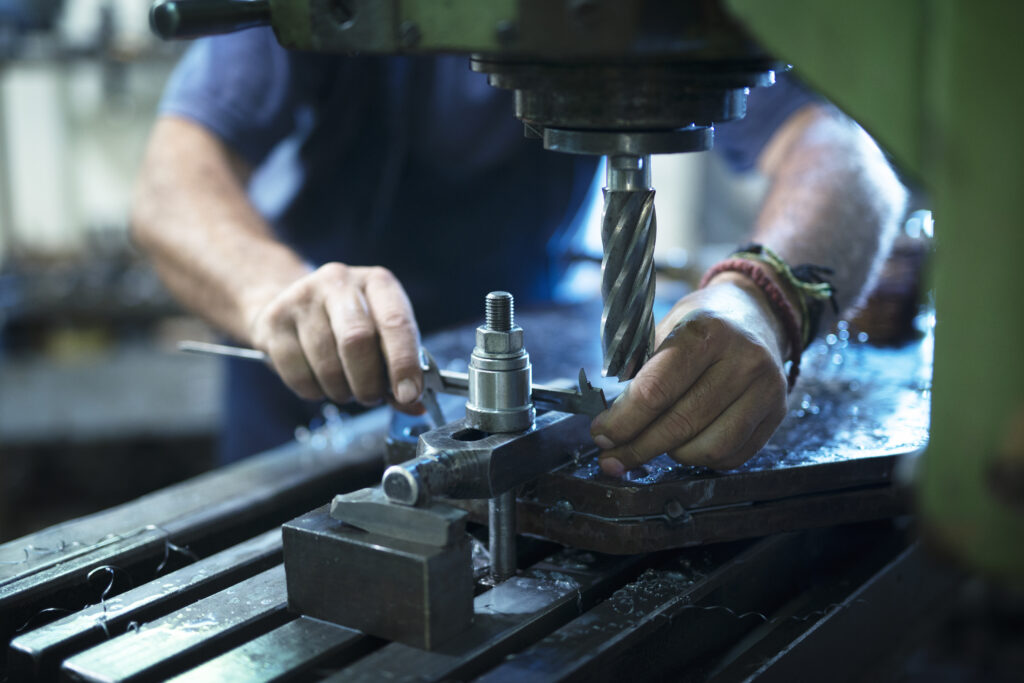
Worker operating industrial machine in metal workshop.
The best CNC turning company is not necessarily the supplier that advertises the smallest tolerance.
A better evaluation considers the complete manufacturing process.
1. Correct Machine Configuration
First determine whether the manufacturer has equipment suited to the part.
Ask whether the project requires:
- Two-axis CNC turning
- Live tooling
- Y-axis turning
- Sub-spindle machining
- Swiss turning
- Mill-turn machining
- Large-diameter turning
- Bar-fed production
Matching the correct machine to the component can eliminate unnecessary setups and significantly improve cost efficiency.
2. Realistic Tolerance Capability
A manufacturer may be capable of machining extremely tight tolerances, but that does not mean every dimension should receive one.
Engineering drawings should reserve tight tolerances for functional features such as:
- Bearing fits
- Sealing diameters
- Press fits
- Locating features
- Critical threads
- Concentric diameters
- Mating surfaces
Applying unnecessary tight tolerances can increase machining and inspection costs without improving part performance.
Before awarding a job, ask the manufacturer to review the drawing and confirm which tolerances require special process controls.
3. Live Tooling and Mill-Turn Capability
Live tooling can have a major effect on complex CNC turned parts.
Imagine a shaft that requires:
- Several turned diameters
- An external thread
- Two cross-holes
- A milled flat
- An axial hole
A conventional process might turn the component on a lathe and then transfer it to a milling machine.
A capable live-tool turning center may be able to complete more of those features during one manufacturing cycle.
Reducing setups can improve lead time and help maintain the positional relationship between features.
4. Material Experience
CNC turning manufacturers may work with materials such as:
Metals
- Aluminum
- Stainless steel
- Carbon steel
- Alloy steel
- Brass
- Bronze
- Copper
- Titanium
- Magnesium
- Nickel alloys
Engineering plastics
- POM/acetal
- Nylon
- PEEK
- PTFE
- Polycarbonate
- ABS
- Polypropylene
But the ability to purchase a material is not the same as being experienced in machining it.
For difficult alloys or sensitive plastics, ask the supplier whether it regularly machines the specific grade required by your drawing.
LEWEI’s turning service, for example, lists aluminum, copper, brass, bronze, steel, stainless steel, magnesium, titanium, and multiple engineering plastics among the available material families.
5. Production Quantity
The best manufacturer for five parts may be very different from the best manufacturer for 500,000.
Prototype and Low Volume
Priorities often include:
- Short setup times
- Rapid quoting
- DFM assistance
- Fast lead time
- Flexible machine scheduling
Medium Volume
The manufacturer needs to balance:
- Setup efficiency
- Cycle time
- Tooling
- Quality control
- Repeatability
High Volume
Important factors become:
- Automatic bar feeding
- Part catchers
- Sub-spindles
- Tool monitoring
- Lights-out capability
- Cycle-time optimization
- Statistical process control where required
- Automated inspection
- Capacity planning
Do not evaluate a high-volume turning supplier using the same criteria you would use for a five-piece prototype.
6. Inspection Capability
For precision turned components, inspection must match the feature being controlled.
Depending on the part, a manufacturer may use:
- Micrometers
- Bore gauges
- Thread gauges
- Pin gauges
- Optical comparators
- Surface-roughness equipment
- Height gauges
- CMMs
- Vision measurement systems
Your RFQ should also state any documentation requirements.
These may include:
- Dimensional inspection reports
- Material certifications
- Certificates of conformity
- First article inspection
- Lot traceability
- Process documentation
Do not assume these documents are included automatically.
7. Secondary Operations
A CNC turned component may not be finished when it leaves the lathe.
It could also require:
- Grinding
- Heat treatment
- Anodizing
- Passivation
- Plating
- Black oxide
- Bead blasting
- Polishing
- Laser marking
- Deburring
- Assembly
Ask whether the turning manufacturer performs these services internally or uses approved outside processors.
A well-managed secondary process can reduce purchasing complexity, but the buyer should understand who controls the final quality.
Domestic CNC Turning vs. International Sourcing
Many American buyers automatically begin by searching for a CNC turning manufacturer in the USA.
Domestic manufacturing can offer important advantages, particularly when:
- Extremely short logistics times are required
- Frequent supplier visits are important
- Domestic sourcing is contractually required
- Specific defense or government rules apply
- Production must remain within a particular country
- Supply-chain geography is strategically important
International CNC sourcing can also be appropriate when the project allows it.
Potential advantages can include:
- Competitive production economics
- Additional machining capacity
- Wider sourcing options
- Prototype-to-production support
- Access to a broader supplier base
The correct decision should be made project by project.
LEWEI Precision as an International CNC Turning Option for U.S. Buyers
LEWEI Precision is not a U.S.-based CNC manufacturer. Its manufacturing operation is based in Dongguan, China.
For American companies open to international sourcing, however, it provides another CNC turning option to compare with domestic suppliers.
Its custom CNC turning service covers prototypes and production parts made from metals and engineering plastics.
Published capabilities include:
- CNC turning
- Live tooling
- Mill-turn machining
- Swiss-style turning
- Prototype production
- Low- and higher-volume manufacturing
- Metal and plastic machining
- Drawing-based tolerance control
- Surface finishing
LEWEI states that tight tolerances down to ±0.005 mm can be achieved on appropriate critical CNC turned features, depending on the design and manufacturing requirements.
For buyers evaluating both U.S. and overseas manufacturing, the right comparison should therefore include not only machining price but also quality documentation, engineering communication, production quantity, freight, lead time, inventory strategy, and total landed cost.
Readers who are still comparing the broader CNC supplier market can also review the existing guide to US CNC manufacturers.
What Information Should You Send for a CNC Turning Quote?
A well-prepared RFQ makes supplier comparison easier and can reduce unnecessary back-and-forth.
Send the manufacturer:
- 3D CAD model
- 2D engineering drawing
- Material specification
- Required quantity
- Critical tolerances
- GD&T requirements
- Thread specifications
- Surface roughness requirements
- Surface finish or coating
- Inspection requirements
- Required documentation
- Target delivery date
The 3D CAD model communicates geometry efficiently.
The drawing communicates requirements that may not be fully represented by geometry alone, including:
- Datums
- Fits
- GD&T
- Surface roughness
- Threads
- Critical tolerances
- Material condition
- Finishing notes
For precision turned parts, supplying both is generally better than relying on a CAD model alone.
Choosing the Right CNC Turning Partner in 2026
There is no single CNC turning manufacturer that is the best choice for every component.
Lewei Precision offers different forms of precision and production machining. Protolabs may be attractive when rapid turnaround is critical. Xometry and Fictiv offer flexible network-based sourcing. Pioneer Service and Cox Manufacturing are relevant when Swiss machining is central to the project. Petersen Precision focuses strongly on high-volume turned production, while companies such as Owens Industries, Wisconsin Metal Parts, and Vescio Manufacturing offer different forms of precision and production machining.
The right supplier is the one whose equipment and production model fit your drawing.
Start with the component itself:
- What diameter must be turned?
- How long is the part?
- Which tolerances are truly critical?
- Does it require cross-holes, slots, or flats?
- Would live tooling eliminate a second setup?
- Is Swiss machining appropriate?
- What quantity is required?
- Which material must be machined?
- What inspection documentation is necessary?
- Is U.S.-based production mandatory?
Once these questions are answered, comparing CNC turning manufacturers becomes considerably easier.
For U.S. buyers who are also open to overseas manufacturing, LEWEI Precision provides CNC turning services for custom metal and plastic components from prototype through production. Submit your CAD model, engineering drawing, material, quantity, tolerance, and finish requirements so the manufacturing process can be evaluated against the actual part rather than a generic machining specification.
Frequently Asked Questions
Who are some of the leading CNC turning manufacturers in the USA?
Notable CNC turning suppliers serving the U.S. market include Protolabs, Xometry, Fictiv, Pioneer Service, Cox Manufacturing, Owens Industries, Wisconsin Metal Parts, Petersen Precision, Vescio Manufacturing, and LEWEI Precision. The best choice depends on part geometry, material, quantity, tolerance, certification requirements, lead time, and whether you need conventional, Swiss, or mill-turn machining.
What is the best CNC turning company for prototypes?
Protolabs, Xometry, Fictiv, and LEWEI Precision are useful starting points for prototype or relatively low-volume CNC turning projects. The best option depends on required lead time, part complexity, material, tolerance, documentation, and whether domestic or international sourcing is acceptable.
Which CNC turning manufacturer is best for high-volume production?
High-volume turned parts should be sourced from manufacturers equipped for automated production. Cox Manufacturing and Petersen Precision are examples of companies that emphasize production-oriented CNC and Swiss turning. The final choice should depend on the component’s diameter, complexity, material, quantity, cycle time, inspection requirements, and capacity.
When should I use Swiss CNC machining?
Swiss machining is generally worth considering for relatively small or slender precision components, particularly when the part has a high length-to-diameter ratio or contains several detailed features. Conventional CNC turning may be more economical for larger or simpler cylindrical parts.
What is live tooling in CNC turning?
Live tooling uses powered cutting tools inside a CNC turning center. Instead of only using stationary turning tools against a rotating workpiece, live tools can drill, mill, slot, or machine other non-rotational features. This can reduce the number of setups required to finish a part.
Can CNC turning make non-round features?
Yes, Modern turning centers equipped with live tooling and suitable machine axes can produce features such as flats, slots, cross-holes, and off-axis holes in addition to traditional cylindrical features.
What materials can CNC turning manufacturers machine?
Common materials include aluminum, stainless steel, carbon steel, alloy steel, brass, bronze, copper, titanium, and engineering plastics such as POM, nylon, PEEK, PTFE, and polycarbonate. Actual material availability depends on the manufacturer.
Is a U.S. CNC turning manufacturer always better than an overseas supplier?
No, domestic suppliers can provide advantages in logistics, supplier access, and projects requiring U.S.-based production. International CNC manufacturers may offer different cost structures or manufacturing capacity. The correct choice depends on quality requirements, regulations, lead time, production quantity, risk, and total landed cost.
ABOUT THE AUTHOR
Lewei Precision Engineering Team — Manufacturing engineers at Lewei PrecisionThe Lewei Precision engineering team has spent more than 21 years machining and molding parts for aerospace, medical, automotive, and semiconductor customers across 120-plus countries. Our factory runs 3-axis through 5-axis CNC machining, turning, injection molding, and sheet metal fabrication under ISO 9001:2015, ISO 13485, ISO 14001, and IATF 16949 quality systems. The guidance here reflects what we see on real production floors and in customer DFM reviews every week, not textbook theory. Have a part in front of you? Send us the CAD file and we will tell you exactly how we would make it.

 English
  简体中文
简体中文  Español
  Deutsch (Sie)
  日本語
日本語  Português