
By Lewei Precision Engineering Team | Updated 2 July 2026 | 8 min read
| QUICK ANSWERUse CNC milling for prismatic parts with flat faces, pockets, slots, and complex 3D geometry, such as brackets, housings, and manifolds. Use CNC turning for round, cylindrical parts, such as shafts, pins, bushings, and threaded fittings. Turning is faster and cheaper for round parts; milling handles everything that is not a simple body of revolution. |
How CNC milling works
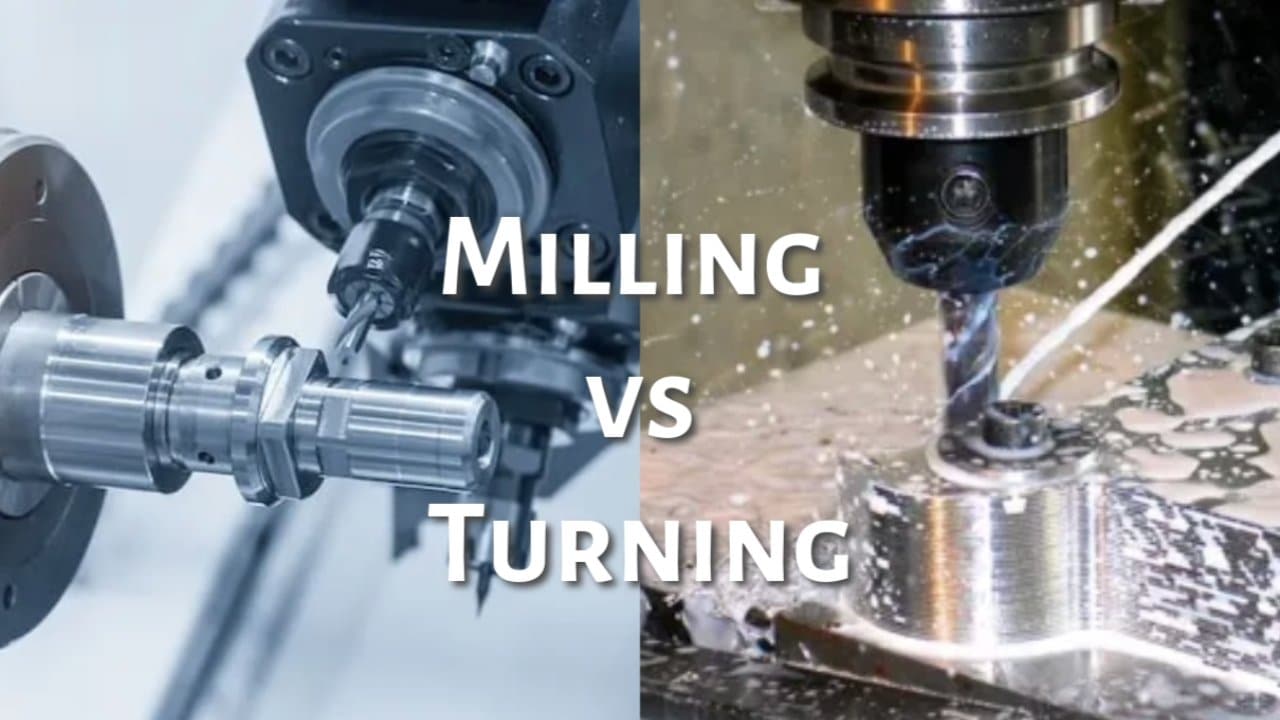
In CNC milling, a multi-point rotating tool moves across a fixed workpiece to cut material away. Because the tool can approach from many directions, milling produces flat surfaces, pockets, slots, holes, and complex contoured shapes. Machines range from 3-axis for straightforward parts up to 5-axis machining for angled features and organic geometry cut in a single setup. If you want the full picture of milling methods, our guide to the types of milling operations goes deeper.
Milling is the more versatile of the two processes. Most parts that are not fundamentally round are milled, which is why milling machines are the backbone of a general machine shop.
How CNC turning works
In CNC turning, the workpiece is clamped in a spindle and rotated at high speed while a stationary single-point tool moves along it to remove material. The result is cylindrical geometry: outer diameters, bores, tapers, grooves, and threads. Turning happens on a lathe and is extremely efficient at producing round parts, often at higher material removal rates than milling for the same body. Our CNC turning guide covers the process, operations, and tolerances in full.
For a shaft, pin, or bushing, turning is almost always faster and cheaper than milling because the geometry matches the process. Live tooling on modern lathes can even add cross-holes and flats without moving the part to a mill.
Milling vs turning side by side
| Factor | CNC milling | CNC turning |
| What rotates | The cutting tool | The workpiece |
| Machine | Machining center | Lathe |
| Best geometry | Prismatic, flat, complex 3D | Round, cylindrical, symmetric |
| Typical parts | Brackets, housings, plates, manifolds | Shafts, pins, bushings, fittings |
| Speed on round parts | Slower | Faster |
| Threads and bores | Possible | Very efficient |
| Complex non-round features | Excellent | Limited without live tooling |
When to use each process
Choose milling when
- The part has flat faces, pockets, slots, or bosses.
- The geometry is complex or three-dimensional, like a manifold or a housing.
- Features approach from multiple faces, which favors 4 or 5-axis work.
Choose turning when
- The part is round or cylindrical, like a shaft, pin, or roller.
- You need concentric bores, tapers, grooves, or threads.
- You are producing round parts in volume, where turning speed compounds savings.
When the answer is both: mill-turn
Plenty of parts are not purely one or the other. A shaft with a flat, a keyway, or a cross-hole starts as a turned body but needs milled features. Two paths handle this. The part can be turned first and then moved to a mill, or it can run on a mill-turn machine that does both in one setup. Combining operations in a single setup improves accuracy by removing re-fixturing error and can cut labor noticeably on complex shafts. Our precision machining team routes each part to whichever combination is fastest and most accurate.
A quick worked example
Say you need a stepped drive shaft with a keyway and two cross-holes. The body is a classic turning job: the outer diameters, the shoulder, and the thread all come off the lathe quickly because the part is round. The keyway and the cross-holes are not round features, so they get milled. On a mill-turn machine the whole part can run in one setup, which removes the re-fixturing step and keeps every feature concentric to the same datum. On separate machines it would be turned first, then transferred to a mill for the keyway and holes. Either way, the round work goes to turning and the non-round work goes to milling. That is the logic you apply to almost every part.
The reverse example is just as clean. A cooling manifold with internal passages, mounting faces, and threaded ports is fundamentally prismatic, so it is milled, often on a 4 or 5-axis machine, with any round bores handled during the same setup. There is no round body to spin, so turning never enters the picture.
Cost and tolerance considerations
For round parts, turning usually wins on both speed and cost because the geometry matches the process and material removal is efficient. For everything else, milling is the practical choice, and cost then depends on complexity, the number of setups, and how tight the tolerances are. Standard turned parts commonly hold tolerances around ±0.05 mm and milled parts around ±0.1 mm at no extra cost, with tighter tolerances adding time. The single biggest cost driver on either process is the number of setups, so a design that can be made in fewer setups is a cheaper design. Our CNC machining cost guide explains those levers in detail.
Frequently Asked Questions
What is the difference between CNC milling and CNC turning?
In CNC milling, the workpiece stays still and a rotating tool removes material, which suits flat and complex prismatic parts. In CNC turning, the workpiece rotates against a stationary tool, which suits round, cylindrical parts. The choice depends on part geometry.
Is milling or turning better for round parts?
Turning is better and usually cheaper for round parts like shafts, pins, and bushings because the workpiece rotates, giving efficient material removal and easy threads and bores. Milling is reserved for the non-round features.
Can one machine do both milling and turning?
Yes. Mill-turn machines combine turning and milling in a single setup, and modern lathes with live tooling can add cross-holes and flats to turned parts. Combining operations improves accuracy by eliminating re-fixturing and can reduce labor.
Which process is more accurate?
Both are highly accurate. Turned parts commonly hold about ±0.05 mm and milled parts about ±0.1 mm as standard, with tighter tolerances available at added cost. Accuracy depends more on setup, tooling, and inspection than on the process itself.
Which is more expensive, milling or turning?
For round parts, turning is typically cheaper because it matches the geometry. For complex non-round parts, milling is the only practical option, and cost then depends on complexity, number of setups, and tolerance rather than a flat process premium.
| ABOUT THE AUTHOR Lewei Precision Engineering Team — Manufacturing engineers at Lewei PrecisionThe Lewei Precision engineering team has spent more than 21 years machining and molding parts for aerospace, medical, automotive, and semiconductor customers across 120-plus countries. Our factory runs 3-axis through 5-axis CNC machining, turning, injection molding, and sheet metal fabrication under ISO 9001:2015, ISO 13485, ISO 14001, and IATF 16949 quality systems. The guidance here reflects what we see on real production floors and in customer DFM reviews every week, not textbook theory. Have a part in front of you? Send us the CAD file and we will tell you exactly how we would make it. |
| Not sure whether your part should be milled, turned, or both? Upload your CAD file to Lewei Precision for a free DFM review and the fastest, most cost-effective route to your part. |

 English
  简体中文
简体中文  Español
  Deutsch (Sie)
  日本語
日本語  Português