
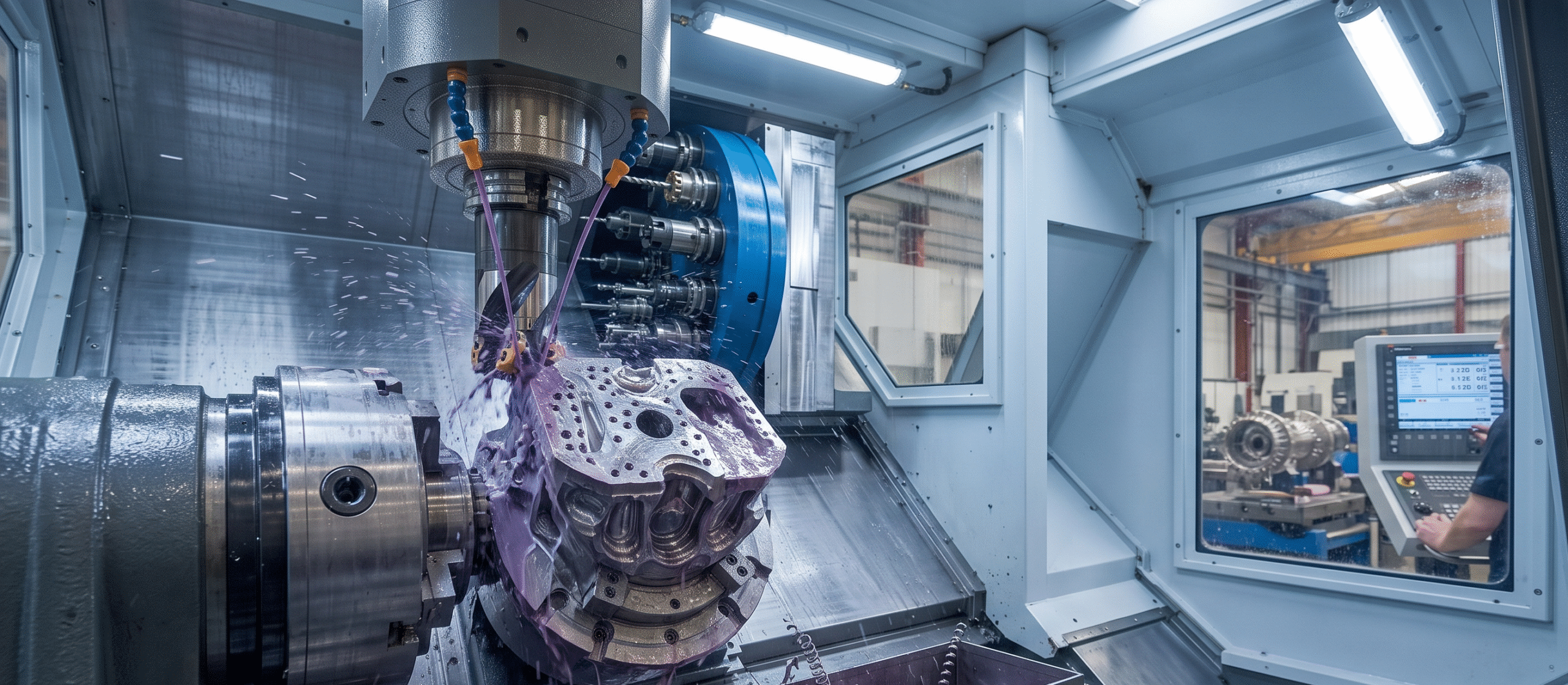
Walk through almost any factory that makes precision parts and you will find CNC machines at its core. There is a reason CNC machining has quietly become the default way to produce metal and plastic components across aerospace, medical, automotive, energy, and consumer products. It is not marketing hype — it is a set of concrete advantages that add up to faster, cheaper, more consistent parts than almost any alternative.
I have watched companies switch from manual machining and casting to CNC and never look back, and the reasons are always the same handful of benefits. This guide lays out the ten real advantages of CNC machining, what each one means in practice, and where the process still has limits worth knowing.
What CNC Machining Is, in One Line
Before the benefits, a quick anchor. CNC — Computer Numerical Control — machining is a process where a computer directs cutting tools to remove material from a solid block or bar, shaping it into a finished part with high precision. If you want the full mechanics, our explainer on what CNC machining is and how it works covers the fundamentals.
Quick answer: The main advantages of CNC machining are high precision, excellent repeatability, fast production, broad material compatibility, reduced labor, and the flexibility to move from prototype to production with the same equipment.
The 10 Key Advantages of CNC Machining
1. Exceptional Precision
CNC machines routinely hold tolerances of ±0.025 mm and precision setups reach ±0.005 mm or tighter. That accuracy is impossible to sustain by hand and is essential wherever parts must fit, seal, or interlock. Precision is the headline benefit that makes everything else possible.
2. Outstanding Repeatability
Because the machine follows a program, the ten-thousandth part is identical to the first. This consistency is the reason CNC underpins mass production — a customer receives the same quality every time, batch after batch. Manual processes simply cannot match it.
3. High Production Speed
Once a program is written, CNC machines cut fast and run with minimal intervention, including overnight and unattended. Faster cycle times mean shorter lead times and lower cost per part, especially at volume — a dynamic we break down in our CNC machining cost guide.
4. Broad Material Compatibility
CNC machining cuts almost anything solid: aluminum, steel, stainless, titanium, brass, lead-free bronze, and engineering plastics. This versatility means one process — and often one supplier — can serve wildly different applications.
5. Reduced Labor and Human Error
One operator can oversee several machines, and the program eliminates the variability of manual skill. Lower labor content and fewer mistakes translate directly into more consistent quality and better economics.
6. Complex Geometry Made Possible
Multi-axis CNC machines produce shapes that would be impossible or wildly impractical by hand — curved surfaces, deep pockets, intricate contours. 5-axis machining in particular unlocks parts that older methods could never make.
7. Excellent Surface Finish
CNC parts come off the machine with clean, consistent finishes, and can be refined further with polishing, anodizing, or plating. Good finishes reduce or eliminate secondary work and improve both function and appearance.
8. Scalability from Prototype to Production
The same machine that cuts a single prototype can run a full production batch. This seamless scaling lets companies validate a design and then ramp volume without changing process or supplier — a flexibility casting and molding cannot match without new tooling.
9. Less Material Waste (with Good Design)
Modern CAM software optimizes toolpaths to minimize wasted material and machine time. While machining is subtractive by nature, smart nesting and design keep scrap — and cost — under control.
10. Reliability and Automation
CNC machines run consistently for long hours with automated tool changes and part handling, enabling lights-out manufacturing. That reliability compounds all the other benefits into dependable, predictable output.
Advantages at a Glance
| Advantage | What it delivers | Who benefits most |
| Precision | Tolerances to ±0.005 mm | Aerospace, medical, oil and gas |
| Repeatability | Identical parts every run | Mass production |
| Speed | Fast, unattended cycles | High-volume manufacturers |
| Material range | Metals and plastics alike | Multi-industry buyers |
| Low labor | Fewer operators, fewer errors | Cost-sensitive producers |
| Complex geometry | 5-axis capability | Advanced engineering |
| Scalability | Prototype to production | Startups to OEMs |
CNC Machining vs. Other Methods
CNC is not the only way to make a part, and knowing when it wins clarifies its value.
| Method | Strength | Weakness vs. CNC |
| CNC machining | Precision, repeatability, materials | Subtractive waste on some parts |
| 3D printing | Complex shapes, no tooling | Lower precision and strength |
| Casting | Cheap at very high volume | High tooling cost, less accurate |
| Manual machining | Low setup for one-offs | Slow, inconsistent, operator-dependent |
For a deeper head-to-head, our CNC machining vs. 3D printing comparison covers exactly when additive makes more sense — usually for highly complex, low-volume geometry where precision is not critical.
The Honest Limitations
No process is perfect, and a credible guide says so. CNC machining is subtractive, so it wastes more raw material than additive or net-shape methods on some designs. Tooling access limits truly enclosed internal geometries. And for extremely high volumes of simple parts, casting or molding can beat it on unit cost. Knowing these limits is exactly how you decide when CNC is the right call — and when it is not. Designing to CNC’s strengths, following sound design rules and avoiding common defects, is how you capture the advantages while sidestepping the weaknesses.
Why the Advantages Add Up
Individually, each benefit is useful. Together, they explain CNC’s dominance. Precision and repeatability guarantee quality; speed and automation drive down cost; material range and scalability make one process serve the whole product lifecycle. That combination is why, from a single prototype to a million-part production run, CNC machining is the process manufacturers keep coming back to — and why it remains the backbone of precision manufacturing at companies like Lewei Precision.
Frequently Asked Questions
What is the biggest advantage of CNC machining?
The single greatest advantage is the combination of precision and repeatability, which lets manufacturers produce parts to tight tolerances and then reproduce them identically thousands of times. This consistency is what makes CNC machining trustworthy for critical applications in aerospace, medical, and energy, where every part must perform the same way. No manual process can match that reliability across a full production run. Precision alone is impressive, but precision that repeats flawlessly is what truly sets CNC apart.
Is CNC machining better than 3D printing?
Neither is universally better; they excel at different things. CNC machining wins on precision, strength, material choice, and surface finish, making it the go-to for functional metal parts. 3D printing wins on producing highly complex geometries without tooling and is excellent for rapid, low-volume prototypes. Which one you reach for hangs on your part’s precision needs, material, strength, and quantity. Plenty of teams refuse to pick at all — they prototype with printing to move fast, then machine the final parts once the design is locked.
Does CNC machining work for both metal and plastic?
Yes, CNC machining handles a very wide range of materials, from aluminum, steel, stainless, and titanium to brass, bronze, and engineering plastics like Delrin, PEEK, and nylon. This versatility is one of its defining strengths, because a single process and often a single supplier can produce parts for completely different applications. What drives the material choice is the part’s strength, weight, corrosion, and thermal demands — not any limit of the machine. If you are torn between grades, a decent shop will happily point you to the one that does the job for the least money.
Is CNC machining cost-effective for small quantities?
CNC machining is genuinely flexible across quantities, from a single prototype to large production runs. For very small quantities, the setup and programming cost is spread over fewer parts, so the per-unit price is higher, but there is no expensive tooling to amortize as there is with casting or molding. This makes CNC especially attractive for prototypes and low-to-medium volumes. As quantities rise, the per-part cost drops, making the same process economical at scale too.
What industries rely most on CNC machining?
Aerospace, medical devices, automotive, oil and gas, defense, electronics, and industrial equipment all depend heavily on CNC machining. These sectors share a need for precise, reliable, high-quality parts that perform consistently, often in demanding environments. CNC machining meets those needs with tight tolerances, tough material options, and full traceability. Its versatility means it serves both cutting-edge prototypes and high-volume production across virtually every corner of modern manufacturing.
ABOUT THE AUTHOR
Lewei Precision Engineering Team — Manufacturing engineers at Lewei PrecisionThe Lewei Precision engineering team has spent more than 21 years machining and molding parts for aerospace, medical, automotive, and semiconductor customers across 120-plus countries. Our factory runs 3-axis through 5-axis CNC machining, turning, injection molding, and sheet metal fabrication under ISO 9001:2015, ISO 13485, ISO 14001, and IATF 16949 quality systems. The guidance here reflects what we see on real production floors and in customer DFM reviews every week, not textbook theory. Have a part in front of you? Send us the CAD file and we will tell you exactly how we would make it.

 English
  简体中文
简体中文  Español
  Deutsch (Sie)
  日本語
日本語  Português