
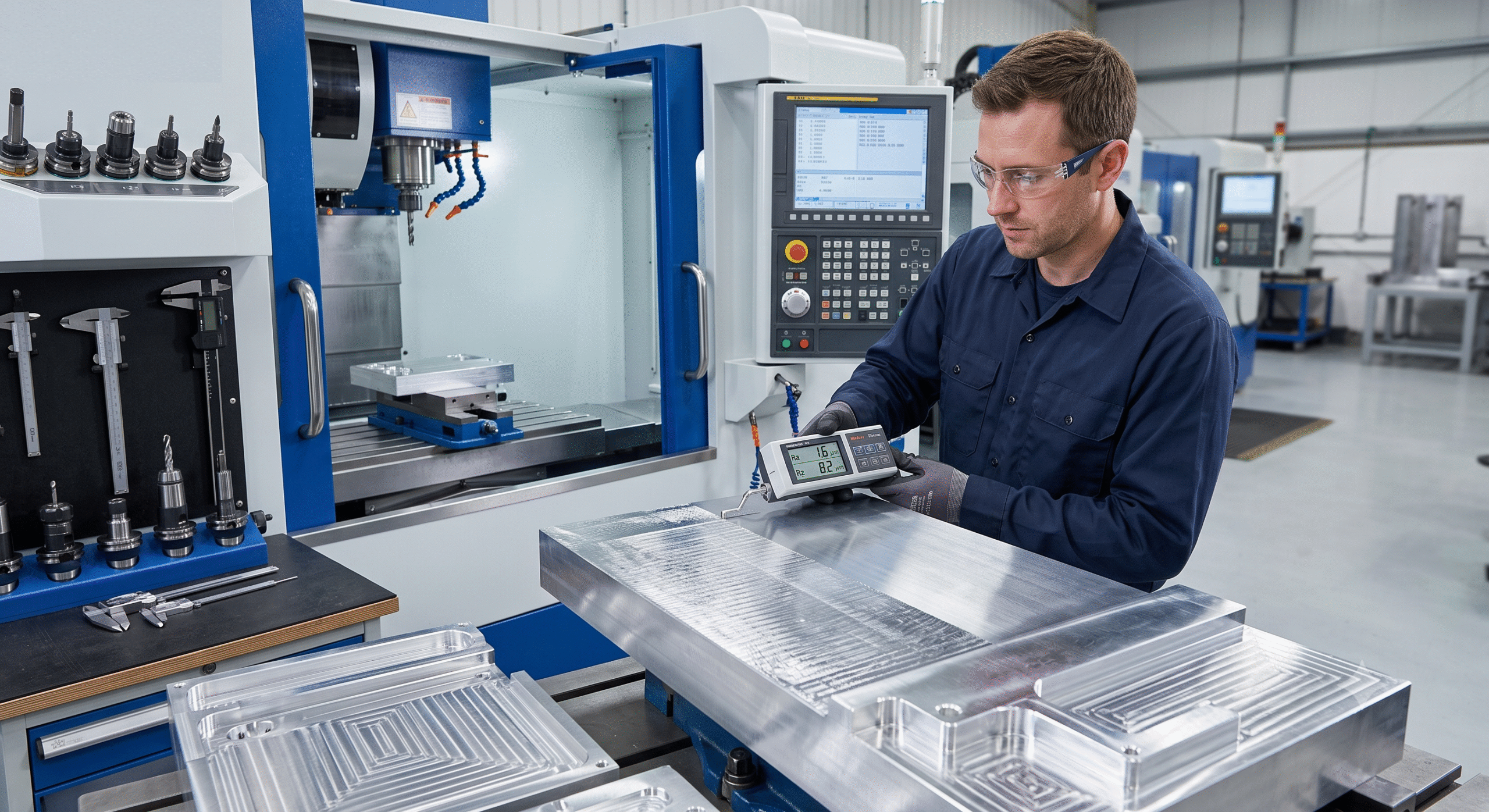
Every machined surface has a texture to it. Drag a fingernail across a freshly milled face and you’ll feel them — faint little ridges the tool left on its way through. That’s surface roughness. And the one number engineers lean on to describe it, Ra, ends up quietly deciding how a part seals, slides, fatigues, and looks. It also decides, just as quietly, what the part costs.
There’s a real tug-of-war here. Smoother almost always performs better — but every step smoother burns machine time and money. Spec it too rough and your seal weeps or your bearing grabs. Spec it too smooth and you’ve just paid to polish a surface nobody will ever lay a finger on. The whole trick is knowing exactly how smooth each face needs to be, and then stopping there. So let’s take Ra apart: what the number actually means, the standard grades, how the different processes stack up, and how to write a finish callout that gets you what you need without bleeding money.
Quick answer: Surface roughness in CNC machining is the microscopic texture left by the cutting tool, measured as Ra — the arithmetic average of peak-and-valley heights in micrometers (µm). A typical as-machined finish is Ra 3.2 µm; fine finishes reach Ra 0.8 µm or lower. Smoother finishes cost more because they require slower cuts and extra operations.
What Ra Actually Measures
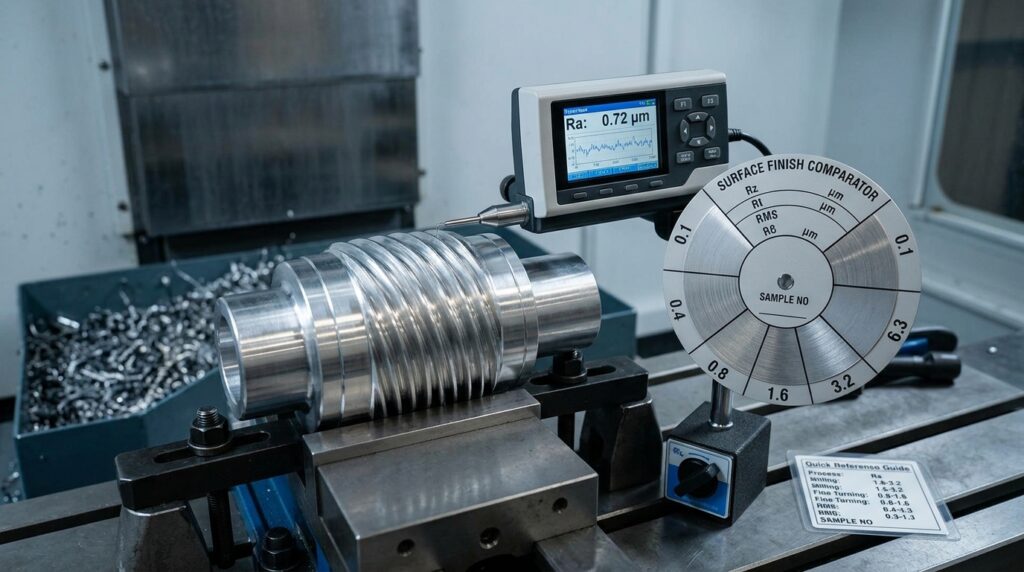
Ra is short for “roughness average.” A profilometer drags a tiny stylus across the surface, recording every peak and valley along a short run. Ra is just the average of how far those points sit from the centerline, given in micrometers (µm) or microinches (µin) — one micrometer is about 40 microinches, if you’re switching between the two.
Now here’s the thing people miss: Ra is an *average*. It blends the highs and lows into a single tidy figure, which makes it easy to spec but also a little blind. One nasty deep scratch can hide inside a perfectly acceptable Ra. That’s why certain jobs also call out Rz — the average of the biggest peak-to-valley heights — to catch exactly the kind of feature Ra papers over. For most machined parts, Ra on its own does the job. Sealing and fatigue-critical surfaces sometimes want both.
Standard Surface Finish Grades
Finishes fall into recognizable bands. This table lines Ra values up with what they actually mean — how the surface looks and feels, and where it belongs.
| Ra (µm) | Ra (µin) | Finish grade | Typical use |
| 6.3 | 250 | Rough machined | Non-critical, hidden surfaces |
| 3.2 | 125 | Standard machined | General parts, default finish |
| 1.6 | 63 | Smooth machined | Mating faces, moderate sliding |
| 0.8 | 32 | Fine machined | Seals, bearings, close fits |
| 0.4 | 16 | Ground / fine | Hydraulic surfaces, precision fits |
| 0.2 | 8 | Polished | Optical, medical, high-fatigue |
| 0.05 | 2 | Mirror | Mold cavities, mirror optics |
Ra 3.2 µm is the workhorse. It’s roughly what a normal milling or turning pass hands you without any fuss, and it covers most general parts just fine. Everything below it costs more, and it climbs fast. Getting down to Ra 0.8 µm usually means finishing passes with sharp tooling; Ra 0.4 and finer generally drags in grinding, lapping, or polishing as a separate step. When a print doesn’t mention finish at all, most shops just deliver around Ra 3.2 by habit. If you want to look past machining marks at the full range of finishing routes, our guide to surface finishes for CNC machined parts walks through them.
How Each Process Compares
Before any finishing operation even enters the picture, the process itself sets your baseline. Turning and grinding tend to leave smoother surfaces than milling, mostly because of how steadily the tool stays engaged with the work.
| Process | Typical Ra (µm) | Best achievable |
| CNC milling | 1.6–3.2 | 0.8 |
| CNC turning | 0.8–1.6 | 0.4 |
| Grinding | 0.2–0.8 | 0.1 |
| Reaming | 0.8–1.6 | 0.4 |
| EDM | 1.6–3.2 | 0.8 |
| Lapping / polishing | 0.05–0.2 | 0.025 |
This is one reason the *process* choice matters as much as the finish number. A round part that needs a smooth surface belongs on a lathe, where turning reaches a fine finish with far less effort than milling — a trade-off we get into in CNC milling vs. CNC turning. Force a milled face to be smoother than milling likes to go, and the shop bolts on a grinding or polishing step. That extra operation is precisely where the cost starts climbing.
What Drives Finish on the Machine
A handful of things at the cutting edge decide the finish you walk away with:
- Feed rate. The single biggest lever, no contest. Slower feeds leave finer, more tightly spaced tool marks and a lower Ra.
- Tool nose radius. A bigger radius smears the peaks between passes, smoothing the surface at the same feed.
- Cutting speed. Push it up and finish generally improves — right up until heat and vibration take the wheel.
- Tool condition. A worn or chipped edge tears instead of shearing, and it’ll wreck a finish in one pass. For anything fine, fresh tooling isn’t optional.
- Rigidity. Chatter prints itself straight onto the part. A rigid setup is the price of admission for low Ra — the same rigidity story that governs thin-wall work.
Because finish and dimensional accuracy both ride on light, controlled cuts, they usually get better together. That’s why our precision machining service treats surface quality and tolerance as one problem instead of two.
Why Finish Changes How a Part Performs
Surface roughness isn’t cosmetics. It changes how a part behaves, sometimes decisively. On a sliding or sealing face, deep tool marks become leak paths and dirt traps — which is exactly why hydraulic and pneumatic seals demand a low Ra to hold pressure. On a fatigue-loaded part it’s even starker: every valley in the surface is a little stress riser where a crack likes to begin. Smooth the surface and you measurably buy back fatigue life, which is the whole reason aerospace and medical parts get polished. Friction and wear play by the same rules — rough surfaces grind down their neighbors faster, while a controlled fine finish beds in and lasts.
But smoother isn’t always the goal, and this trips people up. Some surfaces want a *specific* roughness. A face that’s going to be bonded or coated often grips better with a slightly rough “tooth” for the adhesive to key into, and a bearing surface may need a bit of texture just to hold onto its lubricant. So a blanket “make it as smooth as you can” callout is usually a mistake. The right Ra is a functional target, not a race to zero.
How to Specify Finish Without Overpaying
The most expensive habit in finish specs is slapping one tight Ra across the whole part. Do the opposite. Go surface by surface.
- Default the whole part to Ra 3.2 µm and only tighten the specific faces that earn it.
- Save Ra 0.8 µm and below for functional surfaces — seals, bearings, sliding fits, sealing lands.
- Leave the hidden stuff rough. Nobody benefits from a polished pocket floor buried inside the part.
- Match finish to process. If a face has to be very smooth, put it on a turned or ground feature rather than begging a mill to chase it.
- Call out Rz only when it matters — for fatigue-critical or sealing surfaces where one deep valley could sink you.
Finish is a quality-control checkpoint too, not just a design note. Confirming that the parts you got actually hit the Ra you asked for is part of the routine we run through our quality assurance process, right alongside the dimensional checks. A finish callout nobody ever verifies is just a wish written on a drawing.
Frequently Asked Questions
What is a good surface finish for CNC machining?
For most parts, Ra 3.2 µm is a good, cost-effective default — it is the standard as-machined finish and suits general components. Functional surfaces such as seals and bearings usually need Ra 0.8 µm or smoother, while decorative or optical parts may require polished finishes of Ra 0.2 µm or below.
What does Ra mean in machining?
Ra means “roughness average” — the arithmetic mean of the peaks and valleys measured across a surface, expressed in micrometers. A lower Ra number indicates a smoother surface. It is the most common way to specify and measure surface finish because it produces a single, easy-to-compare value.
What is the difference between Ra and Rz?
Ra is the average of all surface deviations, so it smooths out extremes. Rz averages the largest peak-to-valley heights within sampling lengths, so it captures the worst features that Ra hides. Ra is enough for most parts; Rz is added for sealing or fatigue-critical surfaces where a single deep valley matters.
Does a smoother surface finish cost more?
Yes. Each step smoother requires slower feeds, sharper tooling, and often a secondary operation like grinding or polishing. Going from a standard Ra 3.2 µm to a fine Ra 0.4 µm can add significant machine time and labor, so smoother finishes should be specified only where the function requires them.
Which CNC process gives the smoothest finish?
Among common machining processes, grinding and turning produce the smoothest surfaces — grinding can reach Ra 0.1 µm and turning around Ra 0.4 µm. Milling and EDM typically leave rougher finishes, so parts needing very smooth surfaces are either turned, ground, or given a polishing operation after machining.
About the author
Lewei Precision Engineering Team — Manufacturing engineers at Lewei PrecisionThe Lewei Precision engineering team has spent more than 21 years machining and molding parts for aerospace, medical, automotive, and semiconductor customers across 120-plus countries. Our factory runs 3-axis through 5-axis CNC machining, turning, injection molding, and sheet metal fabrication under ISO 9001:2015, ISO 13485, ISO 14001, and IATF 16949 quality systems. The guidance here reflects what we see on real production floors and in customer DFM reviews every week, not textbook theory. Have a part in front of you? Send us the CAD file and we will tell you exactly how we would make it.

 English
  简体中文
简体中文  Español
  Deutsch (Sie)
  日本語
日本語  Português