
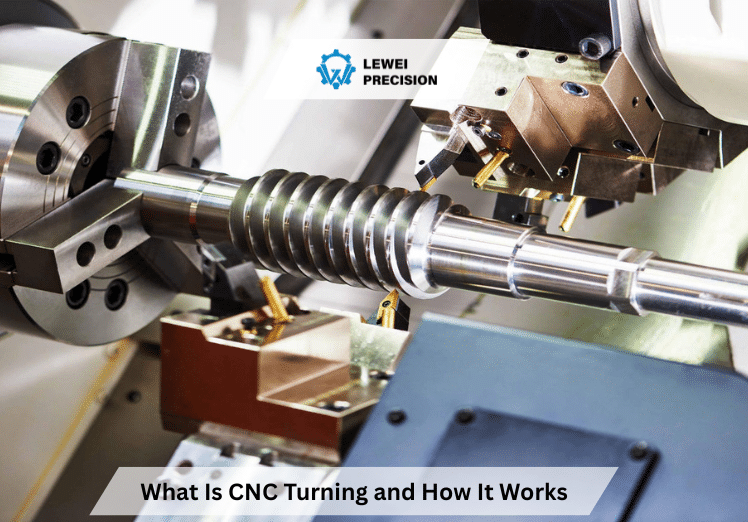
CNC turning is one of the most efficient ways to make precise round parts. In this process, raw stock rotates while a cutting tool removes material to create cylindrical or rounded features. That makes CNC turning ideal for parts such as shafts, pins, bushings, threaded fittings, and similar components that need repeatable dimensions and clean finishes.
Modern CNC turning also fits neatly into a digital workflow. A part is typically designed in CAD, prepared in CAM, checked in simulation, and then exported as machine-ready code before cutting begins. That helps manufacturers verify toolpaths and reduce avoidable setup mistakes before production starts.
What Is CNC Turning?
CNC turning is a subtractive machining process performed on a lathe or turning center. The machine spins the workpiece while the cutting tool moves in controlled directions to remove material. Unlike manual turning, CNC turning follows a programmed set of instructions for tool calls, offsets, spindle speed, coolant, and axis movement.
Because the workpiece rotates, CNC turning is best for parts that are fully round or mostly rotationally symmetric. It is often the better choice for cylindrical parts that need consistency from one piece to the next. Turned cylindrical surfaces can also come out smoother than comparable milled surfaces on the same type of feature.
CNC Turning vs. Other Machining Methods
In CNC turning, the part spins and the tool cuts. In CNC milling, the cutting tool rotates while the workpiece stays fixed. Turning is usually better for shafts, spacers, bushings, and threaded rods. Milling is usually better for flat faces, pockets, slots, and prismatic geometry.
3D printing works differently again. It is an additive process that builds material layer by layer, while CNC turning is subtractive and removes material from stock. In practice, that often makes 3D printing useful for quick iteration and complex forms, while CNC turning is a stronger fit for accurate round parts made from production materials.
How CNC Turning Works
- Create the part model. The part is designed in CAD with the needed diameters, lengths, grooves, threads, and tolerances.
- Build the CAM setup. The programmer selects stock size, workholding, tools, and turning strategies such as facing, roughing, finishing, grooving, or threading.
- Simulate and verify. Toolpaths are checked digitally before the job reaches the machine.
- Set up the lathe. The operator loads the stock into the chuck, sets tool offsets, and confirms the work zero.
- Run the program. The spindle rotates the part while the machine follows the code. Coolant, spindle speed, and positioning are handled through the program.
- Inspect the part. Critical dimensions and surface finish are checked before the job moves to full production or shipping.
Main Parts of a CNC Turning Machine
A CNC lathe or turning center has a few core parts. The chuck grips the material, and the spindle rotates it during cutting. The turret holds multiple tools and switches between them quickly. On more advanced machines, live tooling allows extra operations such as flats, holes, and secondary milling features without moving the part to another machine. A tailstock can support long workpieces, helping improve stability, accuracy, and surface finish.
Image idea: a labeled diagram showing the chuck, spindle, turret, cutting tool, and tailstock around a rotating workpiece.
Common CNC Turning Operations
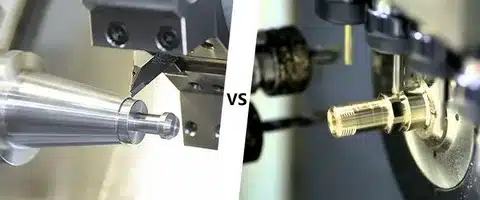
Basic turning work usually starts with longitudinal turning, facing, or profiling. These operations shape the outside diameter, clean the face of the part, and create contours. Grooving cuts channels or reliefs, while thread turning creates external or internal threads and requires the control to synchronize spindle rotation with feed movement. Depending on the machine, live tooling can also add holes or flats in the same setup.
Materials Used in CNC Turning
CNC turning is commonly used with metals such as aluminum, brass, low-carbon steel, alloy steel, stainless steel, and titanium. Many CNC machining services also offer engineering plastics, so material choice should start with what the part needs to do in service. The best material depends on function, environmental exposure, strength requirements, cosmetic needs, cost targets, and any secondary operations such as anodizing or plating.
In simple terms, aluminum is popular when you want good machinability and lower weight. Steel and stainless steel are common when strength or wear resistance matter more. Titanium is often chosen when strength, corrosion resistance, or weight-to-strength ratio are critical. Plastics can make sense for lighter-duty parts, electrical insulation, or corrosion resistance.
Advantages of CNC Turning
The biggest advantage of CNC turning is repeatability. Once the program and setup are correct, the machine can produce the same geometry again and again with far less variation than a manual process. CNC turning can also be very efficient for cylindrical parts, and turned surfaces are often smoother on round features than comparable milled surfaces. For recurring parts, that mix of repeatability, speed, and finish makes a CNC turning service a practical option.
Limits to Keep in Mind
CNC turning is not the best answer for every part. It works best when the geometry is mostly round, but flat-heavy or highly prismatic parts are often better suited to milling. It also has setup and programming costs, so the economics depend on quantity, complexity, and lead time. Tight tolerances are possible, but the actual result depends on the material, tooling, machine condition, fixturing, and inspection plan.
Where CNC Turning Is Used
CNC machining is widely used in aerospace, medical, and automotive manufacturing because it can produce precise parts in production-grade materials. In a turning context, that includes shafts, spacers, threaded parts, housings with round features, and other internal mechanical components where fit and repeatability matter.
How to Choose a CNC Turning Service
A good CNC turning service should match your material, tolerance, quantity, lead time, and finishing needs. Beyond price, look for a supplier that offers design-for-manufacturing feedback, inspection reporting, material certifications, and secondary processes. Those details often matter as much as machine capability, especially for production work.
A practical way to compare suppliers is to send the same drawing or CAD file to three shops and compare how clearly they flag design risks, what inspection and certification options they offer, and whether their lead time and communication fit the job.
Common Mistakes to Avoid
A few problems show up often in CNC turning projects. One is forcing a part into a turning process when the geometry really belongs on a mill. Another is selecting material before defining the part’s real performance requirements. A third is adding unnecessarily tight tolerances, threads, or thin features that increase cost without improving function. Designing for machinability usually reduces cost and speeds up production.
What Affects Cost?
The biggest CNC cost drivers are usually raw material, manufacturing time, and fixed costs such as setup and programming. In practice, the quote is also shaped by part complexity, order quantity, and required lead time. That is why two parts that look similar on paper can come back with very different prices.
Future Trends in CNC Turning
CNC turning is moving toward more automation and smarter digital workflows. Automatic parts loaders and bar feeders are already used to automate loading and keep turning centers productive. On the software side, AI in manufacturing is increasingly used to improve efficiency, accuracy, and decision-making across production systems.
Key Takeaways
- CNC turning shapes round parts by rotating the workpiece against a cutting tool.
- It is best for cylindrical or mostly rotationally symmetric parts.
- The usual workflow is CAD, CAM, simulation, setup, machining, and inspection.
- Common operations include facing, profiling, grooving, and threading.
- Cost depends heavily on material, cycle time, setup, quantity, and lead time.
- The right CNC turning service should offer more than machining alone; DFM feedback and inspection support matter too.
Conclusion
CNC turning is one of the most reliable ways to produce precise round parts. It combines digital programming with fast, repeatable machining, which is why it remains a core process across industries that need accurate metal or plastic components. When the geometry suits a lathe, CNC turning can be an efficient choice for prototypes, repeat orders, and full production.
The biggest publish-risk in your original draft is the unsourced market-size, CAGR, and named-company claims. Those should either be cited properly or removed.
FAQs
What is the difference between CNC turning and CNC milling?
CNC turning rotates the workpiece and cuts it with a tool, which makes it ideal for round parts. CNC milling rotates the cutting tool while the part stays fixed, which makes it better for flats, pockets, and prismatic shapes.
How accurate is CNC turning?
CNC turning can be very accurate, but the exact tolerance depends on the machine, tooling, material, setup, and inspection process. It is better to quote the tolerance required on your drawing than to promise one number for every job.
What materials are commonly used?
Common turned materials include aluminum, brass, low-carbon steel, alloy steel, stainless steel, and titanium. Many shops also machine engineering plastics, depending on part geometry and application.
What affects CNC turning cost most?
Material cost, machining time, and fixed setup costs are three of the main drivers. Complexity, quantity, and lead time also affect the final quote.
When should I use a CNC turning service?
Use a CNC turning service when your part is mostly round, needs repeatable dimensions, and may benefit from smoother cylindrical finishes or efficient batch production.

 English
  简体中文
简体中文  Español
  Deutsch (Sie)
  日本語
日本語  Português